King County Washington (Page 4) has 50 places on the National Register of Historic Places including 9 places of National significance and 8 places of Statewide significance. Significant places include Merrill, R. D., House, Messenger of Peace Chapel Car, Naval Air Station (NAS) Seattle, Naval Military Hangar--University Shell House and Nihon Go Gakko.
Many famous people are associated with these King County historic places including Emerson Neighbor, Louis Olson, Alfred L. Palmer, Frank P. Bennett, William H. Parsons and Matthew Walsh.
Some of the country's most noteable architects helped create the King County places including US Navy, Harvey J. Allan, Barney and Smith Car Company, James Wehn, Post,George B., & Sons, Elmer Fisher, Charles A. Platt, Thompson & Thompson, Bebb & Gould and Sherwood D. Ford. Prominent architectural styles found in King Country are Art Deco, Classical Revival and Colonial Revival.
Historic Significance:
Architecture/Engineering
Architect, builder, or engineer:
Allan,Harvey J., Platt,Charles A.
Architectural Style:
Colonial Revival
Area of Significance:
Art, Education, Architecture, Landscape Architecture, Industry
Period of Significance:
1900-1924
Historic Function:
Domestic
Historic Sub-function:
Single Dwelling
Current Sub-function:
Civic
The R. D. Merrill House, constructed in 1910 in Seattle's historic Harvard-Belmont neighborhood, is architecturally significant as an exceptional example of Georgian Revival residential design. It is the only residential commission in the Pacific Northwest designed by the nationally acclaimed New York architect Charles A. Platt, who was renowned for his integration of formal Italianate gardens with classical American country houses. The brick mansion displays exquisite classical symmetry, characterized by its elegant proportions, refined dentiled cornices, and a monumental two-story Corinthian portico on the garden facade. The estate perfectly embodies the early 20th-century Country Place Era, where the home and its meticulously planned formal gardens were designed to function as a cohesive, harmonious artistic unit.
Historically, the estate is deeply tied to the economic development of the Pacific Northwest through its association with its builder, Richard Dwight (R. D.) Merrill. A prominent timber baron and co-founder of the highly successful Merrill & Ring Lumber Company, Merrill was a pivotal figure in Washington's dominant timber industry during its golden age. The grandeur of the residence reflects the immense wealth and civic influence amassed by the region's industrial elite during the early 20th century. Preserved as a premier landmark of Capitol Hill, the Merrill House stands as a physical testament to the era of industrial expansion that transformed Seattle from a rugged frontier town into a major metropolitan center of commerce and culture.
Historic Significance:
Event
Area of Significance:
Religion
Period of Significance:
1925-1949, 1900-1924, 1875-1899
Historic Function:
Religion, Transportation
Historic Sub-function:
Rail-Related, Religious Structure
Current Function:
Work In Progress
The Messenger of Peace Chapel Car, designated as National Register of Historic Places reference number 08000998, holds profound historical significance as a rare and exceptionally preserved artifact of the late 19th- and early 20th-century religious colportage movement in the American West. Built in 1898 by the Barney and Smith Car Company of Dayton, Ohio, the wooden railcar was commissioned as Chapel Car No. 5 by the American Baptist Publication Society. For over four decades, it traveled along the expanding transcontinental railroad networks, serving as a mobile church, community center, and missionary base for isolated railroad, mining, and timber towns. Equipped with a chapel section containing a pump organ and pews, as well as living quarters for the missionary parson and his wife, the car played a pivotal role in establishing permanent congregations and fostering social cohesion in remote frontier settlements that lacked established places of worship.
Historically significant under Criterion A for its contributions to social history and religion, and under Criterion C as an exceptional example of specialized railroad car engineering and architecture, the Messenger of Peace is one of only a handful of surviving chapel cars in the United States. Following its active missionary service, which ended in the late 1940s, the car served various secular purposes before being acquired and meticulously restored by the Northwest Railway Museum in Snoqualmie, Washington. Today, it stands as a powerful physical testament to the intersection of transportation technology, westward expansion, and religious evangelism that shaped the cultural and social landscape of the Pacific Northwest and the broader American West.
Historic Significance:
Event, Architecture/Engineering
Architectural Style:
Colonial Revival, Art Deco
Area of Significance:
Military, Architecture
Period of Significance:
1950-1974, 1925-1949, 1900-1924
Historic Function:
Defense
Historic Sub-function:
Air Facility
Current Function:
Domestic, Landscape, Recreation And Culture
Current Sub-function:
Institutional Housing, Outdoor Recreation, Park
Naval Air Station (NAS) Seattle, situated on the Sand Point peninsula in King County, Washington, is historically significant for its profound contributions to American military aviation and its pivotal role in the defense of the Pacific Northwest. Originally developed as a municipal airfield, the site achieved international renown in 1924 when it served as both the official starting and ending point for the U.S. Army Air Service's historic "World Flight," the first successful aerial circumnavigation of the globe. Recognizing the site's immense strategic value, the U.S. Navy officially commissioned the station in 1926. It quickly grew into a vital aviation hub, establishing a permanent naval presence that would shape the region's economy and military preparedness for decades.
During World War II, the station served as a critical nerve center for the Pacific Theater, acting as a major logistical, training, and repair base, as well as the headquarters for the Thirteenth Naval District. Architecturally, the historic district comprises an exceptionally intact collection of early to mid-20th-century military structures. Designed largely by the prominent Seattle architectural firm Bebb & Gould, the campus features a cohesive mix of Colonial Revival and Art Deco/Art Moderne style hangars, administrative facilities, workshops, and residential quarters. Now preserved as Warren G. Magnuson Park, the district stands as a remarkably preserved example of a pre-World War II naval airfield and serves as a lasting monument to the region's wartime efforts and maritime history.
Historic Significance:
Event, Architecture/Engineering
Architect, builder, or engineer:
US Navy
Architectural Style:
No Style Listed
Area of Significance:
Architecture, Transportation
Period of Significance:
1900-1924
Historic Function:
Religion
Historic Sub-function:
Ceremonial Site
Current Function:
Vacant/Not In Use
Built in 1918 on the shores of Seattle's Union Bay, the Naval Military Hangar-commonly known as the University Shell House-stands as a rare surviving example of World War I-era wooden military aviation architecture. Originally constructed by the U.S. Navy to house seaplanes for a naval aviation training camp, the hangar was completed just as the war ended, preventing its use for its intended military purpose. In 1919, the Navy transferred ownership of the massive wood-frame, bowstring-truss structure to the University of Washington, paving the way for its transformation into one of the most storied athletic facilities in American collegiate history.
The building's primary historical significance stems from its association with the University of Washington's legendary rowing program and the master boatbuilder George Pocock, who established his workshop in the building's loft. Within this hangar, Pocock crafted the world-renowned cedar racing shells that revolutionized the sport of rowing. Most famously, the Shell House served as the training base and home for the 1936 UW varsity eight-oared crew. This underdog team went on to win the gold medal at the 1936 Berlin Olympics, a historic triumph immortalized in The Boys in the Boat, cementing the structure's status as a monument to American athletic resilience, craftsmanship, and Pacific Northwest maritime history.
Historic Significance:
Event
Area of Significance:
Education, Social History
Period of Significance:
1900-1924
Historic Function:
Education
Historic Sub-function:
School
Current Function:
Education
Current Sub-function:
School
Located in Seattle's historic Nihonmachi (Japantown) neighborhood, the Nihon Go Gakko (Seattle Japanese Language School) is historically significant as the oldest continuously operating Japanese language school in the United States and a vital cornerstone of the Pacific Northwest's Japanese American community. Established in 1902, the school moved to its permanent brick home on South Weller Street in 1913, with subsequent additions constructed to accommodate a rapidly growing student body. For decades, the school served not only as an educational institution where second-generation Nisei children learned Japanese language, history, and values, but also as a central social and civic hub for the region's Issei (first-generation) immigrant families, fostering community cohesion and cultural preservation during a period of intense systemic discrimination.
The school's trajectory was abruptly halted during World War II following the signing of Executive Order 9066, which led to the forced relocation and mass incarceration of Seattle's Japanese American population. During the exclusion period, the empty school building was requisitioned by the U.S. military to serve as temporary housing and defense offices. In the post-war era, despite the displacement and fracturing of the Nihonmachi neighborhood, the returning community successfully reclaimed the property. It eventually reopened as a language school and evolved into the Japanese Cultural & Community Center of Washington (JCCCW). Listed on the National Register of Historic Places in 1982, the Nihon Go Gakko stands as a powerful monument to the resilience, cultural endurance, and civil rights struggles of the Japanese American community.
Historic Significance:
Event
Area of Significance:
Asian, Performing Arts, Social History
Period of Significance:
1900-1924
Historic Function:
Recreation And Culture, Social
Historic Sub-function:
Civic, Theater
Current Function:
Commerce/Trade
Constructed in 1909, the Nippon Kan (also known as the Nippon Kan Theatre) is of paramount historical significance as the cultural, social, and civic heart of Seattle's historic Japanese-American community, Nihonmachi. Designed by the architectural firm Thompson and Thompson, the building was commissioned by prominent Japanese businessmen to serve as a multi-purpose communal space. The venue's ground-floor theater hosted a vibrant array of traditional Japanese performing arts-including kabuki, koto concerts, and literary readings-alongside martial arts exhibitions, cinema, and political rallies, while the upper floors operated as the Astor Hotel, providing essential housing for newly arrived immigrants. For decades, it stood as a vital anchor of community identity and solidarity during a period of intense anti-Asian exclusion in the Pacific Northwest.
The building's narrative is also poignantly tied to the tragic events of World War II following the signing of Executive Order 9066 in 1942, the forced relocation and incarceration of Seattle's Japanese-American population abruptly silenced the theater, and the building fell into decades of neglect. Listed on the National Register of Historic Places in 1978, the Nippon Kan remains one of the most significant surviving physical landmarks of the pre-war Nihonmachi neighborhood. Its subsequent restoration in the late 1970s revived its Western-style Edwardian brick exterior and historic proscenium stage, cementing the building's legacy as an enduring symbol of resilience, cultural preservation, and the rich heritage of the Japanese diaspora in Washington.
Historic Significance:
Event, Architecture/Engineering
Architect, builder, or engineer:
Bebb & Gould, Post,George B., & Sons
Architectural Style:
Other, Renaissance
Area of Significance:
Architecture, Social History
Period of Significance:
1900-1924
Historic Function:
Domestic
Historic Sub-function:
Hotel
Current Function:
Domestic
Current Sub-function:
Hotel
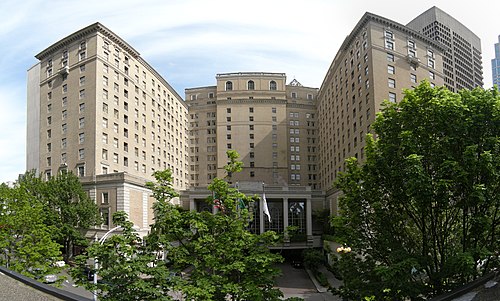
Opened in 1924, the Olympic Hotel stands as a premier architectural landmark and a symbol of Seattle's rapid maturation into a major Pacific Northwest metropolis. Designed by the prestigious New York architectural firm George B. Post & Sons, the grand eleven-story building is an exceptional example of the Italian Renaissance Revival style, featuring a classic brick and terra cotta facade, majestic arched windows, and opulent interior public spaces such as the Spanish Ballroom. The hotel's construction was the result of a monumental civic fundraising campaign led by the Community Hotel Corporation, which mobilized thousands of local citizens to invest in a world-class luxury hotel that would bolster the city's commercial and social prestige on a national scale.
Beyond its architectural grandeur, the Olympic Hotel holds deep historical significance for its unique connection to the University of Washington and its central role in Seattle's civic history. The hotel was constructed on the Metropolitan Tract, the site of the university's original 1861 campus, and the land remains owned by the university to this day under a historic public-private lease agreement. Throughout the twentieth century, the Olympic served as the city's foremost social and political hub, hosting numerous U.S. presidents, international monarchs, celebrities, and key civic events. Its listing on the National Register of Historic Places in 1979 honors both its outstanding design and its enduring legacy as the premier gathering place in downtown Seattle.
Built in 1910 in Seattle's historic Nihonmachi (Japantown) neighborhood, the Panama Hotel is nationally significant as the most intact surviving physical representative of the pre-World War II Japanese American community in the Pacific Northwest. Designed by Sabro Ozasa, the first prominent Japanese American architect in Seattle, the five-story brick building functioned as a vital cultural, social, and commercial anchor for newly arrived Japanese immigrants and working-class laborers. It housed retail businesses, restaurants, lodging, and, most notably, the Hashidate Yu in its basement. This traditional Japanese bathhouse (sento) is the best-preserved urban bathhouse of its kind in the United States, offering a rare and evocative window into the daily communal life and customs of the early twentieth-century Issei (first-generation) immigrant community.
The hotel's historical significance is further heightened by its poignant connection to the forced relocation and internment of Japanese Americans during World War War II. Following the signing of Executive Order 9066 in 1942, local Japanese American families who were ordered to report to assembly centers entrusted their most cherished personal belongings, trunks, and household goods to the hotel's owner, Takashi Shigaya, who stored them for safekeeping in the basement. Because many families were unable to return to Seattle after the war, a large portion of these belongings remained unclaimed. Preserved in situ for decades, this subterranean repository serves as a powerful, untouched material time capsule of a community suddenly uprooted, rendering the Panama Hotel an irreplaceable monument to the Japanese American experience, civil rights history, and wartime resilience.
Historic Significance:
Event, Architecture/Engineering
Architect, builder, or engineer:
Wehn,James, Fisher,Elmer
Architectural Style:
Romanesque
Area of Significance:
Architecture, Social History
Period of Significance:
1900-1924, 1875-1899
Historic Function:
Commerce/Trade, Landscape, Recreation And Culture
Historic Sub-function:
Business, Financial Institution, Park, Street Furniture/Object, Work Of Art (Sculpture, Carving, Rock Art)
Current Function:
Commerce/Trade, Landscape, Recreation And Culture
Current Sub-function:
Park, Street Furniture/Object, Work Of Art (Sculpture, Carving, Rock Art)
The Pioneer Building, Pergola, and Totem Pole form the historic and visual anchor of Seattle's Pioneer Square, representing the city's dramatic transition from a rugged frontier settlement to a major Pacific metropolis at the turn of the twentieth century. The Pioneer Building, designed by prominent architect Elmer Fisher and completed in 1892, is a masterwork of Richardsonian Romanesque architecture. Constructed in the immediate aftermath of the Great Seattle Fire of 1889, its imposing red brick and gray sandstone facade symbolized the city's resilience and rapid economic rebirth. Adjacent to it stands the elegant cast-iron and glass Pergola, designed by Julian F. Everett and erected in 1909 as a shelter for a bustling cable car line and an underground public comfort station. Together, these structures reflect the architectural ambition, civic pride, and rapid infrastructure development catalyzed by the Klondike Gold Rush.
Completing this historic triad is the Pioneer Square Totem Pole, a monumental Tlingit carving that serves as a complex symbol of Seattle's historic relationship with the Pacific Northwest and Alaska. First installed in 1899 after being taken from a Tlingit village in Alaska by a committee of Seattle businessmen, the pole was intended to promote the city as the premier gateway to the north. After a fire damaged the original in 1938, Tlingit carvers from Alaska were commissioned to create the present replica, which was dedicated in 1940. Designated a National Historic Landmark in 1977, this collective site remains an iconic public plaza that captures the intersection of Indigenous heritage, late-Victorian civic design, and the raw entrepreneurial spirit that shaped early Seattle.











.jpg)


