Washington - Clark County
Clark County Washington has 42 places on the National Register of Historic Places including 7 places of National significance and 11 places of Statewide significance. Significant places include Covington House, Fort Vancouver National Historic Site, House of Providence, Officers Row, Fort Vancouver Barracks and Pittock House.

Prehistoric cultural affiliation(s) include Native American, Calaooia and Et.Al. dating back to 1499 BC.

Many famous people are associated with these Clark County historic places including Sisters of Providence, Ulysses S. Grant, Lowell M. Hidden, Columbia Lancaster, Erwin Charles Pomeroy and Silas Maxon.

Some of the country's most noteable architects helped create the Clark County places including Hudson's Bay Co., Richard Covington, Mother of the Sacred Heart Joseph, Hirsh & Watson Helfensteller, Oliver Hidden, Donald McKay, Mother Joseph McKay, Elliote & Hummel Tourt, A.E. Davis and Gilpin Construction Co.. Prominent architectural styles found in Clark Country are Classical Revival, Queen Anne and Bungalow/Craftsman.

Amboy United Brethren Church (added 2008 - - #08001184)
Also known as Evangelical United Brethren Church; Dora Young Chapel;, Methodist Church; North Clark Historical Museum
21416 NE 399th St. , Amboy
Ipoellet, CC BY-SA 4.0, via Wikimedia Commons
Historic Significance:
Architecture/Engineering
Architect, builder, or engineer:
Jensen, Emanuel
Architectural Style:
Late Gothic Revival
Area of Significance:
Architecture
Period of Significance:
1925-1949, 1900-1924
Owner:
Private
Historic Function:
Religion
Historic Sub-function:
Religious Structure
Current Function:
Recreation And Culture
Current Sub-function:
Museum
More Information:
Anderson--Beletski Prune Farm (added 1986 - - #86001100)
Also known as 4-K Farms
4119 N.W. McCann Rd. , Vancouver
Jon Roanhaus, CC BY-SA 3.0, via Wikimedia Commons
Historic Significance:
Event
Area of Significance:
Industry, Agriculture
Period of Significance:
1925-1949, 1900-1924
Owner:
Private
Historic Function:
Agriculture/Subsistence, Domestic
Historic Sub-function:
Agricultural Outbuildings, Secondary Structure, Single Dwelling
Current Function:
Agriculture/Subsistence, Domestic
Current Sub-function:
Agricultural Outbuildings, Secondary Structure, Single Dwelling
Arndt Prune Dryer (added 1979 - - #79002527)
SE of Ridgefield at 2109 NW 219th St. , Ridgefield
Ipoellet, CC BY-SA 4.0, via Wikimedia Commons
Historic Significance:
Event
Area of Significance:
Agriculture, Industry
Period of Significance:
1900-1924, 1875-1899
Owner:
Private
Historic Function:
Agriculture/Subsistence
Historic Sub-function:
Processing
Current Function:
Agriculture/Subsistence
Current Sub-function:
Processing
More Information:
Basalt Cobblestone Quarries District (added 1981 - - #81000587)
Also known as 45-CL-113
Ridgefield National Wildlife Refuge , Ridgefield
Ipoellet, Public domain, via Wikimedia Commons
Historic Significance:
Event, Architecture/Engineering
Area of Significance:
Community Planning And Development, Social History
Period of Significance:
1900-1924, 1875-1899
Owner:
Federal
Historic Function:
Industry/Processing/Extraction
Historic Sub-function:
Extractive Facility
Current Function:
Landscape
Current Sub-function:
Unoccupied Land
More Information:
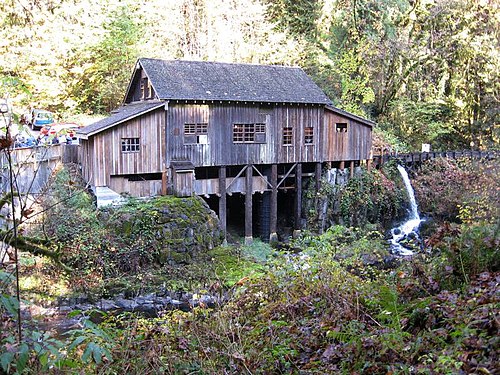
Cedar Creek Grist Mill (added 1975 - - #75001844)
9 mi. E of Woodland on Cedar Creek , Woodland
Historic Significance:
Event
Area of Significance:
Industry
Period of Significance:
1875-1899
Owner:
State
Historic Function:
Industry/Processing/Extraction
Historic Sub-function:
Manufacturing Facility
Current Function:
Vacant/Not In Use
More Information:
Chumasero--Smith House (added 1998 - - #98000282)
Also known as Vintage Inn
310 W. 11th St. , Vancouver
I am a cat, CC BY-SA 3.0, via Wikimedia Commons
Historic Significance:
Architecture/Engineering
Architectural Style:
Other
Area of Significance:
Architecture
Period of Significance:
1925-1949, 1900-1924
Owner:
Private
Historic Function:
Domestic
Historic Sub-function:
Single Dwelling
Current Function:
Domestic
Current Sub-function:
Hotel
More Information:
Columbia City to Cascade City Road (added 2005 - - #05001231)
Also known as Silas Maxon Home and steamboat landing
Located near 144th Ct. and SE Evergreen Hwy , Vancouver
send us a photo to share
Historic Significance:
Event, Person, Information Potential
Historic Person:
Maxon, Silas
Significant Year:
1852, 1850, 1853
Area of Significance:
Exploration/Settlement, Transportation
Period of Significance:
1925-1949, 1900-1924, 1875-1899, 1850-1874, 1825-1849
Owner:
Private
Historic Function:
Transportation
Historic Sub-function:
Road-Related
Current Function:
Transportation
Current Sub-function:
Road-Related
Covington House (added 1972 - - #72001268)
4208 Main St. , Vancouver
send us a photo to share
Historic Significance:
Architecture/Engineering
Architect, builder, or engineer:
Covington,Richard
Architectural Style:
Other
Area of Significance:
Architecture
Period of Significance:
1825-1849
Owner:
Local
Historic Function:
Domestic
Historic Sub-function:
Single Dwelling
Current Function:
Social
Current Sub-function:
Meeting Hall
More Information:
Erected circa 1848, the Covington House is widely recognized as one of the oldest surviving residential log structures in the state of Washington. Built by Richard and Charlotte Covington, English immigrants employed by the Hudson's Bay Company at Fort Vancouver, the cabin originally stood at Fourth Plain, about five miles northeast of the fort. The Covingtons were highly educated and cultured pioneers who brought refinement to the Pacific Northwest wilderness, famously installing the region's first piano in their home. The cabin quickly became a vital social and educational hub for the early settlement, functioning as a boarding school where Charlotte taught local children, and hosting many notable historical figures of the era, including Ulysses S. Grant during his station at Vancouver Barracks.

Architecturally, the building is an exceptional surviving specimen of early pioneer hewn-log construction. To save the structure from decay and demolition, the Vancouver Women's Club undertook a major preservation effort in the late 1920s and early 1930s, relocating the cabin to its present site in Vancouver's Leverich Park. Reconstructed using its original timbers, the Covington House stands as a rare physical link to the transitional period between the Hudson's Bay Company's fur-trading hegemony and the establishment of American civil society in the Oregon Territory. It was listed on the National Register of Historic Places in 1972, honoring both its pioneering architectural merit and its profound social contributions to early Washington history.
Elks Building (added 1983 - - #83003322)
916 Main St. , Vancouver
I am a cat, CC BY-SA 3.0, via Wikimedia Commons
Historic Significance:
Architecture/Engineering, Event
Architect, builder, or engineer:
Tegan,Robert F.
Architectural Style:
Late 19th And 20th Century Revivals
Area of Significance:
Architecture, Social History
Period of Significance:
1925-1949, 1900-1924
Owner:
Private
Historic Function:
Social
Historic Sub-function:
Clubhouse
Current Function:
Commerce/Trade
Current Sub-function:
Business
More Information:
Evergreen Hotel (added 1979 - - #79002529)
500 Main St. , Vancouver
Werewombat, CC BY-SA 3.0, via Wikimedia Commons
Historic Significance:
Event
Area of Significance:
Community Planning And Development, Commerce
Period of Significance:
1925-1949
Owner:
Private
Historic Function:
Domestic
Historic Sub-function:
Hotel
Current Function:
Domestic
Current Sub-function:
Hotel
More Information:
Farrell Building (added 2006 - - #06000135)
Also known as Farrell & Eddy Department Store, Golden Rule Store; JC Penny; Fashionette
305 NE 4th Ave. , Camas
Rotatebot, CC BY-SA 3.0, via Wikimedia Commons
Historic Significance:
Event, Architecture/Engineering
Architect, builder, or engineer:
Roffler, John
Architectural Style:
Early Commercial
Area of Significance:
Commerce, Architecture
Period of Significance:
1900-1924
Owner:
Private
Historic Function:
Commerce/Trade, Domestic
Historic Sub-function:
Department Store, Multiple Dwelling
Current Function:
Commerce/Trade, Domestic
Current Sub-function:
Department Store, Multiple Dwelling
More Information:
Fort Vancouver National Historic Site (added 1966 - - #66000370)
NE of Vancouver , Vancouver
Steven Walling, CC BY 2.0, via Wikimedia Commons
Historic Significance:
Event
Area of Significance:
Politics/Government, Transportation, Agriculture, Commerce, Military, Industry
Period of Significance:
1825-1849
Owner:
Federal
Historic Function:
Defense
Historic Sub-function:
Fortification
Current Function:
Landscape
Current Sub-function:
Park
More Information:
Established in 1824 by the Hudson's Bay Company, Fort Vancouver served as the premier fur trading post, agricultural hub, and political headquarters of the British Empire's Columbia Department in the Pacific Northwest. Under the leadership of Chief Factor Dr. John McLoughlin, the fort grew into a sprawling, self-sufficient mercantile empire that controlled a vast territory stretching from Spanish California to Russian Alaska. It played a pivotal role during the joint-occupancy era of the Oregon Country, acting as the primary point of contact, supply, and assistance for thousands of American emigrants arriving via the Oregon Trail. Its strategic economic dominance and cosmopolitan community of European, Native American, Hawaiian (Kanaka), and Mtis workers shaped the geopolitical boundaries and cultural landscape of the region, ultimately influencing the treaty that established the 49th parallel as the international boundary in 1846.

Following the resolution of the boundary dispute, the site transitioned into a vital American military installation with the establishment of the Vancouver Barracks in 1849, the first U.S. Army post in the Pacific Northwest. The barracks served as a major administrative and staging ground during the Indian Wars, the Civil War, and both World Wars, hosting prominent military figures such as Ulysses S. Grant, Philip Sheridan, and George C. Marshall. Designated as a National Historic Site in 1961, Fort Vancouver is also of exceptional archaeological significance. Decades of meticulous excavations have uncovered millions of artifacts that provide unparalleled insight into 19th-century colonial life, global trade networks, and the diverse, multi-ethnic communities that laid the foundations for the modern state of Washington.
Glenwood School (added 1992 - - #92000697)
Jct. of NE. 87th Ave. and NE. 134th St., SE corner , Glenwood
Ipoellet, CC BY-SA 4.0, via Wikimedia Commons
Historic Significance:
Event
Area of Significance:
Education
Period of Significance:
1925-1949, 1900-1924, 1875-1899
Owner:
Private
Historic Function:
Education
Historic Sub-function:
School
Current Function:
Work In Progress
More Information:
Green, Albert and Letha, House and Barn (added 1982 - - #82004202)
25716 NE Lewisville Hwy. , Battle Ground
Ipoellet, CC BY-SA 4.0, via Wikimedia Commons
Historic Significance:
Event, Architecture/Engineering
Architect, builder, or engineer:
Geen,Albert
Architectural Style:
No Style Listed
Area of Significance:
Exploration/Settlement, Agriculture, Architecture
Period of Significance:
1875-1899
Owner:
Private
Historic Function:
Agriculture/Subsistence, Domestic
Historic Sub-function:
Animal Facility, Secondary Structure, Single Dwelling
Current Function:
Domestic
Current Sub-function:
Single Dwelling
More Information:
Heisen, Henry, House (added 1979 - - #79002526)
27904 NE 174th Ave. , Heisson
Ipoellet, CC BY-SA 4.0, via Wikimedia Commons
Historic Significance:
Event, Architecture/Engineering
Architect, builder, or engineer:
Heisen,Henry Rhinehart
Architectural Style:
No Style Listed
Area of Significance:
Exploration/Settlement, Architecture
Period of Significance:
1875-1899
Owner:
Private
Historic Function:
Agriculture/Subsistence, Domestic
Historic Sub-function:
Animal Facility, Single Dwelling
Current Function:
Domestic
Current Sub-function:
Single Dwelling
More Information:
Hidden Houses (added 1978 - - #78002737)
Also known as Lowell M. and W. Foster Hidden Houses
100 and 110 W. 13th St. , Vancouver
I am a cat, CC BY-SA 3.0, via Wikimedia Commons
Historic Significance:
Person, Architecture/Engineering
Architect, builder, or engineer:
Davis,A.E., Hidden,Oliver
Architectural Style:
Other, Queen Anne, Colonial Revival
Historic Person:
Hidden,Lowell M.,et al.
Significant Year:
1913, 1884
Area of Significance:
Architecture, Industry
Period of Significance:
1900-1924, 1875-1899
Owner:
Private
Historic Function:
Agriculture/Subsistence, Domestic
Historic Sub-function:
Animal Facility, Secondary Structure, Single Dwelling, Storage
Current Function:
Commerce/Trade, Domestic, Work In Progress
Current Sub-function:
Professional, Restaurant, Secondary Structure
More Information:
House of Providence (added 1978 - - #78002738)
Also known as Providence Academy
400 E. Evergreen Blvd. , Vancouver
I am a cat, CC BY-SA 3.0, via Wikimedia Commons
Historic Significance:
Person, Event, Architecture/Engineering
Architect, builder, or engineer:
Joseph,Mother of the Sacred Heart
Architectural Style:
No Style Listed
Historic Person:
Sisters of Providence
Significant Year:
1874, 1873
Area of Significance:
Exploration/Settlement, Education, Architecture, Religion, Social History
Period of Significance:
1875-1899, 1850-1874
Owner:
Private
Historic Function:
Domestic, Religion
Historic Sub-function:
Church Related Residence, Church School, Institutional Housing, Secondary Structure
Current Function:
Commerce/Trade
Current Sub-function:
Professional, Specialty Store
More Information:
The House of Providence, also known as Providence Academy, holds immense historical significance as the motherhouse of the Sisters of Charity of Providence in the Northwest and as a pioneering educational and social institution. Established in 1873 under the leadership of Mother Joseph of the Sacred Heart, the facility served as an academy, orphanage, and the administrative headquarters for the Sisters' extensive network of hospitals and schools throughout the region. As the first permanent base of operations for the Sisters of Providence in the Oregon Territory, the site represents the profound impact of Catholic sisterhoods on the social, medical, and educational development of the Pacific Northwest during the late 19th and early 20th centuries.

Architecturally, the House of Providence is a monumental achievement, designed and constructed under the direct supervision of Mother Joseph, who is recognized as one of the region's first female architects. Constructed of over one million bricks baked on-site from local clay, the imposing four-story, Georgian and Classical Revival-influenced structure was the largest brick building north of San Francisco at the time of its completion in 1874. The building's preservation stands as a testament to pioneering craftsmanship, featuring a beautifully preserved chapel with intricate, hand-carved wooden altars, and it remains a prominent landmark of Vancouver's early history and the enduring legacy of Mother Joseph.
Kiggins, John P. and Mary, House (added 1995 - - #95000804)
411 E. Evergreen Blvd. , Vancouver
Visitor7, CC BY-SA 3.0, via Wikimedia Commons
Historic Significance:
Person, Architecture/Engineering
Architect, builder, or engineer:
Unknown
Architectural Style:
Bungalow/Craftsman
Historic Person:
Kiggins, John P.
Significant Year:
1907
Area of Significance:
Politics/Government, Commerce, Architecture
Period of Significance:
1925-1949, 1900-1924
Owner:
Private
Historic Function:
Domestic
Historic Sub-function:
Single Dwelling
Current Function:
Commerce/Trade
Current Sub-function:
Business
More Information:
Lambert School (added 1989 - - #89000216)
21814 NW 11th , Ridgefield
Werewombat, CC BY-SA 3.0, via Wikimedia Commons
Historic Significance:
Event
Area of Significance:
Education
Period of Significance:
1925-1949
Owner:
Private
Historic Function:
Education
Historic Sub-function:
School
Current Function:
Social
Current Sub-function:
Civic
More Information:
Lancaster, Judge Columbia, House (added 1975 - - #75001843)
Also known as Plas Newydd Farm
N of Ridgefield on Lancaster Rd. , Ridgefield
TDavisPayne, CC BY-SA 3.0, via Wikimedia Commons
Historic Significance:
Person, Event
Historic Person:
Lancaster,Columbia
Significant Year:
1960, 1850
Area of Significance:
Politics/Government, Architecture
Period of Significance:
1875-1899, 1850-1874
Owner:
Private
Historic Function:
Domestic
Historic Sub-function:
Single Dwelling
Current Function:
Domestic
Current Sub-function:
Single Dwelling
More Information:
Lewisville Park (added 1986 - - #86001202)
26411 N.E. Lewisville Hwy. , Battle Ground
Vanmom, CC BY-SA 3.0, via Wikimedia Commons
Historic Significance:
Event, Architecture/Engineering
Architect, builder, or engineer:
Paeth,William J.
Architectural Style:
Other
Area of Significance:
Politics/Government, Landscape Architecture, Architecture
Period of Significance:
1925-1949
Owner:
Local
Historic Function:
Landscape
Historic Sub-function:
Park
Current Function:
Landscape
Current Sub-function:
Park
More Information:
Officers Row, Fort Vancouver Barracks (added 1974 - - #74001948)
Also known as Veterans Admistration Hospital Quarters
611-1616 E. Evergreen Blvd. , Vancouver
Khirad~commonswiki, CC BY-SA 3.0, via Wikimedia Commons
Historic Significance:
Person, Architecture/Engineering
Architect, builder, or engineer:
Unknown
Architectural Style:
No Style Listed
Historic Person:
Grant,Ulysses S.
Significant Year:
1904, 1849
Area of Significance:
Architecture, Military
Period of Significance:
1900-1924, 1850-1874, 1850-1874, 1825-1849
Owner:
Private, Federal
Historic Function:
Domestic
Historic Sub-function:
Multiple Dwelling, Single Dwelling
Current Function:
Commerce/Trade, Domestic, Recreation And Culture
Current Sub-function:
Multiple Dwelling, Museum, Organizational, Single Dwelling
More Information:
Officers' Row at the Vancouver Barracks represents a critical anchor of military and political history in the Pacific Northwest, serving as the residential core of the oldest continuous military post in the region. Established in 1849 as the Columbia Barracks, the post was created to assert American sovereignty, protect settlers, and maintain peace following the 1846 Oregon Treaty with Great Britain. Officers' Row signifies the physical transition of the Pacific Northwest from a fur-trading empire dominated by the Hudson's Bay Company to a formally organized territory of the United States. Throughout the late 19th and early 20th centuries, the barracks served as a vital administrative and logistical headquarters for military campaigns, peacekeeping efforts, and infrastructural development across the vast Department of the Columbia, deeply influencing the settlement and economic development of the entire region.

Architecturally and biography-wise, the historic district comprises twenty-one beautifully preserved residences dating from 1849 to 1906, arranged along a grand, tree-lined promenade overlooking the Columbia River. These structures showcase an evolution of military residential architecture, ranging from the classic timber framing of the historic Grant House-the oldest standing building on the post, built in 1849-to the elaborate Queen Anne and Colonial Revival designs of the late Victorian era, such as the George C. Marshall House. The row is highly significant for its direct association with several of the nation's most illustrious military figures who lived and worked here, including Ulysses S. Grant, Philip H. Sheridan, and George C. Marshall. Together, these homes stand as an exceptional physical record of military domestic life and the evolving architectural tastes of the United States Army on the Western frontier.
Parkersville Site (added 1976 - - #76001880)
Also known as 45-CL-115
Address Restricted , Camas
Jon Roanhaus, CC BY-SA 3.0, via Wikimedia Commons
Historic Significance:
Information Potential, Event
Area of Significance:
Exploration/Settlement, Historic - Aboriginal, Prehistoric
Cultural Affiliation:
Native American
Period of Significance:
500-999 BC, 499-0 BC, 499-0 AD, 1900-1750 AD, 1749-1500 AD, 1499-1000 AD, 1000-500 AD, 1000-1499 BC
Owner:
Local
Historic Function:
Domestic
Historic Sub-function:
Camp
Current Function:
Domestic
Current Sub-function:
Single Dwelling
Pittock House (added 1979 - - #79003148)
Also known as Lakeside;Leadbetter House
N of Camas at 114 NE Leadbetter Rd. , Camas
LyremK, CC BY-SA 3.0, via Wikimedia Commons
Historic Significance:
Architecture/Engineering
Architect, builder, or engineer:
Unknown
Architectural Style:
Queen Anne
Area of Significance:
Architecture
Period of Significance:
1900-1924
Owner:
Private
Historic Function:
Agriculture/Subsistence, Domestic
Historic Sub-function:
Animal Facility, Single Dwelling
Current Function:
Domestic
Current Sub-function:
Single Dwelling
More Information:
Built in 1901, the Pittock House-often referred to as the Pittock-Leadbetter House-in Camas, Washington, is of outstanding historical significance for its direct association with Henry L. Pittock, the pioneering publisher of The Oregonian newspaper, and his son-in-law, Frederick W. Leadbetter. Pittock and Leadbetter were towering figures in the industrial development of the Pacific Northwest, most notably establishing the local paper mill that would drive the economy of Camas for over a century. Constructed as a grand lakeside country estate on the shores of Lacamas Lake, the home served as a prestigious seasonal retreat and residence that reflected the immense wealth, social status, and regional influence of the family during the turn of the twentieth century.

Architecturally, the residence is a premier and rare local representation of the Shingle Style, incorporating elements of Queen Anne and Colonial Revival design. Designed by the prominent Portland architect Emil Schacht, the sprawling two-and-a-half-story mansion features a rustic, shingled exterior designed to blend harmoniously with its natural, wooded surroundings, as well as expansive covered verandas and a complex roofline. Today, the Pittock House stands as an elegant monument to the Gilded Age in Clark County, embodying both the architectural sophistication of the era and the foundational industrial history of the city of Camas.
Pomeroy Farm (added 1987 - - #87000413)
20902 N.E. Lucia Falls Rd. , Yacolt
Callworth360, CC BY-SA 3.0, via Wikimedia Commons
Historic Significance:
Person, Event
Historic Person:
Pomeroy,Erwin Charles,et al.
Significant Year:
1911, 1937, 1910
Area of Significance:
Exploration/Settlement, Agriculture
Period of Significance:
1925-1949, 1900-1924
Owner:
Private
Historic Function:
Agriculture/Subsistence, Domestic
Historic Sub-function:
Agricultural Outbuildings, Secondary Structure, Single Dwelling, Storage
Current Function:
Agriculture/Subsistence, Domestic, Recreation And Culture
Current Sub-function:
Agricultural Outbuildings, Museum, Secondary Structure, Single Dwelling, Storage
More Information:
Ridgefield American Women's League Chapter House (added 1990 - - #82004203)
406 N. 1st St. , Ridgefield
send us a photo to share
Historic Significance:
Event
Area of Significance:
Social History
Period of Significance:
1900-1924
Owner:
Private
Historic Function:
Social
Historic Sub-function:
Civic
Current Function:
Domestic
Current Sub-function:
Single Dwelling
The Ridgefield American Women's League Chapter House, constructed in 1911, is historically significant for its direct association with the American Woman's League (AWL) and the broader women's civic and self-improvement movements of the early twentieth century. Founded by national publisher Edward Gardner Lewis, the AWL sought to empower women by providing educational opportunities, financial independence, and a collective voice. To foster local engagement, the national organization rewarded chapters that met specific magazine subscription sales quotas with standardized, architect-designed clubhouses. The Ridgefield chapter successfully met this challenge, erecting this building to serve as a vital local center for correspondence education, suffrage discussions, and cultural activities, making it a cornerstone of progressive-era women's activism in Clark County.

Architecturally, the chapter house is a rare and intact example of the "Class II" clubhouse design created by the prominent St. Louis architectural firm of Helfensteller, Hirsch & Watson. Reflecting the Prairie School and Craftsman styles popular at the time, the one-story stucco building features a low-pitched hip roof, wide overhanging eaves, and a symmetrical facade with a prominent central entrance. When the national AWL collapsed shortly after the building's completion, the local women retained ownership and deeded the property for community use. It subsequently served as Ridgefield's public library and a versatile civic meeting hall for decades. Listed on the National Register of Historic Places in 1982, the building stands as a physical testament to the determination, organization, and enduring civic legacy of Ridgefield's early female leaders.
Roffler, John, House (added 1993 - - #93000368)
Also known as Roffler I House
1437 NE. Everett St. , Camas
LyremK, CC BY-SA 3.0, via Wikimedia Commons
Historic Significance:
Person, Architecture/Engineering
Architect, builder, or engineer:
Roffler, John
Architectural Style:
Queen Anne
Historic Person:
Roffler, John
Area of Significance:
Architecture
Period of Significance:
1900-1924
Owner:
Private
Historic Function:
Domestic
Historic Sub-function:
Single Dwelling
Current Function:
Domestic
Current Sub-function:
Single Dwelling
More Information:
Sara Store (added 1995 - - #95000304)
17903 NW. 41st Ave. , Ridgefield
Werewombat, CC BY-SA 3.0, via Wikimedia Commons
Historic Significance:
Event
Area of Significance:
Commerce
Period of Significance:
1925-1949, 1900-1924
Owner:
Private
Historic Function:
Commerce/Trade, Domestic, Government
Historic Sub-function:
Department Store, Government Office, Single Dwelling
Current Function:
Domestic, Vacant/Not In Use
Current Sub-function:
Single Dwelling
More Information:
Shobert, William Henry, House (added 1979 - - #79002528)
621 Shobert Lane , Ridgefield
Byroney, CC BY-SA 3.0, via Wikimedia Commons
Historic Significance:
Event, Architecture/Engineering
Architect, builder, or engineer:
Shobert,William Henry
Architectural Style:
No Style Listed
Area of Significance:
Exploration/Settlement, Architecture
Period of Significance:
1900-1924
Owner:
Private
Historic Function:
Domestic
Historic Sub-function:
Secondary Structure, Single Dwelling
Current Function:
Domestic
Current Sub-function:
Secondary Structure, Single Dwelling
More Information:
Slocum House (added 1973 - - #73001867)
605 Esther St. , Vancouver
Visitor7, CC BY-SA 3.0, via Wikimedia Commons
Historic Significance:
Architecture/Engineering
Architect, builder, or engineer:
Unknown
Architectural Style:
Other
Area of Significance:
Architecture
Period of Significance:
1850-1874, 1825-1849
Owner:
Local
Historic Function:
Domestic
Historic Sub-function:
Single Dwelling
Current Function:
Work In Progress
More Information:
St. James Cathedral (added 1986 - - #86003847)
Also known as St. James Church
204 W. Twelfth St. , Vancouver
send us a photo to share
Historic Significance:
Event, Architecture/Engineering
Architect, builder, or engineer:
McKay,Donald, McKay,Mother Joseph
Architectural Style:
Gothic
Area of Significance:
Religion, Architecture
Period of Significance:
1900-1924, 1875-1899
Owner:
Private
Historic Function:
Religion
Historic Sub-function:
Religious Structure
Current Function:
Religion
Current Sub-function:
Religious Structure
Stanger, John, House (added 1990 - - #90000785)
9213 Evergreen Hwy. , Vancouver
Jon Roanhaus, CC BY-SA 3.0, via Wikimedia Commons
Historic Significance:
Event
Area of Significance:
Exploration/Settlement
Period of Significance:
1900-1924, 1875-1899, 1850-1874
Owner:
Private
Historic Function:
Domestic
Historic Sub-function:
Single Dwelling
Current Function:
Domestic
Current Sub-function:
Single Dwelling
More Information:
U.S. National Bank Building (added 1988 - - #84004010)
Also known as Ford Building
601 Main St. , Vancouver
Historic Significance:
Architecture/Engineering
Architect, builder, or engineer:
Voorhees,C.S.
Architectural Style:
Other, Chicago
Area of Significance:
Architecture
Period of Significance:
1900-1924
Owner:
Private
Historic Function:
Commerce/Trade
Current Function:
Vacant/Not In Use
More Information:
US Post Office--Camas Main (added 1991 - - #91000639)
440 NE. Fifth Ave. , Camas
Werewombat, CC BY-SA 3.0, via Wikimedia Commons
Historic Significance:
Architecture/Engineering, Event
Architect, builder, or engineer:
Nicholson,Douglas, Simon,Louis A.
Architectural Style:
Colonial Revival
Area of Significance:
Politics/Government, Architecture, Art
Period of Significance:
1925-1949
Owner:
Federal
Historic Function:
Government
Historic Sub-function:
Post Office
Current Function:
Government
Current Sub-function:
Post Office
More Information:
US Post Office--Vancouver Main (added 1991 - - #91000659)
Also known as Vancouver Downtown Station
1211 Daniels , Vancouver
I am a cat, CC BY-SA 3.0, via Wikimedia Commons
Historic Significance:
Event, Architecture/Engineering
Architect, builder, or engineer:
Wetmore,James A.
Architectural Style:
Classical Revival
Area of Significance:
Politics/Government, Architecture
Period of Significance:
1925-1949, 1900-1924
Owner:
Federal
Historic Function:
Government
Historic Sub-function:
Post Office
Current Function:
Government
Current Sub-function:
Post Office
More Information:
Vancouver National Historic Reserve Historic District (added 2007 - - #06001216)
Also known as Vancouver National Historic Reserve, Vancouver Barracks; Fort Vancouver National Historic Site
Roughly bounded by an alley N of Officers' Row, East Reserve St., Columbia River, and I-5 , Vancouver
Acroterion, Public domain, via Wikimedia Commons
Historic Significance:
Information Potential, Event, Architecture/Engineering
Architect, builder, or engineer:
et.al., Hudson's Bay Co.
Architectural Style:
Late Victorian, Late 19th And 20th Century Revivals
Area of Significance:
Commerce, Military, Industry, Exploration/Settlement, Historic - Non-Aboriginal, Historic - Aboriginal, Prehistoric, Architecture, Agriculture, Education
Cultural Affiliation:
Calaooia, Et.Al.
Period of Significance:
499-0 BC, 499-0 AD, 1950-1974, 1925-1949, 1900-1924, 1900-1750 AD, 1749-1500 AD, 1499-1000 AD, 1000-500 AD
Owner:
Local, Federal, Private
Historic Function:
Agriculture/Subsistence, Commerce/Trade, Defense, Domestic, Industry/Processing/Extraction, Religion, Transportation
Historic Sub-function:
Air-Related, Business, Fortification, Manufacturing Facility, Processing, Religious Structure, Single Dwelling
Current Function:
Commerce/Trade, Defense, Domestic, Government, Recreation And Culture, Transportation
Current Sub-function:
Air-Related, Business, Government Office, Military Facility, Museum, Professional, Single Dwelling
More Information:
The Vancouver National Historic Reserve Historic District is a premier cultural landscape that spans over 360 years of history, representing the intersection of indigenous cultures, European fur trading, American military expansion, and early aviation in the Pacific Northwest. At the heart of the district lies the reconstructed Fort Vancouver, which served as the 19th-century headquarters of the Hudson's Bay Company's Columbia Department, acting as the political, economic, and social hub of the vast Oregon Country. The site is uniquely significant for its role in the global fur trade, its complex relationships with regional Native American tribes, and its status as the terminal point for many early overland emigrants traveling along the Oregon Trail.

Following the settlement of the boundary dispute between Great Britain and the United States, the site transitioned into the Vancouver Barracks, established in 1849 as the first U.S. Army post in the Pacific Northwest. The barracks played a vital role in regional settlement and national defense through World War II, hosting legendary military figures such as Ulysses S. Grant, Philip Sheridan, and George C. Marshall. The district also encompasses Pearson Airfield, one of the oldest continuously operating aviation fields in the United States, which played a critical role in the world's first round-the-world flight in 1924 and served as a major hub for the World War I-era Spruce Production Division. Together, these elements form an extraordinarily preserved historic corridor that documents the evolution of the American West from a remote frontier outpost into a modern industrial and military powerhouse.
Vancouver Public Library (added 1982 - - #82004204)
Also known as Clark County Historical Museum
1511 Main St. , Vancouver
Werewombat, CC BY-SA 3.0, via Wikimedia Commons
Historic Significance:
Event, Architecture/Engineering
Architect, builder, or engineer:
Kaufman,William, Nichols,Dennis
Architectural Style:
No Style Listed
Area of Significance:
Education, Architecture, Social History
Period of Significance:
1900-1924
Owner:
Local
Historic Function:
Education
Historic Sub-function:
Library
Current Function:
Recreation And Culture
Current Sub-function:
Museum
More Information:
Vancouver Telephone Building (added 1986 - - #86003092)
Also known as Pacific Northwest Bell Building
112 W. Eleventh , Vancouver
I am a cat, CC BY-SA 3.0, via Wikimedia Commons
Historic Significance:
Event, Architecture/Engineering
Architect, builder, or engineer:
Albertson,Wilson & Richardson
Architectural Style:
Other
Area of Significance:
Architecture, Communications
Period of Significance:
1925-1949
Owner:
Private
Historic Function:
Industry/Processing/Extraction
Historic Sub-function:
Communications Facility
Current Function:
Commerce/Trade
More Information:
Vancouver-Portland Bridge (added 1982 - - #82004205)
Also known as Columbia River Interstate Bridge
Spans Columbia River , Vancouver
Visitor7, CC BY-SA 3.0, via Wikimedia Commons
Historic Significance:
Event, Architecture/Engineering
Architect, builder, or engineer:
Harrington,Howard & Ash
Architectural Style:
No Style Listed
Area of Significance:
Engineering, Transportation
Period of Significance:
1900-1924
Owner:
State
Historic Function:
Transportation
Historic Sub-function:
Pedestrian Related, Rail-Related, Road-Related
Current Function:
Transportation
Current Sub-function:
Pedestrian Related, Road-Related
More Information:
Venersborg School (added 1989 - - #89000215)
Also known as Venersborg Community Club
NE 209th St at NE 242nd Ave. , Battle Ground
Ipoellet, CC BY-SA 4.0, via Wikimedia Commons
Historic Significance:
Event
Area of Significance:
European, Education
Period of Significance:
1925-1949, 1900-1924
Owner:
Private
Historic Function:
Education
Historic Sub-function:
School
Current Function:
Social
Current Sub-function:
Clubhouse
More Information:
Washington School for the Blind (added 1993 - - #93000370)
Also known as Washington School for Defective Youth
2214 E. 13th St. , Vancouver
Visitor7, CC BY-SA 3.0, via Wikimedia Commons
Historic Significance:
Architecture/Engineering, Event
Architect, builder, or engineer:
Zittel, Julius
Architectural Style:
Classical Revival
Area of Significance:
Education, Social History, Architecture
Period of Significance:
1925-1949, 1900-1924
Owner:
State
Historic Function:
Education, Industry/Processing/Extraction
Historic Sub-function:
Educational Related Housing, Energy Facility, School
Current Function:
Education, Vacant/Not In Use
Current Sub-function:
School
More Information:
Yale Bridge (added 1982 - - #82004206)
Spans Lewis River on WA 502 , Yale
KudzuVine, Public domain, via Wikimedia Commons
Historic Significance:
Event, Architecture/Engineering
Architect, builder, or engineer:
Gilpin Construction Co., Gilbert,Harold H.
Architectural Style:
Other
Area of Significance:
Engineering, Transportation
Period of Significance:
1925-1949
Owner:
State
Historic Function:
Transportation
Historic Sub-function:
Road-Related
Current Function:
Transportation
Current Sub-function:
Road-Related
More Information:
Return to Top
Select a Different Washington County (map)
Adams
Asotin
Benton
Chelan
Clallam
Clark
Columbia
Cowlitz
Douglas
Ferry
Franklin
Garfield
Grant
Grays Harbor
Island
Jefferson
King
Kitsap
Kittitas
Klickitat
Lewis
Lincoln
Mason
Okanogan
Pacific
Pend Oreille
Pierce
San Juan
Skagit
Skamania
Snohomish
Spokane
Stevens
Thurston
Wahkiakum
Walla Walla
Whatcom
Whitman
Yakima
Select a Different State (map)
Alabama
Alaska
Arizona
Arkansas
California
Colorado
Connecticut
Delaware
District Of Columbia
Florida
Georgia
Hawaii
Idaho
Illinois
Indiana
Iowa
Kansas
Kentucky
Louisiana
Maine
Maryland
Massachusetts
Michigan
Minnesota
Mississippi
Missouri
Montana
Nebraska
Nevada
New Hampshire
New Jersey
New Mexico
New York
North Carolina
North Dakota
Ohio
Oklahoma
Oregon
Pennsylvania
Rhode Island
South Carolina
South Dakota
Tennessee
Texas
Utah
Vermont
Virginia
Washington
West Virginia
Wisconsin
Wyoming
Return to Home Page