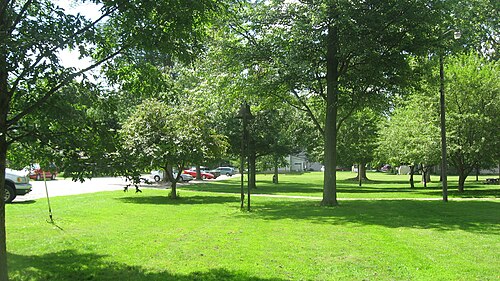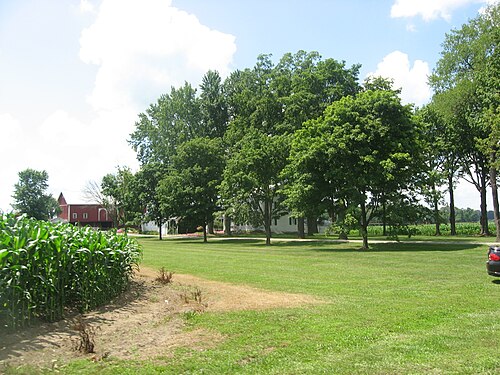
Elkhart County Indiana (Vacant / Not In Use) has 3 places on the National Register of Historic Places including 1 place of National significance. Significant places include Beardsley, Albert R., House, Nappanee West Park and Pavilion, Rohrer, Joseph J., Farm.
Some of the country's most noteable architects helped create the Elkhart County places including Enock Hill Turnock. Prominent architectural styles found in Elkhart Country are Art Deco, Bungalow/Craftsman and Federal.
Historic Significance:
Architecture/Engineering
Architect, builder, or engineer:
Turnock,Enock Hill
Architectural Style:
Art Deco
Area of Significance:
Art, Architecture
Period of Significance:
1900-1924
Historic Function:
Domestic
Historic Sub-function:
Single Dwelling
Current Function:
Education, Vacant/Not In Use
Current Sub-function:
Library
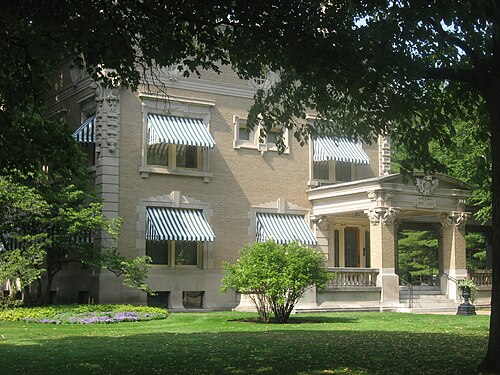
The Albert R. Beardsley House, widely known as "Ruthmere," is a premier example of Beaux-Arts residential architecture in Elkhart, Indiana. Constructed between 1908 and 1910, the magnificent three-story Indiana limestone mansion was designed by prominent local architect Enoch Hill Turnock. The residence showcases the opulence of the Gilded Age with its symmetrical facade, grand portico supported by monumental Ionic columns, and a balustraded roofline. The interior is equally lavish, featuring imported Italian marble, hand-carved woodwork, elaborate plaster relief ceilings, exquisite Tiffany-style leaded glass, and a built-in Aeolian player pipe organ. The estate, which includes a historic greenhouse and formal gardens, remains a remarkably intact representation of early 20th-century high-style architectural design and craftsmanship.
Historically, the property is significant for its association with Albert R. Beardsley, a prominent civic leader, industrialist, and philanthropist who played a crucial role in Elkhart's economic development. Albert was the nephew of Elkhart's founder, Havilah Beardsley, and served as the general manager of the Dr. Miles Medical Company (later Miles Laboratories), which grew into an international pharmaceutical giant. Albert and his wife, Elizabeth, named the estate "Ruthmere" in memory of their only child, Ruth, who died in infancy. The house served as a center for local social and political life during the early 1900s, reflecting the Beardsley family's immense influence on the region's business, political, and cultural landscape.