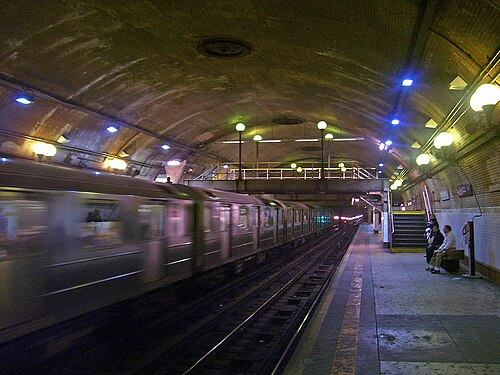
Washington Heights sits high, towering over the rest of Manhattan. So when the Interborough Rapid Transit Company pushed its first line north in the early 1900s, engineers hit a wall of solid schist. They couldn't just dig up the street. Instead, miners blasted a deep-bore tunnel eighty feet below the surface. This created the 168th Street station, which finally opened in April 1906. Walk onto the platform today. You still look up at a massive, cavernous arch that feels more like a European railway hall than a gritty subway stop. No columns block your view of the tracks. Just an open vault. Actually, the builders achieved this structural feat by using a wide brick-lined arch that shrugged off the immense weight of the rock above.
You don't take stairs here. Well, you can, but it is a brutal, emergency-only spiral climb of several flights. Since the station sits so deep, the IRT had to install elevators from day one. That was a massive deal in 1906. People weren't used to sinking into the earth in motorized cages just to catch a train. The original shafts still dictate how the station breathes and moves. But they also cause bottlenecks. Over the decades, the transit authority patched, painted, and retrofitted the space, yet they preserved those gorgeous, glazed terracotta name tablets. The tiles sport a vibrant orange and green scheme. They spell out "168" with a clean typography that survives despite the grime of millions of daily commutes.
- T Walker
What Makes 168th Street Subway Station (IRT) Special: