Washington - Kitsap County - Historic Districts
Kitsap County Washington (Historic Districts) has 8 places on the National Register of Historic Places including 7 places of National significance. Significant places include Fort Ward Historic District, Hospital Reservation Historic District, Marine Reservation Historic District, Navy Yard Puget Sound and Officers' Row Historic District.

Some of the country's most noteable architects helped create the Kitsap County places including Chamberlin & Siebrand, J.B. DeSibour, US Navy, E.R. Gayler, R.E. Thomas and U.S. Navy. Prominent architectural styles found in Kitsap Country are Classical Revival, Colonial Revival and Bungalow/Craftsman.

Fort Ward Historic District (added 1978 - - #78002759)
S of Winslow , Winslow
Jmabel, CC BY-SA 3.0, via Wikimedia Commons
Historic Significance:
Event, Architecture/Engineering
Architect, builder, or engineer:
Unknown
Architectural Style:
No Style Listed
Area of Significance:
Architecture, Military
Period of Significance:
1900-1924, 1875-1899
Owner:
Private, State
Historic Function:
Defense
Historic Sub-function:
Fortification, Military Facility
Current Function:
Domestic, Landscape
Current Sub-function:
Park, Single Dwelling
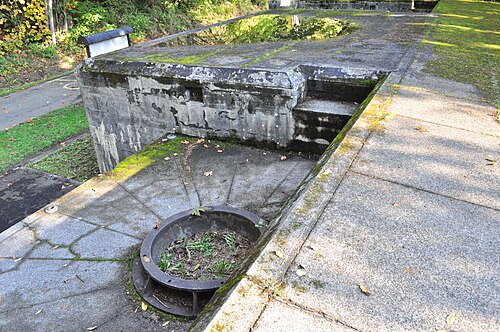
The Fort Ward Historic District, located on the southern tip of Bainbridge Island in Kitsap County, Washington, is historically significant as a vital component of the Puget Sound coastal defense system and as a premier military intelligence site during World War II. Established in the late 1890s and officially activated in 1903, the fort was constructed under the recommendations of the Endicott and Taft Boards to protect the strategic Puget Sound Naval Shipyard in Bremerton from naval attack. The district retains a remarkable collection of turn-of-the-century military architecture, including concrete gun batteries, a powerhouse, barracks, and classic colonial-revival style officers' quarters arranged around a central parade ground, reflecting the standardized planning of the U.S. Army Coast Artillery Corps.

While its role as a coastal defense fort diminished after World War I, the site gained national intelligence significance in 1938 when it was transferred to the U.S. Navy and transformed into a highly classified naval radio intercept station known as "Station S." During World War II, Fort Ward served as one of the nation's primary listening posts, monitoring and intercepting Japanese military and diplomatic radio communications, which provided invaluable data for Allied codebreakers in the Pacific Theater. Today, the historic district is celebrated for its dual legacy of early 20th-century coastal defense and pivotal wartime intelligence operations, with many of its historic structures seamlessly integrated into residential neighborhoods and Fort Ward State Park.
Fort Ward Historic District (Boundary Increase) (added 1996 - - #96000415)
Also known as US Naval Radio Communications Station;Fort Ward;See also For
Fort Ward, approximately .5 mi N of Beans Pt. , Bainbridge Island
send us a photo to share
Historic Significance:
Event
Area of Significance:
Military, Communications
Period of Significance:
1925-1949
Owner:
State, Private
Historic Function:
Defense
Historic Sub-function:
Communications Facility, Naval Facility
Current Function:
Agriculture/Subsistence, Industry/Processing/Extraction, Landscape
Current Sub-function:
Extractive Facility, Fishing Facility Or Site, Manufacturing Facility, Park
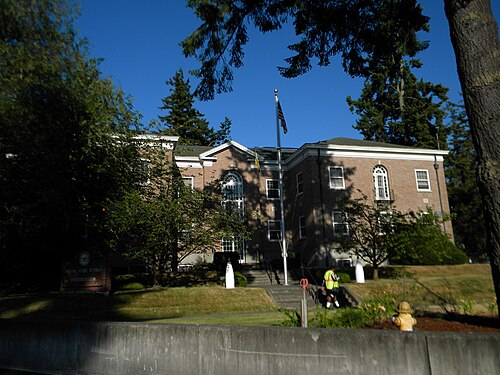
Hospital Reservation Historic District (added 1990 - - #88003052)
Roughly bounded by Mahan Ave., Hoogewerf Rd., Decatur Ave., and Dewey St. , Bremerton
Jon Roanhaus, CC BY-SA 3.0, via Wikimedia Commons
Historic Significance:
Event
Area of Significance:
Military
Period of Significance:
1925-1949, 1900-1924
Owner:
Federal
Historic Function:
Defense, Domestic, Health Care
Historic Sub-function:
Hospital, Institutional Housing, Multiple Dwelling, Naval Facility, Single Dwelling
Current Function:
Defense, Domestic
Current Sub-function:
Institutional Housing, Multiple Dwelling, Naval Facility, Single Dwelling
The Hospital Reservation Historic District, situated within the Puget Sound Naval Shipyard in Bremerton, Washington, is a highly cohesive enclave of military medical and residential buildings that reflects the evolution of naval healthcare in the Pacific Northwest. Established in 1911, the district was designed as a distinct, self-contained campus within the larger shipyard, characterized by its manicured lawns, mature trees, and commanding views of the Sinclair Inlet. Architecturally, the district is defined by its handsome, classically inspired brick buildings, primarily designed in the Colonial and Classical Revival styles. These structures, which include the prominent former naval hospital building and elegant officers' quarters, showcase the standardized, high-quality design principles employed by the U.S. Navy's Bureau of Yards and Docks during the early 20th century to project a sense of order, permanent authority, and civic pride.

Historically, the district is significant for its vital role in supporting the Pacific Fleet and the shipyard's massive workforce through both World Wars and the interwar period. As the primary naval medical facility in the region, the hospital reservation was instrumental in treating sick and wounded servicemen, managing public health challenges such as the 1918 influenza pandemic, and providing medical care for the thousands of civilian workers who built and repaired the nation's warships. The district stands as a testament to the strategic expansion of the Puget Sound Naval Shipyard and the critical integration of specialized medical infrastructure to sustain military readiness on the West Coast. Today, the district remains a powerful physical reminder of the Navy's administrative and humanitarian efforts, as well as its enduring historical and economic impact on Kitsap County.
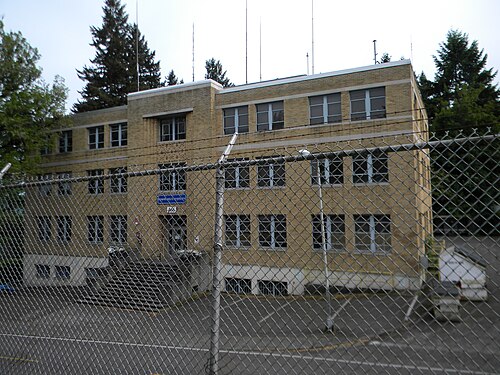
Marine Reservation Historic District (added 1990 - - #88003051)
Bounded by Cole St., Dewey St., Decatur Ave., and Doyen St. , Bremerton
Jon Roanhaus, CC BY-SA 3.0, via Wikimedia Commons
Historic Significance:
Event
Area of Significance:
Military
Period of Significance:
1900-1924
Owner:
Federal
Historic Function:
Defense, Domestic
Historic Sub-function:
Naval Facility, Single Dwelling
Current Function:
Defense, Domestic
Current Sub-function:
Naval Facility, Single Dwelling
The Marine Reservation Historic District, located on the southern tip of Bainbridge Island in Kitsap County, Washington, is historically significant for its critical role in United States military communications and intelligence-gathering during the mid-20th century. Originally established as part of the Fort Ward coastal defense system at the turn of the 20th century to protect the nearby Bremerton Navy Yard, the site underwent a dramatic transformation in 1938 when the U.S. Navy acquired the property. It was developed into "Station S," a highly classified naval radio intercept station. During World War II, the station served as a primary intelligence post, intercepting and decoding Japanese military radio traffic, which played an invaluable role in Allied strategic planning and operations in the Pacific Theater.

Architecturally, the historic district consists of a well-preserved collection of military buildings designed to accommodate the Marine detachment tasked with guarding this top-secret installation. Constructed primarily between 1910 and the early 1940s, the contributing structures-including the Colonial Revival-style Navy wireless station, the Marine barracks, officer quarters, and utility buildings-demonstrate the evolution of military architecture from early 20th-century coastal artillery support to World War II-era operational security. Today, the district stands as a remarkable physical record of the nation's pre-war mobilization and the vital, clandestine contributions of Bainbridge Island to the global war effort.
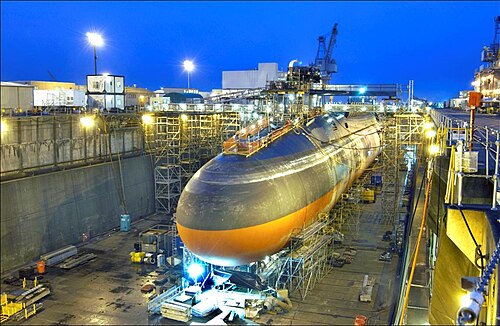
Navy Yard Puget Sound (added 1992 - - #92001883)
Also known as Bremerton Navy Yard;Puget Sound Naval Shipyard
N shore of Sinclair Inlet , Bremerton
PMG, Public domain, via Wikimedia Commons
Historic Significance:
Event
Area of Significance:
Military
Period of Significance:
1925-1949
Owner:
Federal
Historic Function:
Defense
Historic Sub-function:
Naval Facility
Current Function:
Defense
Current Sub-function:
Naval Facility
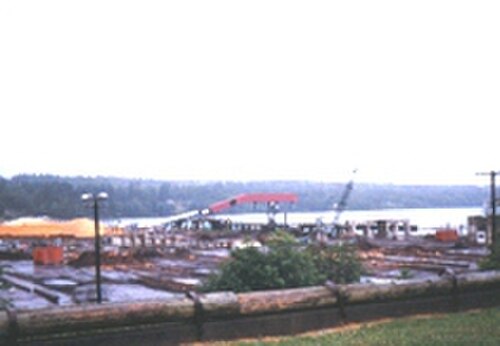
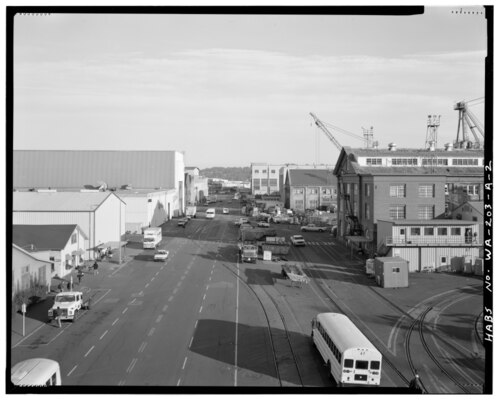
Established in 1891 as the Pacific Northwest's first major naval station, the Navy Yard Puget Sound (now known as the Puget Sound Naval Shipyard) in Bremerton, Washington, played a pivotal role in United States naval history and maritime defense. The yard's significance peaked during World War War II, when it served as the principal repair facility for the battle-damaged ships of the U.S. Pacific Fleet. Remarkably, five of the battleships damaged during the attack on Pearl Harbor-the USS Tennessee, Maryland, Nevada, California, and West Virginia-were sent to Puget Sound to be repaired, modernized, and sent back into action. In addition to its vital repair work, the shipyard constructed dozens of new vessels, including destroyers, submarines, and escort carriers, making it one of the most productive and logistically crucial industrial facilities in the nation during the war.

Designated as a National Historic Landmark District in 1992, the historic district encompasses a vast array of industrial architecture and engineering marvels that reflect the evolution of naval technology from the late-19th century through World War II. Key contributing resources include Dry Dock 1, completed in 1896 as a pioneering timber-lined dry dock, and the massive concrete Dry Dock 2, alongside monumental brick and steel industrial workshops, machine shops, and administrative offices. These structures, characterized by their utilitarian and robust Classical Revival and Industrial style designs, stand as a testament to the extraordinary engineering feats required to support the nation's naval supremacy in the Pacific.
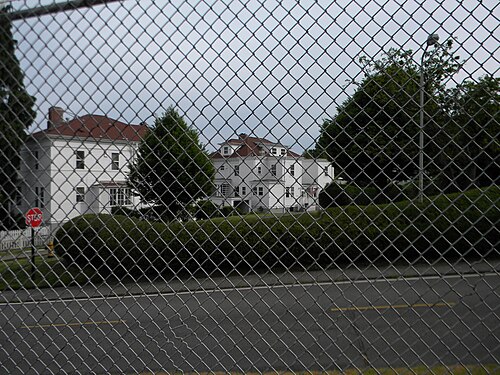
Officers' Row Historic District (added 1990 - - #88003054)
Roughly bounded by Mahan Ave., Decatur Ave., and Coghlan Rd. , Bremerton
Jon Roanhaus, CC BY-SA 3.0, via Wikimedia Commons
Historic Significance:
Event
Area of Significance:
Military
Period of Significance:
1900-1924, 1875-1899
Owner:
Federal
Historic Function:
Defense, Domestic
Historic Sub-function:
Naval Facility, Single Dwelling
Current Function:
Defense, Domestic
Current Sub-function:
Naval Facility, Single Dwelling
The Officers' Row Historic District, located within the Puget Sound Naval Shipyard in Bremerton, Washington, is historically significant for its direct association with the establishment and early development of the Pacific Northwest's first major naval installation. Established in 1891, the shipyard became a vital cornerstone of United States naval strategy in the Pacific. The district, which contains a collection of prestigious residences built between 1896 and 1914, served as the domestic and social hub for the yard's highest-ranking officers, including the shipyard's Commandant. These homes reflect the rigid social hierarchy and customs of the turn-of-the-century U.S. Navy, standing as a physical representation of the naval command structure during a period of rapid American naval expansion.

Architecturally, the historic district is a remarkably well-preserved showcase of late-19th and early-20th-century residential design adapted for military use. Characterized by prominent styles of the era, such as Queen Anne and Colonial Revival, the homes-most notably the grand Commandant's Residence (Quarters A)-feature distinctive craftsmanship, wrap-around porches, and classic detailing. The district's cohesive, park-like setting, complete with manicured lawns and mature trees overlooking the water, contrasts with the industrial character of the surrounding shipyard. The Officers' Row Historic District remains highly significant under National Register Criteria A and C, embodying both the military heritage of the region and the distinct architectural tastes of the federal government during the golden age of naval shore construction.
Port Gamble Historic District (added 1966 - - #66000746)
NW end of Kitsap Peninsula near entrance to Hood Canal, Puget Sound , Port Gamble
Finavon, Public domain, via Wikimedia Commons
Historic Significance:
Event
Area of Significance:
Industry
Period of Significance:
1875-1899, 1850-1874
Owner:
Private
Historic Function:
Commerce/Trade, Domestic, Industry/Processing/Extraction
Historic Sub-function:
Business, Manufacturing Facility, Single Dwelling
Current Function:
Commerce/Trade, Industry/Processing/Extraction
Current Sub-function:
Business, Manufacturing Facility
Established in 1853 by the Puget Mill Company, the Port Gamble Historic District is nationally significant as one of the oldest and most intact company-owned mill towns in the United States. Founded by Maine partners Josiah Keller, Charles Talbot, and Andrew Pope, the town quickly became the epicenter of a massive lumber empire that fueled the growth of San Francisco, Hawaii, and international markets. The Port Gamble mill operated continuously for 142 years until its closure in 1995, making it the longest-operating sawmill in the nation. This remarkable industrial longevity established the district as a vital cornerstone of the Pacific Northwest's maritime and timber heritage.

Visually distinct from other western settlements, Port Gamble was intentionally designed to replicate the traditional New England villages of the founders' home state of Maine. The district's highly preserved landscape features uniform rows of frame cottages, manicured maple-lined streets, and high-style Victorian residences, all showcasing the popular architectural trends of the mid-to-late 19th century. Notable landmarks include the 1879 St. Paul's Episcopal Church, modeled after a church in East Machias, Maine, and the historic General Store. Designated a National Historic Landmark in 1966, the Port Gamble Historic District remains an extraordinary physical manifestation of 19th-century paternalistic corporate planning and Yankee architectural influence on the Pacific Frontier.
Puget Sound Radio Station Historic District (added 1990 - - #88003053)
Roughly bounded by Mahan Ave., Coghlan Rd., and Cottman Rd. , Bremerton
F\u00e6, Public domain, via Wikimedia Commons
Historic Significance:
Event
Area of Significance:
Military
Period of Significance:
1925-1949, 1900-1924, 1875-1899
Owner:
Federal
Historic Function:
Defense, Domestic, Industry/Processing/Extraction
Historic Sub-function:
Communications Facility, Naval Facility, Single Dwelling, Water Works
Current Function:
Defense, Domestic, Education, Industry/Processing/Extraction
Current Sub-function:
Naval Facility, School, Single Dwelling, Water Works
The Puget Sound Radio Station Historic District, situated on Bainbridge Island in Kitsap County, Washington, is historically significant for its pioneering role in the development of military and maritime communications in the Pacific Northwest. Established by the United States Navy in 1913, the facility was designed to serve as a vital link in the Navy's trans-Pacific radio network, connecting the Puget Sound Naval Shipyard with critical outposts in Alaska, Hawaii, and the East Coast of the United States. Architecturally and technologically, the district is anchored by its monumental brick transmitter building, which represents the early 20th-century transition from primitive spark-transmitter technology to advanced continuous-wave radio transmission, marking a major milestone in global telecommunications and military engineering.

During World War I and continuing through World War II, the station played a crucial national security role as a high-power naval communications hub and intelligence-gathering outpost. Its powerful transmitters and receivers allowed the Navy to monitor shipping traffic, intercept foreign military transmissions, and maintain secure command-and-control capabilities across the Pacific theater. Following its decommissioning in the post-war era, the site was eventually transferred to local custody and transformed into Battle Point Park, with the landmark transmitter building adapted for community use and astronomical research. Today, the district stands as a prominent physical legacy of the United States' early electronic defense infrastructure and the strategic military build-up of the Puget Sound region during the 20th century.
Return to Top
Select a Different Washington County (map)
Adams
Asotin
Benton
Chelan
Clallam
Clark
Columbia
Cowlitz
Douglas
Ferry
Franklin
Garfield
Grays Harbor
Island
Jefferson
King
Kitsap
Kittitas
Klickitat
Lewis
Lincoln
Mason
Pacific
Pend Oreille
Pierce
San Juan
Skagit
Skamania
Snohomish
Spokane
Stevens
Thurston
Wahkiakum
Walla Walla
Whatcom
Whitman
Yakima
Select a Different State (map)
Alabama
Alaska
Arizona
Arkansas
California
Colorado
Connecticut
Delaware
District Of Columbia
Florida
Georgia
Hawaii
Idaho
Illinois
Indiana
Iowa
Kansas
Kentucky
Louisiana
Maine
Maryland
Massachusetts
Michigan
Minnesota
Mississippi
Missouri
Montana
Nebraska
Nevada
New Hampshire
New Jersey
New Mexico
New York
North Carolina
North Dakota
Ohio
Oklahoma
Oregon
Pennsylvania
Rhode Island
South Carolina
South Dakota
Tennessee
Texas
Utah
Vermont
Virginia
Washington
West Virginia
Wisconsin
Wyoming
Return to Home Page