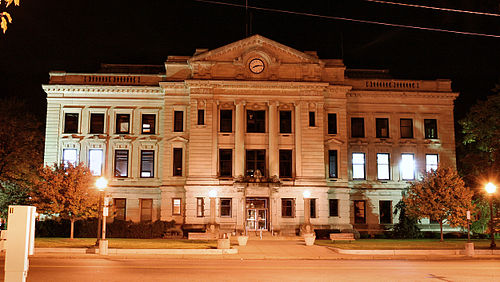
De Kalb County Indiana has 33 places on the National Register of Historic Places including 1 place of National significance and 1 place of Statewide significance. Significant places include Auburn Cord Duesenberg Automobile Facility and Wiltrout, Maria and Franklin, Polygonal Barn, Bevier, Samuel, House, Bowman, Joseph, Farmhouse and Breechbill-Davidson House.
The famous person Henry Wesley Mountz is associated with one of more of the De Kalb County historic places.
Some of the country's most noteable architects helped create the De Kalb County places including Sheets Inc., A. M. Strauss, Frank Reynolds, Samuel Bevier, Jacob Shull, J. Perry Long, Henry Davidson, J.H. Haag, John Mckay and William Fountain. Prominent architectural styles found in De Kalb Country are Italianate, Greek Revival and Colonial Revival.
Historic Significance:
Event, Architecture/Engineering
Architect, builder, or engineer:
Sheets Inc., Strauss, A. M.
Architectural Style:
Art Deco
Area of Significance:
Architecture, Transportation
Period of Significance:
1925-1949
Historic Function:
Commerce/Trade
Historic Sub-function:
Business
Current Function:
Recreation And Culture
Current Sub-function:
Museum
The Auburn Cord Duesenberg Automobile Facility, constructed between 1929 and 1930 in Auburn, Indiana, serves as an exceptional monument to the golden age of American automotive design and entrepreneurship. As the international headquarters for the Auburn Automobile Company, this site was the nerve center where industry visionary Errett Lobban Cord united three of the most prestigious luxury and high-performance automobile brands of the interwar era: Auburn, Cord, and Duesenberg. The facility was not only the administrative hub but also the creative birthplace of legendary, technologically advanced automobiles that defined 1930s style, power, and prestige. Its association with E. L. Cord and his empire represents a pinnacle of American industrial design, engineering innovation, and marketing genius during the Great Depression.
Architecturally, the facility is a masterpiece of the Art Deco style, designed by prominent Fort Wayne architect Alvin M. Strauss. The building's exterior features intricate brickwork and geometric terra cotta ornamentation, but its crown jewel is the soaring, two-story main showroom. This opulent space is adorned with terrazzo floors, ornate plaster ceilings, custom brass chandeliers, and grand staircase balustrades, all designed to present the company's sleek vehicles as works of fine art. Recognized for its extraordinary national significance, the complex was designated a National Historic Landmark in 2005 and now operates as the world-renowned Auburn Cord Duesenberg Automobile Museum, preserving both the physical space and the legacy of these classic American motorcars.