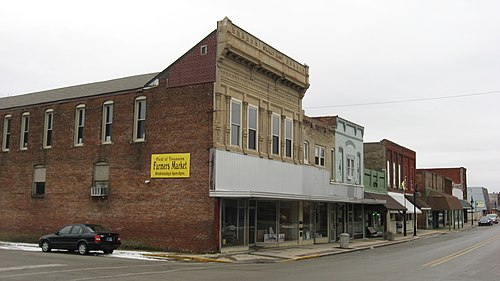
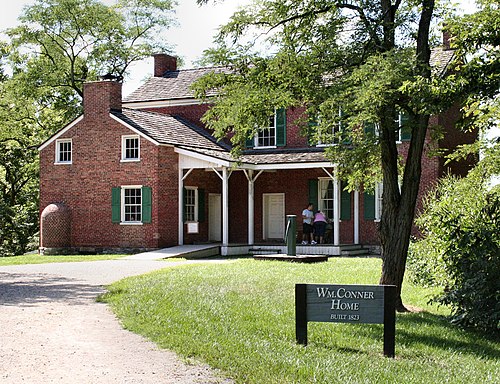
Hamilton County Indiana has 29 places on the National Register of Historic Places including 1 place of National significance and 6 places of Statewide significance. Significant places include Hamilton County Courthouse Square, Castor Farm Site, Conner, William, House, Kinzer, John, House and Potter's Covered Bridge.
Prehistoric cultural affiliation(s) include Late Woodland, Mississippian, Fort Ancient/Oliver Phase, Oneota, Castor Phase-Primary and Albee And Oliver Phase-Secondary dating back to 1000.
Many famous people are associated with these Hamilton County historic places including Dr. Samuel Harrell, Micah Newby, India Crago Harris, Henderson E. Davenport, Addison Clay Harris and George Boxley.
Some of the country's most noteable architects helped create the Hamilton County places including W.R. Parsons, Edwin May, John D. Kinzer, Josiah & Co. Durfee, Avriel Shull, Charles Austin Bond, Alf Robbins, Thomas West, Alex Holliday and George Boxley. Prominent architectural styles found in Hamilton Country are Italianate, Queen Anne and Federal.
Historic Significance:
Event, Architecture/Engineering
Architect, builder, or engineer:
May,Edwin, Parsons,W.R.
Architectural Style:
Second Empire
Area of Significance:
Politics/Government, Social History, Architecture
Period of Significance:
1900-1924, 1875-1899
Historic Function:
Government
Historic Sub-function:
Correctional Facility, Courthouse
Current Function:
Government
Current Sub-function:
Courthouse
The Hamilton County Courthouse Square, listed on the National Register of Historic Places in 1978, stands as the monumental civic and architectural centerpiece of Noblesville, Indiana. The square features two exceptionally preserved examples of Second Empire-style architecture designed by the prominent Indiana architect Edwin May: the Hamilton County Sheriff's Residence and Jail (completed in 1876) and the grand Hamilton County Courthouse (constructed between 1877 and 1879). The courthouse is characterized by its dramatic mansard roof, finely carved Indiana limestone, ornate classical cornices, and a towering central clock tower. Together with the adjacent brick-and-limestone Sheriff's Residence, these structures epitomize the post-Civil War boom in Midwestern civic architecture, showcasing the prosperity and immense civic pride of Hamilton County during the late nineteenth century.
Beyond its architectural grandeur, the Courthouse Square has served as the political, social, and judicial heart of Hamilton County for nearly a century and a half. Notably, it was the site of one of the most influential legal proceedings in Indiana history: the 1925 trial of D.C. Stephenson, the powerful Grand Dragon of the Indiana Ku Klux Klan, for the murder of Madge Oberholtzer. Held in the courthouse's second-floor courtroom, the high-profile trial and Stephenson's subsequent conviction exposed widespread political corruption and dealt a devastating, permanent blow to the Klan's influence across the state and the nation. Today, the Courthouse Square remains a vibrant public commons, anchoring the surrounding historic commercial district and serving as an enduring symbol of community identity and Hoosier history.