Marion County Indiana has 50 places on the National Register of Historic Places including 4 places of National significance and 9 places of Statewide significance. Significant places include Allison Mansion, Bates-Hendricks House, Broad Ripple Park Carousel, Butler Fieldhouse and Allison Mansion.
Many famous people are associated with these Marion County historic places including Thomas A. Hendricks, James A. Allison, Caleb Blood Smith, James Lee Thompson, William Buschman and Lew Wallace.
Some of the country's most noteable architects helped create the Marion County places including Mangels-Illions, H. Bass, Fermor S. Cannon, Gustav A. Dentzel, United States Army, Vonnegut & Bohn, Borie & Medary Zantzinger, Charles S. Lewis, Paul Cret and William Tinsley. Prominent architectural styles found in Marion Country are Italianate, Colonial Revival and Late 19th And 20th Century Revivals.
Historic Significance:
Person, Architecture/Engineering
Architect, builder, or engineer:
Bass,H.
Architectural Style:
No Style Listed
Historic Person:
Allison,James A.
Significant Year:
1914, 1911
Area of Significance:
Engineering, Art, Architecture, Industry
Period of Significance:
1925-1949, 1900-1924
Historic Function:
Domestic
Historic Sub-function:
Single Dwelling
Current Function:
Education
Current Sub-function:
Library
Completed in 1914, the Allison Mansion, historically known as Riverdale, is highly significant for its direct association with James A. Allison, a pioneering industrialist who helped shape the American automotive and aviation industries. As a co-founder of the Indianapolis Motor Speedway, the Prest-O-Lite Company, and the Allison Engineering Company (which later became a major division of General Motors), Allison was a central figure in establishing Indianapolis as a national hub of technological innovation. Constructed as his primary country estate, the mansion stands as a physical testament to the immense wealth, civic influence, and visionary enterprise generated during the city's early 20th-century industrial boom.
Architecturally, the mansion is an outstanding eclectic masterpiece that heavily incorporates Prairie School and Arts and Crafts design principles, executed by local architect Herbert L. Bass. The imposing brick-and-stone residence boasts a lavish interior featuring a two-story grand foyer, a massive music room with a built-in pipe organ, hand-carved walnut woodwork, and elegant Tiffany-style stained glass. The estate's significance is further elevated by its surrounding grounds, which were masterfully designed by the legendary landscape architect Jens Jensen. Jensen's signature Prairie style is evident in the estate's naturalistic stone drainage ravines, native plantings, and scenic water gardens. Today, the beautifully preserved mansion serves as the centerpiece of the Marian University campus, representing one of the finest surviving examples of the American Country House movement in Indiana.
Historic Significance:
Person, Architecture/Engineering
Architectural Style:
Other, Second Empire, Italianate
Historic Person:
Hendricks,Thomas A.
Significant Year:
1865, 1875, 1860
Area of Significance:
Politics/Government, Architecture
Period of Significance:
1875-1899, 1850-1874
Historic Function:
Domestic
Historic Sub-function:
Single Dwelling
Current Function:
Domestic
Current Sub-function:
Single Dwelling
The Bates-Hendricks House, located in Indianapolis, Indiana, is a historically and architecturally significant landmark representing the city's early development and 19th-century residential evolution. Originally constructed around 1831 as a modest brick dwelling by Hervey Bates, Marion County's first sheriff and a prominent civic leader, the house underwent several major expansions over the subsequent decades. These later additions incorporated elegant Greek Revival and Italianate architectural elements, transforming the structure into a grand, eclectic mansion. As one of the oldest remaining residential structures in Marion County, the home beautifully illustrates the physical transition of Indianapolis from a frontier settlement into a bustling mid-nineteenth-century state capital.
The property's historical significance is further elevated by its association with Thomas A. Hendricks, a towering figure in 19th-century American politics who purchased the home in 1865. Hendricks, who lived in the house during some of his most politically active years, served as a United States Senator, the Governor of Indiana, and ultimately as the 21st Vice President of the United States under President Grover Cleveland. During his residency, the home was a prominent hub for state and national political strategy. Listed on the National Register of Historic Places in 1977, the Bates-Hendricks House stands today as a vital monument to Indiana's political legacy and serves as the historic anchor for the vibrant Indianapolis neighborhood that bears its name.
Historic Significance:
Event
Area of Significance:
Entertainment/Recreation
Period of Significance:
1900-1924, 1875-1899
Historic Function:
Recreation And Culture
Historic Sub-function:
Fair
Current Function:
Recreation And Culture
Current Sub-function:
Fair, Museum
The Broad Ripple Park Carousel, currently housed in the Children's Museum of Indianapolis, is a premier example of early twentieth-century American amusement art. Manufactured by the renowned Dentzel Carousel Company of Philadelphia, the carousel features a diverse menagerie of hand-carved wooden animals, including horses, goats, giraffes, lions, tigers, and a rare deer. The exquisite carvings are largely attributed to master craftsman Salvatore Cernigliaro, showcasing the realistic anatomy, expressive features, and intricate details characteristic of the "Philadelphia Style" of carousel carving. As one of only a handful of surviving, fully operative Dentzel carousels in the United States, it represents the pinnacle of craftsmanship from the Golden Age of Carousels.
Originally assembled in 1917 at Broad Ripple Park in Indianapolis, the carousel served as a beloved community centerpiece for decades. It miraculously survived a devastating 1956 fire that destroyed the park's pavilion, after which the dismantled animals were placed into storage. In the 1970s, the Children's Museum of Indianapolis acquired the surviving components and initiated a meticulous restoration process, reuniting the original mechanism and animals with a period-appropriate 1919 Wurlitzer organ. Reopened to the public in 1977, the carousel was designated a National Historic Landmark in 1987, celebrating both its artistic masterpiece and its enduring legacy as an active, living piece of recreation history.
Historic Significance:
Event, Architecture/Engineering
Architect, builder, or engineer:
Cannon,Fermor S.
Architectural Style:
No Style Listed
Area of Significance:
Architecture, Entertainment/Recreation
Period of Significance:
1975-2000, 1950-1974, 1925-1949
Historic Function:
Recreation And Culture
Historic Sub-function:
Sport Facility
Current Function:
Recreation And Culture
Current Sub-function:
Sport Facility
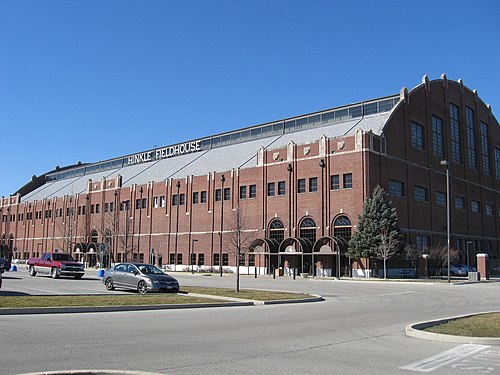
Built in 1928, the Butler Fieldhouse (renamed Hinkle Fieldhouse in 1966) is an architectural and athletic landmark located on the campus of Butler University in Indianapolis. Designed by prominent local architect Fermor Spencer Cannon, the colossal brick-faced structure was the largest basketball arena in the United States upon its completion, a title it held for more than two decades. The building's innovative design features a massive, barrel-vaulted roof supported by three-hinged steel arches, which eliminated the need for interior support pillars and provided unobstructed sightlines for up to 15,000 spectators. This pioneering engineering feat set a new standard for sports arena construction across the nation and stood as a physical monument to the soaring popularity of basketball in Indiana during the early twentieth century.
Beyond its architectural merit, the fieldhouse is deeply woven into the cultural fabric of Indiana as the historic cradle of "Hoosier Hysteria." For decades, it hosted the state's prestigious high school boys' basketball tournament, including the legendary 1954 "Milan Miracle" championship game that later inspired the film Hoosiers. During World War II, the facility was converted into a military barracks and training center for the U.S. Navy and Army Air Forces. Having hosted numerous political rallies, professional sports teams, and presidential visits, the arena was designated a National Historic Landmark in 1987. It remains one of the oldest active collegiate basketball venues in the country, symbolizing the enduring passion for the sport and serving as a living monument to American athletic history.










_from_War_Memorial_Plaza.jpg)


