Athens County Ohio has 28 places on the National Register of Historic Places including 1 place of National significance and 10 places of Statewide significance. Significant places include Manasseh Cutler Hall, Ohio University, Athens State Hospital, Blackwood Covered Bridge, Hocking Valley Coal Company Town Historic District and Hocking Valley Railway Historic District.
Prehistoric cultural affiliation(s) include Adena dating back to 999 BC.
Several famous people are associated with these Athens County historic places including William Holmes McGuffey, Daniel Stewart, Thomas J. Herrold and Daniel Weethee.
Some of the country's most noteable architects helped create the Athens County places including Hocking Valley Railway, Frank L. Packard, E.S. White, Bertram Goodhue, Charles A. Breining, William Mills, John Moser, Vorhees,W.H.,Co., Unkefer,John G.,& Co. and James Knox Taylor. Prominent architectural styles found in Athens Country are Colonial Revival, Italianate and Late Victorian.
Historic Significance:
Event
Area of Significance:
Education
Period of Significance:
1800-1824
Historic Function:
Education
Historic Sub-function:
College
Current Function:
Education
Current Sub-function:
College
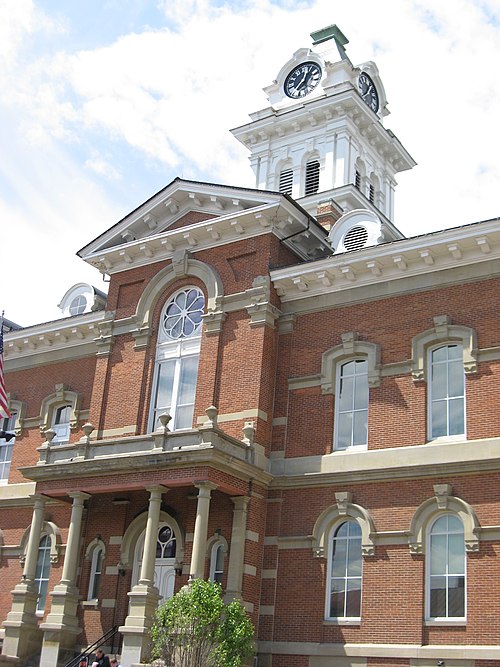
Manasseh Cutler Hall, constructed between 1816 and 1819 on the campus of Ohio University in Athens, Ohio, holds immense historical significance as the oldest building erected for higher education in the Northwest Territory. Originally known as the "College Edifice," the building stands as a physical manifestation of the Northwest Ordinance of 1787, which famously declared that "schools and the means of education shall forever be encouraged." It was later named in honor of Manasseh Cutler, a co-founder of Ohio University and a key drafter of the Ordinance. As the centerpiece of the university's historic College Green, Cutler Hall represents the pioneering spirit of early American higher education as it expanded westward beyond the original thirteen colonies.
Architecturally, Cutler Hall is an exceptional and highly preserved example of early 19th-century Federal-style institutional architecture. Built of locally fired red brick, the three-story building features a symmetrical design, a gabled roof, and a prominent central wooden cupola that houses a historic clock and bell. While the interior has been adapted over the decades to serve various functions-ranging from dormitories, classrooms, and a laboratory to its current role housing the university's administrative offices-the exterior remains a remarkably intact symbol of early Ohio history. Designated a National Historic Landmark in 1966, Cutler Hall continues to serve as the iconic focal point of Ohio University and a monument to the birth of public higher education in the United States.