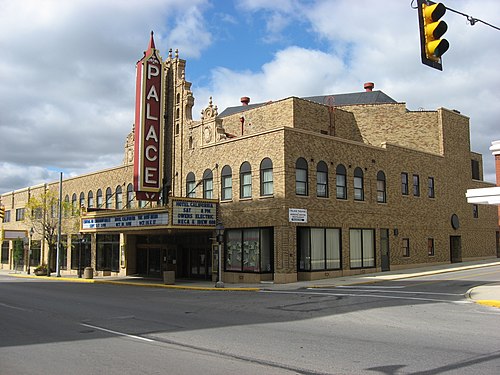
Marion County Ohio has 15 places on the National Register of Historic Places including 2 places of National significance and 3 places of Statewide significance. Significant places include Harding Tomb, Harding, Warren G., House, Caledonia Bowstring Bridge, Palace Theater and Wyatt's Tavern-Fort Morrow Site.
Several famous people are associated with these Marion County historic places including Warren G. Harding, Warren Gamaliel Harding and George W. King.
Some of the country's most noteable architects helped create the Marion County places including Henry Horbostel, John Eberson, Wrought Iron Bridge Co., D.W. Gibbs, W.C. Whitehead, Joseph Carabelli, Wilson Eyre, William Earl Russ, D.W. & Co. Gibbs and John W. Uncafer. Prominent architectural styles found in Marion Country are Classical Revival, Gothic and Italian Villa.
Historic Significance:
Person, Architecture/Engineering
Architect, builder, or engineer:
Horbostel,Henry
Architectural Style:
No Style Listed
Historic Person:
Harding,Warren G.
Significant Year:
1927, 1926
Area of Significance:
Politics/Government, Architecture
Period of Significance:
1925-1949
Historic Function:
Funerary
Historic Sub-function:
Graves/Burials
Current Function:
Funerary
Current Sub-function:
Graves/Burials
The Harding Tomb, listed on the National Register of Historic Places in 1976, is historically significant as the final resting place of Warren G. Harding, the 29th President of the United States, and his First Lady, Florence Kling Harding. Designed by the acclaimed architectural team of Henry Hornbostel and Eric Fisher Wood, the monument is a masterpiece of Neoclassical design. Constructed between 1926 and 1927 from white Georgia marble, the tomb is uniquely styled as an open-air circular cloister, resembling a Greek temple or tholos. Unlike most presidential tombs, which are enclosed mausoleums, the Harding Tomb features an open center where the two emerald pearl granite sarcophagi sit under a canopy of maple trees and a carpet of green ivy, symbolizing the late president's love for nature and the outdoors.
Beyond its architectural distinction, the monument holds profound cultural significance as a testament to the complex legacy of the Harding presidency and the public sentiment of the era. Following Harding's sudden death in office in 1923, the Harding Memorial Association raised nearly $1 million for the tomb's construction, largely through small, grassroots donations, including pennies contributed by over a million American school children. However, the subsequent exposure of the Teapot Dome and other administration scandals cast a pall over Harding's memory, delaying the monument's formal dedication. It was not until 1931 that President Herbert Hoover officially dedicated the memorial in a ceremony that acknowledged both Harding's personal warmth and the tragedies of his administration. Today, the Harding Tomb stands as a powerful monument to early 20th-century civic commemoration and a focal point for understanding a pivotal era in American political history.
Historic Significance:
Person
Historic Person:
Harding,Warren Gamaliel
Significant Year:
1923, 1891
Area of Significance:
Politics/Government, Military
Period of Significance:
1900-1924, 1875-1899
Historic Function:
Commerce/Trade, Domestic
Historic Sub-function:
Professional, Single Dwelling
Current Function:
Recreation And Culture
Current Sub-function:
Museum
The Warren G. Harding House, located at 380 Mount Vernon Avenue in Marion, Ohio, is of exceptional national significance as the primary residence of the 29th President of the United States during his formative political career. Designed by Harding and his fiance, Florence Kling, and completed in 1891 shortly after their marriage, the elegant Queen Anne-style home features a distinctive asymmetrical design, a prominent octagonal corner tower, and a spacious wrap-around front porch. The house served as the couple's home for nearly three decades, a pivotal period that saw Harding rise from the local editor and publisher of the Marion Daily Star to an Ohio State Senator, Lieutenant Governor, and ultimately a United States Senator.
The property gained its greatest historical fame during the presidential election of 1920, serving as the headquarters for Harding's highly successful "Front Porch Campaign." Eschewing extensive national travel, Harding remained at home and addressed more than 600,000 voters, journalists, and delegations who gathered on his spacious lawn, projecting a reassuring image of stable, small-town American "normalcy" in the tumultuous aftermath of World War I. This masterfully orchestrated campaign strategy culminated in a landslide victory, forever cementing the Marion residence as a landmark of American political history. Designated a National Historic Landmark in 1965 and formally listed on the National Register of Historic Places in 1966, the home is meticulously restored to its 1920 appearance and operates as a museum dedicated to preserving the legacy of President Harding and the First Lady.