Chelan County Washington has 48 places on the National Register of Historic Places including 5 places of National significance and 13 places of Statewide significance. Significant places include Chatter Creek Guard Station, Leavenworth Ranger Station, Rock Island Railroad Bridge, Stevens Pass Historic District and Wenatchee Flat Site.
Prehistoric cultural affiliation(s) include Native American dating back to 1000.
Many famous people are associated with these Chelan County historic places including D.A. Beal, Frank Lucas, Richard Hinton Lord, Michael Horan and W.T. Clark.
Some of the country's most noteable architects helped create the Chelan County places including USDA Forest Svce. Architecture Group, Civilian Conservation Corps, Great Northern Railway, Edge Moor Bridge Works, Bureau of Reclamation, Washington Water Power Co., US Steel Co. American Bridge Divisio, Puget Sound Bridge & Dredging Co., Frank Lucas and Washington Bridge Co.. Prominent architectural styles found in Chelan Country are Bungalow/Craftsman, Queen Anne and Beaux Arts.
Historic Significance:
Event, Architecture/Engineering
Architect, builder, or engineer:
Civilian Conservation Corps, USDA Forest Svce. Architecture Group
Architectural Style:
Other
Area of Significance:
Conservation, Politics/Government, Architecture
Period of Significance:
1925-1949
Historic Function:
Domestic
Historic Sub-function:
Camp, Secondary Structure, Single Dwelling
Current Function:
Domestic
Current Sub-function:
Camp, Secondary Structure, Single Dwelling
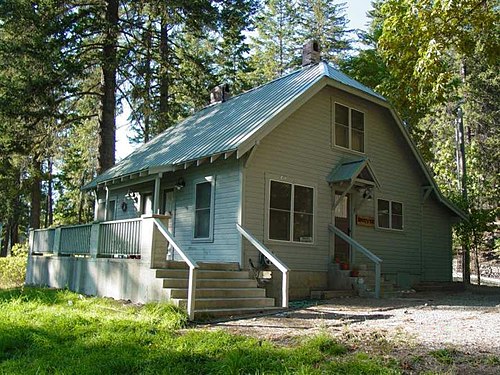
The Chatter Creek Guard Station, located in the Wenatchee National Forest along the scenic Icicle Creek corridor in Chelan County, Washington, is historically significant for its association with the expansion of the U.S. Forest Service and the conservation efforts of the Great Depression. Constructed between 1935 and 1936 by the Civilian Conservation Corps (CCC), the station served as a vital administrative outpost for forest management, fire detection, and trail maintenance in the rugged Cascade Range. The establishment of this station reflects the federal government's commitment to mobilizing unemployed youth to develop and protect the nation's public lands, marking a pivotal era in the administrative history of the Wenatchee National Forest.
Architecturally, the guard station is an outstanding and highly intact representation of the "U.S. Forest Service Rustic" design style, which was popularized and standardized during the 1930s. Designed to blend seamlessly with the surrounding natural environment, the building features wood-frame construction, rough-sawn horizontal siding, stone foundations, and hand-crafted details using local materials. This rustic aesthetic was intentionally employed to evoke a sense of pioneer ruggedness while minimizing the visual impact on the pristine forest landscape. Preserving its original design, workmanship, and wilderness setting, the Chatter Creek Guard Station stands as a tangible monument to the enduring legacy of the New Deal-era conservation program in the Pacific Northwest.
Historic Significance:
Event, Architecture/Engineering
Architect, builder, or engineer:
Civilian Conservation Corps, USDA Forest Svce. Architecture Group
Architectural Style:
Other
Area of Significance:
Conservation, Politics/Government, Architecture
Period of Significance:
1925-1949
Historic Function:
Commerce/Trade, Domestic, Government
Historic Sub-function:
Government Office, Secondary Structure, Single Dwelling, Warehouse
Current Function:
Commerce/Trade, Domestic, Government
Current Sub-function:
Government Office, Secondary Structure, Single Dwelling, Warehouse
The Leavenworth Ranger Station, located in Chelan County, Washington, is historically significant for its association with the expansion of the United States Forest Service (USFS) and federal conservation efforts in the Pacific Northwest during the early 20th century. Constructed primarily between 1936 and 1938, the station serves as a prominent example of the administrative infrastructure built during the Great Depression under the New Deal. Developed by the Civilian Conservation Corps (CCC) for the Wenatchee National Forest, the complex was vital in managing timber resources, fire prevention, and recreational development in the surrounding Cascade Mountains. Its construction reflects a transformative era when federal agencies rapidly modernized their facilities to handle increased public use and resource management.
Architecturally, the Leavenworth Ranger Station is highly significant as an outstanding representation of the USDA Forest Service "Rustic" style. Designed to blend harmoniously with the rugged natural landscape, the buildings feature natural materials such as local stone and wood, characterized by fine wood-shingle siding, exposed timber framing, and gable roofs. This cohesive design aesthetic was standardized by regional Forest Service architects to project a sense of permanence, craftsmanship, and environmental stewardship. The remarkably well-preserved complex stands as a physical testament to the high-quality craftsmanship of the CCC and remains an enduring landmark of 1930s federal conservation architecture.
Historic Significance:
Event, Architecture/Engineering
Architect, builder, or engineer:
Edge Moor Bridge Works
Architectural Style:
Other
Area of Significance:
Engineering, Transportation
Period of Significance:
1875-1899
Historic Function:
Transportation
Historic Sub-function:
Rail-Related
Current Function:
Transportation
Current Sub-function:
Rail-Related
The Rock Island Railroad Bridge, completed in 1893, holds monumental historical significance as the very first bridge to span the mighty Columbia River. Built by the Great Northern Railway under the vision of transcontinental railroad magnate James J. Hill, this critical crossing was the final link in the railway's mainline connecting St. Paul, Minnesota, to Puget Sound. Before its completion, the lack of a permanent crossing over the high-volume river was a major logistical bottleneck for westward expansion. By bridging the Columbia, the Great Northern successfully integrated the agricultural and timber resources of the Pacific Northwest into the national economy, fostering rapid growth and development throughout Douglas and Chelan counties.
Engineered by the firm of Lacy R. Jacoby and constructed by the Edge Moor Bridge Works, the original structure was an impressive pin-connected steel cantilever truss. As rail traffic grew and locomotives became significantly heavier, the bridge became the site of a remarkable engineering feat in 1925. Rather than halting vital transcontinental traffic to build a new crossing, engineers successfully erected a stronger, modern continuous steel truss bridge directly around and through the existing 1893 framework. Listed on the National Register of Historic Places in 1975, the Rock Island Railroad Bridge stands as a testament to the golden age of American railroading and remains a vital, active monument to industrial engineering.
Historic Significance:
Event, Architecture/Engineering
Architect, builder, or engineer:
Great Northern Railway
Area of Significance:
Engineering, Transportation, Commerce, Social History, Communications
Period of Significance:
1900-1924, 1875-1899
Historic Function:
Transportation
Historic Sub-function:
Rail-Related
Current Function:
Agriculture/Subsistence, Transportation
The Stevens Pass Historic District, spanning the rugged Cascade Range between Chelan and King counties, stands as a monument to one of the most formidable engineering triumphs in American railroad history. Designated to preserve the original route of the Great Northern Railway, the district commemorates the vision of railroad tycoon James J. Hill and his chief engineer, John F. Stevens, who located the low mountain pass in 1890. Completed in 1893, the initial crossing utilized a dizzying system of eight high-elevation switchbacks to move trains over the summit. To bypass these steep and dangerous grades, workers undertook the grueling construction of the original 2.7-mile Cascade Tunnel, which opened in 1900. The district encapsulates this dramatic struggle to conquer the Pacific Northwest's geographic barriers, serving as a physical record of the late 19th-century race to connect the Puget Sound with transcontinental commerce.
In addition to its engineering prowess, the district is deeply tied to one of the nation's worst transportation tragedies and the subsequent evolution of railway safety. On March 1, 1910, near the townsite of Wellington on the west side of the pass, a massive avalanche swept two snowbound trains down the mountain, killing 96 people in the deadliest avalanche in United States history. This disaster prompted the Great Northern Railway to build miles of massive concrete snowsheds and eventually abandon the entire high-elevation route in 1929 upon the completion of the new 7.8-mile Cascade Tunnel. Today, the abandoned right-of-way, preserved within the Mt. Baker-Snoqualmie and Okanogan-Wenatchee National Forests, has been repurposed as the Iron Goat Trail. The district remains a evocative landscape of concrete ruins, historic portals, and interpretive trails that reflect both the triumph and the tragedy of early transcontinental railroading.
Historic Significance:
Information Potential
Area of Significance:
Prehistoric, Historic - Aboriginal
Cultural Affiliation:
Native American
Period of Significance:
1900-1750 AD, 1749-1500 AD, 1499-1000 AD
Historic Function:
Domestic
Historic Sub-function:
Village Site
Current Function:
Agriculture/Subsistence
The Wenatchee Flat Site, listed on the National Register of Historic Places in 1973, is an archaeologically significant area located in Chelan County, Washington, near the strategically important confluence of the Wenatchee and Columbia rivers. This site serves as a vital preservation of pre-contact Native American habitation, specifically associated with the ancestral Wenatchi (P'squosa) people and other Indigenous groups of the Columbia Plateau. For millennia, the river terraces of the Wenatchee Flat offered an ideal geographic setting for seasonal encampments, where native populations gathered to harvest salmon, hunt game, and gather roots and berries. The site represents a crucial node in the regional network of resource extraction, cultural exchange, and permanent or semi-permanent settlement.
As an archaeological resource listed under Criterion D, the Wenatchee Flat Site possesses immense scientific value for its potential to yield critical information regarding the prehistory of the Pacific Northwest. Investigations of the site and its surrounding deposits have revealed valuable material culture, including lithic tools, projectile points, hearths, and organic remains that document the subsistence strategies, technological adaptations, and trade networks of the region's early inhabitants. The site provides researchers with an undisturbed window into the chronological development of Plateau culture and underscores the profound, enduring relationship between the Indigenous peoples of the Columbia Basin and their riverine environment.