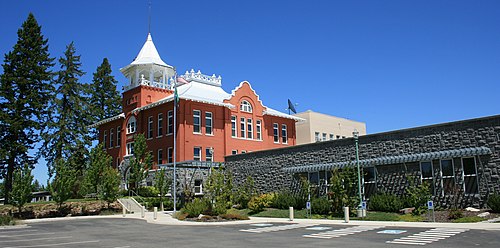
Douglas County Washington has 15 places on the National Register of Historic Places including 2 places of National significance and 3 places of Statewide significance. Significant places include Pangborn-Herndon Memorial Site, Rock Island Railroad Bridge, Badger Mountain Lookout, Douglas County Courthouse and Gallaher House.
The famous person William J. Canton is associated with one of more of the Douglas County historic places.
Some of the country's most noteable architects helped create the Douglas County places including Edge Moor Bridge Works, Walter Graham, Newton C. Gauntt, Civilian Conservation Corps, James Kinney, C. Schmidt, Washington State Department of Hwys, Bell & Haskins, J.C. Calhoun and Calhoun & Bell. Prominent architectural styles found in Douglas Country are Bungalow/Craftsman, Late Victorian and Mission/Spanish Revival.
Historic Significance:
Event
Area of Significance:
Transportation
Period of Significance:
1925-1949
Historic Function:
Transportation
Historic Sub-function:
Air-Related
Current Function:
Recreation And Culture
Current Sub-function:
Monument/Marker
The Pangborn-Herndon Memorial Site, perched on a high basalt bluff overlooking East Wenatchee and the Columbia River, commemorates one of the greatest milestones in aviation history: the first non-stop transpacific flight. On October 5, 1931, American aviators Clyde Pangborn and Hugh Herndon Jr. successfully crash-landed their Bellanca CH-400 Skyrocket, Miss Veedol, on the sagebrush-covered hills of Douglas County. Having departed from Misawa, Japan, 41 hours and 13 minutes earlier, the pilots had deliberately jettisoned their landing gear over the Pacific Ocean to reduce drag and conserve fuel. Their daring belly-landing at Fancher Field completed a perilous 4,800-mile journey, proving that transoceanic air travel between Asia and North America was possible and forever linking the Wenatchee Valley with the golden age of aviation.
Listed on the National Register of Historic Places in 1972, the memorial site serves as a permanent tribute to the courage, skill, and ingenuity of Pangborn and Herndon. The site features a striking basalt monument designed to evoke the wing of an airplane, oriented toward the landing zone and offering panoramic views of the valley below. As a site of national and international significance, it preserves the physical landscape where this historic flight concluded, honoring an achievement that captured the world's imagination and dramatically advanced the progress of global commercial aviation.
Historic Significance:
Event, Architecture/Engineering
Architect, builder, or engineer:
Edge Moor Bridge Works
Architectural Style:
Other
Area of Significance:
Engineering, Transportation
Period of Significance:
1875-1899
Historic Function:
Transportation
Historic Sub-function:
Rail-Related
Current Function:
Transportation
Current Sub-function:
Rail-Related
The Rock Island Railroad Bridge, completed in 1893, holds monumental historical significance as the very first bridge to span the mighty Columbia River. Built by the Great Northern Railway under the vision of transcontinental railroad magnate James J. Hill, this critical crossing was the final link in the railway's mainline connecting St. Paul, Minnesota, to Puget Sound. Before its completion, the lack of a permanent crossing over the high-volume river was a major logistical bottleneck for westward expansion. By bridging the Columbia, the Great Northern successfully integrated the agricultural and timber resources of the Pacific Northwest into the national economy, fostering rapid growth and development throughout Douglas and Chelan counties.
Engineered by the firm of Lacy R. Jacoby and constructed by the Edge Moor Bridge Works, the original structure was an impressive pin-connected steel cantilever truss. As rail traffic grew and locomotives became significantly heavier, the bridge became the site of a remarkable engineering feat in 1925. Rather than halting vital transcontinental traffic to build a new crossing, engineers successfully erected a stronger, modern continuous steel truss bridge directly around and through the existing 1893 framework. Listed on the National Register of Historic Places in 1975, the Rock Island Railroad Bridge stands as a testament to the golden age of American railroading and remains a vital, active monument to industrial engineering.