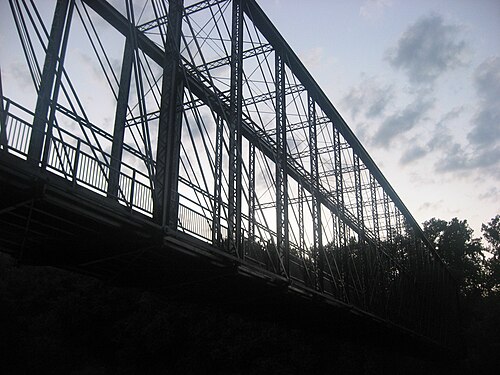
Dearborn County Indiana (Vacant / Not In Use) has 2 places on the National Register of Historic Places including 1 place of National significance and 1 place of Statewide significance. Significant places include Jennison Guard Site and Laughery Creek Bridge.
Prehistoric cultural affiliation(s) include Fort Ancient dating back to 1000.
Some of the country's most noteable architects helped create the Dearborn County places including William & Co. Green and Wrought Iron Bridge Company. Prominent architectural styles found in Dearborn Country are .
Historic Significance:
Information Potential
Area of Significance:
Prehistoric
Cultural Affiliation:
Fort Ancient
Period of Significance:
1499-1000 AD
Historic Function:
Domestic
Historic Sub-function:
Village Site
Current Function:
Agriculture/Subsistence, Vacant/Not In Use
The Jennison Guard Site, designated archaeologically as 12D29, is a premier prehistoric archaeological site located near the confluence of the Great Miami and Ohio Rivers in Dearborn County, Indiana. Listed on the National Register of Historic Places in 1975, the site represents a major, well-preserved village of the Fort Ancient culture, dating primarily to the late prehistoric period between approximately A.D. 1000 and 1300. Because it was buried under thick layers of alluvial silt deposited by seasonal flooding, the site was shielded from the destructive effects of modern agriculture and looting. This exceptional preservation makes the Jennison Guard Site one of the most significant and intact examples of a Fort Ancient settlement in the middle Ohio River Valley.
Archaeological investigations at the site have yielded a wealth of information regarding prehistoric Native American life, revealing a classic circular village layout complete with a central plaza, surrounding residential zones, and domestic refuse middens. Excavations have uncovered postmold patterns delineating rectangular wall-trench houses, deep storage pits, and hearths, alongside an abundant assemblage of diagnostic pottery, shell hoes, triangular stone projectile points, and bone tools. The exceptional preservation of organic remains, including faunal bones and carbonized plant seeds, has provided researchers with invaluable data to reconstruct the subsistence strategies, agricultural practices, social organization, and regional trade networks of the region's late prehistoric inhabitants.