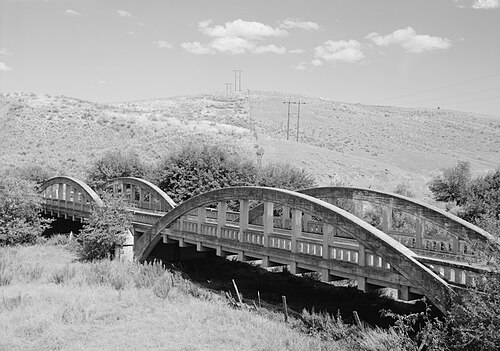
Asotin County Washington has 9 places on the National Register of Historic Places including 2 places of National significance and 3 places of Statewide significance. Significant places include Snake River Archeological District, Van Arsdol, C. C., House, Indian Timothy Memorial Bridge, Nez Perce Snake River Archeological District and US Post Office--Clarkston Main.
Prehistoric cultural affiliation(s) include Nez Perce, Numipu and Salishan dating back to 6999 BC.
The famous person Cassius C. Van Arsdol is associated with one of more of the Asotin County historic places.
Some of the country's most noteable architects helped create the Asotin County places including J.D. McGovern, Washington St. Dept. of Transportion, Louis A. Simon, Henry Howard, Washington State Highway Dept. and Henry Hagman. Prominent architectural styles found in Asotin Country are Colonial Revival, Early Commercial and Gothic.
Historic Significance:
Information Potential
Area of Significance:
Historic - Aboriginal, Prehistoric
Cultural Affiliation:
Numipu, Salishan, Nez Perce
Period of Significance:
5000-6999 BC, 3000-4999 BC, 1900-1750 AD, 1749-1500 AD, 1499-1000 AD, 1000-2999 BC, 1000 AD-999 BC
Historic Function:
Domestic, Funerary, Recreation And Culture
Historic Sub-function:
Camp, Graves/Burials, Village Site, Work Of Art (Sculpture, Carving, Rock Art)
Current Function:
Agriculture/Subsistence
The Snake River Archeological District, listed on the National Register of Historic Places in 1976, is a highly significant cultural resource area spanning the rugged canyon lands of the Snake River in Asotin County, Washington, and extending into neighboring Idaho. This expansive district encompasses a dense concentration of archaeological sites that document over 10,000 years of continuous human occupation, primarily associated with the ancestral Nez Perce (Nimiipuu) people and their predecessors. The river corridor served as a vital economic, social, and spiritual artery, and the district's preserved sites-including semi-subterranean housepit villages, seasonal fishing camps, tool manufacturing workshops, and resource processing areas-offer an unparalleled record of how indigenous populations successfully adapted to the diverse riverine and upland environments of the Columbia Plateau.
Beyond its domestic and utilitarian sites, the district is highly regarded for its rich spiritual and artistic legacy, highlighted by numerous rock art panels featuring both petroglyphs and pictographs carved and painted onto the basalt canyon walls. These sacred sites, alongside sensitive burial grounds, underscore the deep, enduring cultural and spiritual connection of the Nez Perce Tribe to this landscape. As one of the most archaeologically diverse and well-preserved river canyon districts in the Pacific Northwest, the Snake River Archeological District continues to yield invaluable scientific data regarding prehistoric settlement patterns, technological innovations, trade networks, and long-term environmental changes in the region.
Historic Significance:
Person
Historic Person:
Van Arsdol,Cassius C.
Significant Year:
1903, 1914, 1882
Area of Significance:
Engineering, Transportation, Agriculture
Period of Significance:
1900-1924, 1875-1899
Historic Function:
Domestic
Historic Sub-function:
Single Dwelling
Current Function:
Vacant/Not In Use
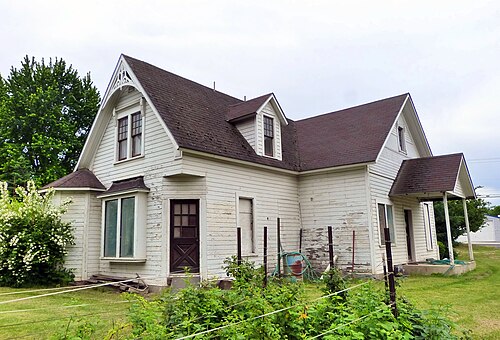
The Cassius C. Van Arsdol House, constructed in 1901 in Clarkston, Washington, is architecturally significant as an exceptional local transition between the late Victorian and early Craftsman styles. Situated on a scenic bluff overlooking the Snake River, the residence features a robust foundation constructed of local basalt, rustic shingle siding, and asymmetrical massing. Its design is characterized by broad, sweeping eaves and expansive covered porches that integrate the structure with its natural surroundings, reflecting the burgeoning early 20th-century aesthetic that favored native materials and organic integration. The home stands as a remarkably well-preserved monument to the early residential development of Asotin County during a pivotal era of regional expansion.
Historically, the property is highly significant for its direct association with its builder and namesake, Cassius Columbus Van Arsdol, one of the Pacific Northwest's most influential civil engineers. Van Arsdol played a monumental role in shaping the infrastructure of the Inland Empire he surveyed challenging railway passages through the Rocky and Cascade mountains for the Northern Pacific Railroad, directed the construction of the vital Lewiston-Clarkston bridge, and engineered the sophisticated irrigation networks that transformed the arid valley into a productive agricultural paradise. Serving as his personal residence during the height of his career, the house stands as a physical testament to a pioneer engineer whose masterworks laid the foundation for the modern economic and physical landscape of Asotin County.