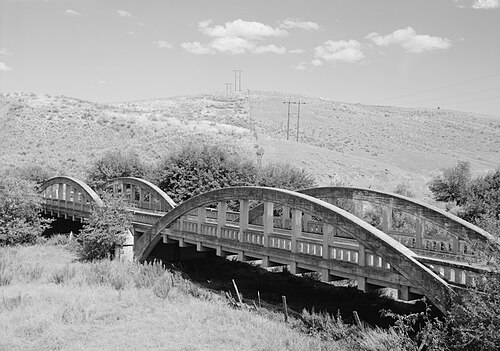
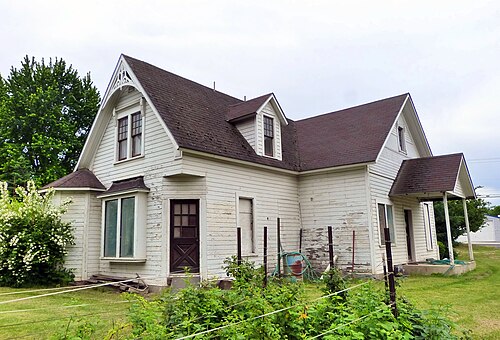
Asotin County Washington (Vacant / Not In Use) has 2 places on the National Register of Historic Places including 1 place of National significance and 1 place of Statewide significance. Significant places include Van Arsdol, C. C., House and Indian Timothy Memorial Bridge.
The famous person Cassius C. Van Arsdol is associated with one of more of the Asotin County historic places.
Some of the country's most noteable architects helped create the Asotin County places including Washington St. Dept. of Transportion. Prominent architectural styles found in Asotin Country are .
Historic Significance:
Person
Historic Person:
Van Arsdol,Cassius C.
Significant Year:
1903, 1914, 1882
Area of Significance:
Engineering, Transportation, Agriculture
Period of Significance:
1900-1924, 1875-1899
Historic Function:
Domestic
Historic Sub-function:
Single Dwelling
Current Function:
Vacant/Not In Use
The Cassius C. Van Arsdol House, constructed in 1901 in Clarkston, Washington, is architecturally significant as an exceptional local transition between the late Victorian and early Craftsman styles. Situated on a scenic bluff overlooking the Snake River, the residence features a robust foundation constructed of local basalt, rustic shingle siding, and asymmetrical massing. Its design is characterized by broad, sweeping eaves and expansive covered porches that integrate the structure with its natural surroundings, reflecting the burgeoning early 20th-century aesthetic that favored native materials and organic integration. The home stands as a remarkably well-preserved monument to the early residential development of Asotin County during a pivotal era of regional expansion.
Historically, the property is highly significant for its direct association with its builder and namesake, Cassius Columbus Van Arsdol, one of the Pacific Northwest's most influential civil engineers. Van Arsdol played a monumental role in shaping the infrastructure of the Inland Empire he surveyed challenging railway passages through the Rocky and Cascade mountains for the Northern Pacific Railroad, directed the construction of the vital Lewiston-Clarkston bridge, and engineered the sophisticated irrigation networks that transformed the arid valley into a productive agricultural paradise. Serving as his personal residence during the height of his career, the house stands as a physical testament to a pioneer engineer whose masterworks laid the foundation for the modern economic and physical landscape of Asotin County.