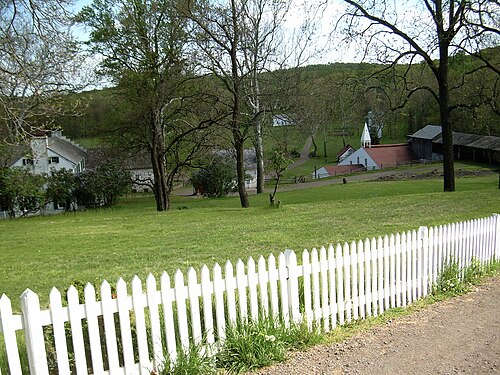
Chester County Pennsylvania (Historic Districts) has 50 places on the National Register of Historic Places including 6 places of National significance and 5 places of Statewide significance. Significant places include Chester Springs Historic District, Coventryville Historic District, Dilworthtown Historic District, Hopewell Furnace National Historic Site and Longwood Gardens District.
Several famous people are associated with these Chester County historic places including Rebecca Webb Penncock Lukens, Emmor Kimber and Abraham Marshall.
Some of the country's most noteable architects helped create the Chester County places including Cope & Stewardson, Pierre S. Dupont, McIlvain & Roberts, Abraham Hamor, George Aman, Milton Medary, Robeson Lea Perot, Mordecai Hayes, B.H. Downing and E.William Martin. Prominent architectural styles found in Chester Country are Federal, Georgian and Colonial Revival.
Historic Significance:
Architecture/Engineering, Event
Architect, builder, or engineer:
Unknown
Architectural Style:
No Style Listed
Area of Significance:
Art, Architecture, Military, Social History
Period of Significance:
1825-1849, 1800-1824
Historic Function:
Education, Health Care
Historic Sub-function:
Resort, School
Current Function:
Commerce/Trade, Domestic
The Chester Springs Historic District, historically known as Yellow Springs and located in West Pikeland Township, Chester County, Pennsylvania, is a site of immense national significance spanning over two centuries of American history. Originally revered by Native Americans for its healing mineral waters, the site developed into a fashionable spa resort in the mid-18th century, drawing visitors seeking health and recreation. Its prominence grew dramatically during the American Revolutionary War when General George Washington commissioned the construction of the Yellow Springs Hospital on the property in 1777. As the only purpose-built military hospital of the Revolution, it treated thousands of sick and wounded Continental soldiers, particularly during and after the nearby Valley Forge encampment, and was visited by Washington himself.
Following the war, the property resumed its role as a premier health resort through the antebellum era, boasting grand hotels and bathhouses that hosted prominent figures of the early republic. In 1868, the site transitioned to an educational and humanitarian mission as the Chester Springs Soldiers' Orphan School, which housed and educated the children of Civil War veterans until 1912. The site's cultural legacy was further enriched in 1916 when the Pennsylvania Academy of the Fine Arts acquired it for its country summer school, fostering generations of prominent American artists until 1952. Later serving as a film studio for Good News Productions-where the 1958 cult classic The Blob was partially filmed-the district survives today as Historic Yellow Springs, a remarkably preserved village that chronicles the evolution of American wellness, military medicine, education, and the arts.
Historic Significance:
Event, Architecture/Engineering
Architect, builder, or engineer:
Unknown
Architectural Style:
No Style Listed
Area of Significance:
Military, Architecture, Commerce
Period of Significance:
1850-1874, 1700-1749
Historic Function:
Commerce/Trade, Domestic, Social
Historic Sub-function:
Meeting Hall, Restaurant, Single Dwelling, Specialty Store
Current Function:
Commerce/Trade, Domestic, Vacant/Not In Use
Current Sub-function:
Single Dwelling
The Dilworthtown Historic District, situated in Birmingham and Thornbury Townships in Chester County, Pennsylvania, is a remarkably well-preserved 18th-century crossroads hamlet of profound historical and military significance. Settled by English Quakers in the early 1700s, the village developed around the intersection of Brinton's Bridge Road and Wilmington-West Chester Pike, largely on land purchased by James Dilworth in 1718. The district gained national prominence during the American Revolutionary War as a focal point of the Battle of Brandywine on September 11, 1777. Following the intense engagement, British and Hessian forces occupied the village, and several local structures-most notably the Dilworthtown Inn-were requisitioned as field hospitals to treat the wounded of both armies, forever linking the hamlet to one of the largest land battles of the war.
Architecturally, the district stands as an exceptional representation of southeastern Pennsylvania's early stone vernacular style, reflecting the agrarian prosperity of the Quaker settlers. The focal point of the district is the Dilworthtown Inn, a two-and-a-half-story stone tavern erected around 1758 by Charles Dilworth, which served as a vital social and commercial hub for travelers and locals alike. Complementing the inn are several well-preserved 18th- and early 19th-century structures, including stone residences, a former schoolhouse, and a blacksmith/wheelwright shop. Collectively, these buildings retain a high degree of architectural integrity, offering a cohesive visual record of a colonial-era transportation and trade nexus that has survived amidst modern suburban development.
Historic Significance:
Event, Architecture/Engineering
Architect, builder, or engineer:
Multiple
Architectural Style:
No Style Listed
Area of Significance:
Architecture, Military, Industry
Period of Significance:
1875-1899, 1850-1874, 1825-1849, 1800-1824, 1750-1799
Historic Function:
Domestic, Industry/Processing/Extraction
Historic Sub-function:
Manufacturing Facility, Village Site
Current Function:
Recreation And Culture
Current Sub-function:
Museum
Established in 1771 by ironmaster Mark Bird, Hopewell Furnace National Historic Site stands as one of the finest and most complete surviving examples of an American "iron plantation." Located in Berks County, Pennsylvania, this cold-blast, charcoal-fueled iron enterprise played a pivotal role in the early industrial development of the United States. During the American Revolutionary War, the furnace served as a vital patriotic asset, manufacturing cannons and shot for the Continental Army. Throughout its era of operation, which lasted until 1883, the furnace produced pig iron and a variety of cast-iron consumer goods, most notably the widely distributed Hopewell stoves. The site represents a crucial transitional phase in American history, marking the shift from a rural, agrarian economy to a highly organized, resource-intensive industrial system.
The significance of Hopewell Furnace extends beyond its industrial technology to its preservation of an intact, self-contained company town. The historic site encompasses a remarkably preserved cultural landscape that includes the central stone blast furnace, the waterwheel-powered blowing engine, the ironmaster's mansion, tenant houses, a company store, and support structures like the blacksmith shop and barn. This cohesive community layout illustrates the paternalistic social hierarchy and daily lives of the diverse workforce-including skilled founders, molders, woodcutters, and colliers-who lived and labored on the plantation. Listed on the National Register of Historic Places in 1966, Hopewell Furnace remains a premier educational resource for the study of early American technology, labor relations, and rural industrial life.
Historic Significance:
Architecture/Engineering, Event
Architect, builder, or engineer:
Et al., Dupont,Pierre S.
Architectural Style:
Federal
Area of Significance:
Conservation, Architecture, Landscape Architecture, Agriculture
Period of Significance:
1900-1924, 1700-1749
Historic Function:
Domestic, Landscape, Recreation And Culture, Religion
Historic Sub-function:
Forest, Hotel, Outdoor Recreation, Religious Structure, Single Dwelling
Current Function:
Domestic, Landscape, Recreation And Culture
Current Sub-function:
Forest, Outdoor Recreation, Single Dwelling
Listed on the National Register of Historic Places in 1972, the Longwood Gardens District in Chester County, Pennsylvania, holds national significance as one of the country's premier historic estate gardens and arboretums. The property's history dates back to 1700 when the Peirce family purchased the land from William Penn's commissioners. In 1798, twin brothers Joshua and Samuel Peirce began planting an arboretum, known as Peirce's Park, which featured an exceptional collection of native and exotic trees. By the mid-19th century, it boasted one of the finest collections of woody plants in the United States. The historic core of the district includes the Peirce-du Pont House, a federal-style brick home originally constructed in 1730 and subsequently expanded, which stands as a testament to the property's early agricultural and conservationist roots.
The district's modern transformation began in 1906 when industrialist and philanthropist Pierre S. du Pont purchased the property to save the historic arboretum from being cleared for lumber. Under du Pont's vision and design, the estate was transformed into a world-class public garden blending English, French, and Italian landscape traditions. Notable contributing resources within the district include the monumental Conservatory, completed in 1921, which remains an engineering and horticultural marvel the 1913 Open-Air Theatre the Italian Water Garden and a series of complex fountain systems that showcase early 20th-century technology. Today, the Longwood Gardens District stands as an extraordinary monument to American estate gardening, botanical conservation, and the philanthropic legacy of Pierre S. du Pont.