Pacific County Washington (Historic Districts) has 2 places on the National Register of Historic Places including 1 place of National significance and 1 place of Statewide significance. Significant places include Cape Disappointment Historic District and Oysterville Historic District.
The famous person Robert Hamilton Espy is associated with one of more of the Pacific County historic places. Prominent architectural styles found in Pacific Country are Gothic Revival.
Historic Significance:
Information Potential, Event
Area of Significance:
Historic - Non-Aboriginal, Engineering, Transportation, Military, Commerce, Communications
Cultural Affiliation:
American
Period of Significance:
1900-1924, 1875-1899, 1850-1874, 1800-1824
Historic Function:
Defense, Transportation
Historic Sub-function:
Fortification, Water-Related
Current Function:
Landscape, Transportation
Current Sub-function:
Park, Water-Related
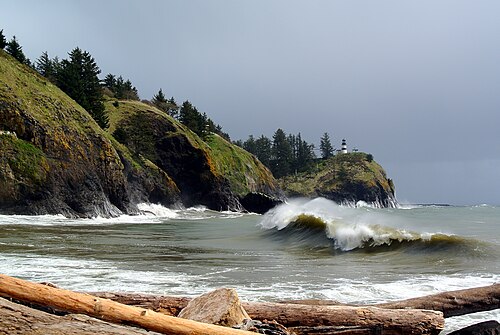
Situated at the extreme southwestern tip of Washington state where the Columbia River meets the Pacific Ocean, the Cape Disappointment Historic District is of outstanding national significance for its associations with early exploration, maritime transportation, and military history. The cape was a pivotal landmark for maritime fur traders, Spanish and English explorers, and most notably, the Lewis and Clark Expedition, which reached this destination in November 1805, marking the successful completion of their transcontinental journey. Officially listed on the National Register of Historic Places in 1975, the district encompasses a dramatic landscape that has played a vital role in the commercial and political development of the Pacific Northwest.
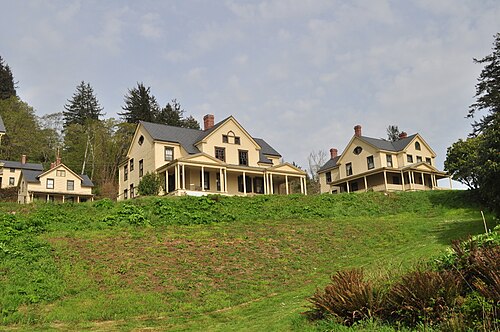
The district's built environment reflects over a century of maritime safety and coastal defense efforts. It features the Cape Disappointment Lighthouse, constructed in 1856 as the oldest operating lighthouse in the Pacific Northwest, and the North Head Lighthouse, built in 1898 to provide additional guidance through the treacherous waters known as the "Graveyard of the Pacific." Additionally, the district contains the remnants of Fort Canby (originally Fort Cape Disappointment), established during the Civil War to protect the mouth of the Columbia River and later expanded during World Wars I and II. Together, these historic structures and defense installations document the evolution of federal efforts to secure and facilitate commerce along one of the nation's most crucial and dangerous waterways.