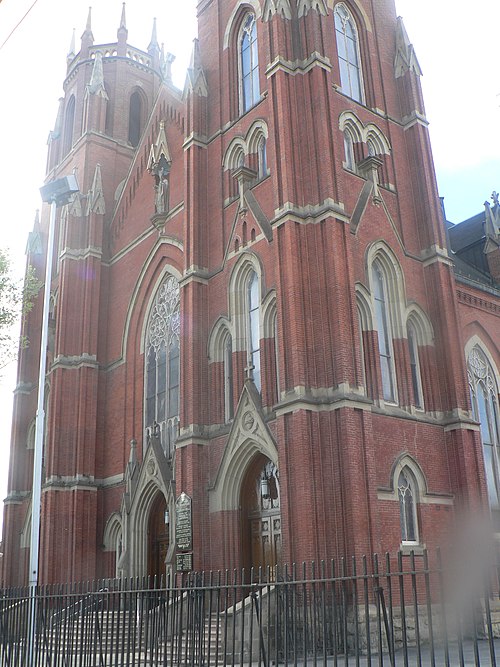
Cuyahoga County Ohio (Page 8) has 50 places on the National Register of Historic Places including 2 places of National significance and 2 places of Statewide significance. Significant places include USS COD (submarine), Union Terminal Group, Superior Avenue Viaduct and Tinkers Creek Aqueduct and St. Stanislaus Church.
Prehistoric cultural affiliation(s) include Late Archaic, Early Late Woodland and Late Woodland Period dating back to 1999 BC.
Many famous people are associated with these Cuyahoga County historic places including Sophia Strong Taylor, Clayton Townes, John Stoughton Strong, George R. Canfield and Joseph Stoneman.
Some of the country's most noteable architects helped create the Cuyahoga County places including Electric Boat Co., Walker & Weeks, Graham,Anderson,Probst & White, E.W. Ensign, B.F. Morse, unknown, Charles F. Schweinfurth, Cudell & Richardson, Charles R. Greco and W.A. Thorp. Prominent architectural styles found in Cuyahoga Country are Italianate, Classical Revival and Gothic.
Historic Significance:
Event
Area of Significance:
Military
Period of Significance:
1925-1949
Historic Function:
Defense, Transportation
Historic Sub-function:
Naval Facility, Water-Related
Current Function:
Recreation And Culture
Current Sub-function:
Museum
Commissioned in 1943, the USS Cod (SS-224) is a Gato-class fleet submarine that served with distinction in the Pacific Theater during World War II. Over the course of seven combat patrols, the Cod sank more than a dozen Japanese vessels, totaling over 27,000 tons of enemy shipping, and damaged many others. The vessel's most legendary exploit occurred in July 1945, when she performed history's first international submarine-to-submarine rescue, saving the crew of the grounded Dutch submarine O-19 in the South China Sea. After the war, the submarine served as a training vessel in the Great Lakes before being decommissioned and eventually opened as a memorial and museum ship in Cleveland, Ohio, in 1976.
The USS Cod is of exceptional national significance as one of the best-preserved and least-modified World War II fleet submarines remaining in existence. Unlike other surviving fleet boats that underwent post-war modernization, the Cod retains her wartime configuration, offering an authentic representation of the living and working conditions endured by American submariners. Crucially, the vessel's hull has never been breached to install doors or stairways for public access visitors still enter and exit the submarine using her original vertical ladders and hatches. Designated a National Historic Landmark in 1986, the USS Cod stands as a pristine engineering monument to the American industrial mobilization and the naval strategy that proved pivotal to victory in the Pacific.
Historic Significance:
Event, Architecture/Engineering
Architect, builder, or engineer:
Graham,Anderson,Probst & White, Walker & Weeks
Architectural Style:
Art Deco, Beaux Arts
Area of Significance:
Commerce, Transportation, Community Planning And Development, Architecture
Period of Significance:
1925-1949, 1900-1924
Historic Function:
Commerce/Trade, Domestic, Government, Transportation
Historic Sub-function:
Business, Hotel, Post Office, Rail-Related
Current Function:
Commerce/Trade, Domestic, Government, Transportation
Current Sub-function:
Business, Hotel, Post Office, Rail-Related
The Union Terminal Group, dominated by the iconic 52-story Terminal Tower, stands as an extraordinary monument to early 20th-century architecture, engineering, and urban planning. Constructed between 1926 and 1930, the massive Beaux-Arts and Neoclassical complex was designed by the prominent Chicago architectural firm Graham, Anderson, Probst & White under the direction of the visionary real estate developers Oris P. and Mantis J. Van Sweringen. Rising 708 feet over Cleveland's historic Public Square, the Terminal Tower was the tallest building in the world outside of New York City until 1953, serving as a soaring visual symbol of Cleveland's industrial and economic prosperity. The complex unified a monumental railway terminal with a vast array of office, retail, hotel, and civic spaces, defining the city's skyline and creating a cohesive, grand entryway to the city.
Beyond its architectural grandeur, the Union Terminal Group is historically significant as a pioneering, world-class model of transit-oriented, mixed-use development. Conceived to connect the Van Sweringen brothers' planned suburban enclave of Shaker Heights to the downtown core, the complex integrated local rapid transit lines and national steam railroads into a single centralized hub. This innovative "city within a city" concept allowed commuters to transition seamlessly from trains to offices, department stores, and the Hotel Cleveland without ever stepping outside. As an engineering marvel of its era, the project required the excavation of millions of cubic yards of soil and the demolition of dozens of historic buildings, ultimately reshaping the physical and economic geography of downtown Cleveland and establishing a national precedent for modern urban transit planning.












_-_exterior_photographed_from_A_Christmas_Story_House_property.jpg)


.jpg)


.jpg)


