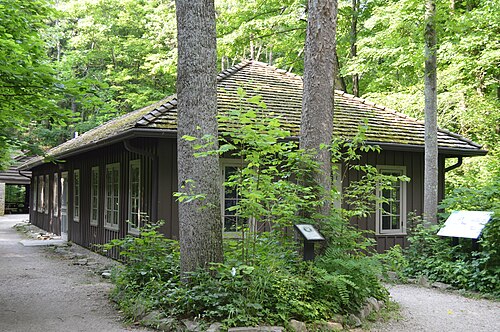
Owen County Indiana (Vacant / Not In Use) has 2 places on the National Register of Historic Places including 1 place of National significance and 1 place of Statewide significance. Significant places include New Albany and Salem Railroad Station and CCC Recreation Building--Nature Museum.
Some of the country's most noteable architects helped create the Owen County places including Civilian Conservation Corps (CCC). Prominent architectural styles found in Owen Country are .
Historic Significance:
Event, Architecture/Engineering
Architectural Style:
No Style Listed
Area of Significance:
Commerce, Transportation, Architecture
Period of Significance:
1850-1874
Historic Function:
Transportation
Historic Sub-function:
Rail-Related
Current Function:
Vacant/Not In Use
The New Albany and Salem Railroad Station in Gosport, Indiana, is historically significant as one of the oldest surviving wooden passenger and freight depots in the state. Constructed circa 1854 by the New Albany and Salem Railroad-which was later renamed the iconic Monon Railroad-the station was instrumental in the early economic and physical development of Owen County and southern Indiana. As the railroad pushed northward to connect the Ohio River at New Albany with Lake Michigan, Gosport emerged as a vital transit hub. The depot served as a crucial shipping point for local agricultural goods, livestock, and timber from the surrounding White River valley, symbolizing the transformative impact of steam-powered transportation on rural Midwestern commerce during the mid-19th century.
Architecturally, the station is a remarkably intact example of early railroad vernacular design. The simple, one-story rectangular frame building features a gabled roof and is characterized by its distinctive board-and-batten siding, a hallmark of mid-19th-century utilitarian structures. Situated near the junction of the New Albany and Salem and the Indianapolis and Vincennes railroads, the depot was designed for practical utility, featuring wide overhanging eaves supported by brackets to shield waiting passengers and transferred freight from the elements. Its inclusion on the National Register of Historic Places in 1976 honors its architectural rarity and its pivotal role in integrating Owen County into the broader national market economy.