Marion County Indiana (Historic Districts) has 50 places on the National Register of Historic Places including 6 places of National significance and 11 places of Statewide significance. Significant places include Crown Hill Cemetery, Fort Benjamin Harrison Historic District, Indianapolis Motor Speedway, Indianapolis Park and Boulevard System and Lockerbie Square Historic District.
Many famous people are associated with these Marion County historic places including Lilly, Josiah Kirby, Jr, Percival; Olmstead Brothe Gallagher, Benjamin Harrison, David Maclean Parry and Margaret Weymouth Jackson.
Some of the country's most noteable architects helped create the Marion County places including Lawrence Sheridan, D. A. Bohler, Park Taliaferro Andrews, Olmsted Brothers, Army Quartermaster Corps, Adolf Scherrer, Lewis Ketchem Davis, George Edward Kessler, Walkers & Weeks and Charles S. Lewis. Prominent architectural styles found in Marion Country are Late 19th And 20th Century Revivals, Bungalow/Craftsman and Colonial Revival.
Historic Significance:
Architecture/Engineering
Architect, builder, or engineer:
Scherrer, Adolf, Bohler, D. A.
Architectural Style:
Late Victorian
Area of Significance:
Architecture, Landscape Architecture
Period of Significance:
1950-1974, 1925-1949, 1900-1924, 1875-1899
Historic Function:
Funerary
Historic Sub-function:
Cemetery
Current Function:
Funerary
Current Sub-function:
Cemetery
Established in 1863 amidst the turmoil of the American Civil War, Crown Hill Cemetery in Indianapolis is historically significant as a premier and exceptionally well-preserved example of the 19th-century Rural Cemetery movement. Conceived to replace the city's overflowing Greenlawn Cemetery, Crown Hill was designed by renowned landscape architect John Chislett to harmonize the natural topography of the rolling Indiana landscape with picturesque, winding carriage paths, a mature forest canopy, and dramatic scenic vistas. Spanning hundreds of acres, it became one of the largest private cemeteries in the United States. Its historical importance is further elevated by the inclusion of the Crown Hill National Cemetery, established within its grounds in 1866, which serves as the final resting place for thousands of Union soldiers and Confederate prisoners of war, underscoring the site's profound connection to the Civil War era.
Architecturally, the cemetery is renowned for its outstanding collection of Victorian, Gothic Revival, and Classical Revival structures, most notably the iconic 1875 Gothic Chapel designed by Diedrich A. Bohlen, and the grand limestone arched gateway. Beyond its landscape and architectural merit, Crown Hill possesses immense national significance as the burial site of numerous historically prominent individuals who shaped the political, social, and cultural fabric of the United States. Among those interred within its scenic grounds are U.S. President Benjamin Harrison, three U.S. Vice Presidents (Thomas A. Hendricks, Charles W. Fairbanks, and Thomas R. Marshall), legendary Hoosier poet James Whitcomb Riley, and the notorious Depression-era outlaw John Dillinger.
Historic Significance:
Event, Architecture/Engineering
Architect, builder, or engineer:
Army Quartermaster Corps
Architectural Style:
Colonial Revival
Area of Significance:
Community Planning And Development, Architecture, Military
Period of Significance:
1925-1949, 1900-1924
Historic Function:
Defense, Domestic
Historic Sub-function:
Military Facility, Multiple Dwelling, Secondary Structure, Single Dwelling
Current Function:
Defense, Domestic
Current Sub-function:
Military Facility, Multiple Dwelling, Secondary Structure, Single Dwelling
Established in 1903 and named in honor of Indiana's only U.S. President, the Fort Benjamin Harrison Historic District holds national significance as a premier military installation that played a vital role in American defense and military administration throughout the twentieth century. Located in Lawrence, Marion County, the fort served as a major training and mobilization site during both World Wars, hosting Officer Candidate Schools during World War I and serving as a massive troop induction center, Finance School, and Allied prisoner-of-war camp during World War II. In the post-war era, the base transitioned into the "Service School of the Army," housing the massive U.S. Army Finance Center-historically the second-largest administrative building in the Department of Defense after the Pentagon-and the Adjutant General's Corps, cementing its legacy as the administrative and financial heart of the nation's military.
Architecturally, the historic district is highly significant for its exceptionally well-preserved collection of early twentieth-century military buildings, primarily designed in the stately Colonial Revival style. The district's layout reflects formal military planning of the era, centered around a sprawling, picturesque parade ground flanked by impressive brick officers' quarters, barracks, a hospital, and administrative structures that showcase the standardized, high-quality construction of the Quartermaster General's office. Following the base's closure in 1991 under the Base Realignment and Closure (BRAC) action, a highly successful adaptive reuse campaign preserved these historic assets, integrating them into Fort Harrison State Park, residential neighborhoods, and commercial spaces while maintaining the visual integrity of this crucial Hoosier military landmark.
Historic Significance:
Event, Architecture/Engineering
Architect, builder, or engineer:
Andrews,Park Taliaferro
Architectural Style:
Other
Area of Significance:
Engineering, Landscape Architecture, Transportation, Entertainment/Recreation, Industry, Invention
Period of Significance:
1975-2000, 1950-1974, 1925-1949, 1900-1924
Historic Function:
Recreation And Culture, Transportation
Historic Sub-function:
Road-Related, Sport Facility
Current Function:
Recreation And Culture, Transportation
Current Sub-function:
Road-Related, Sport Facility
Established in 1909 by local automotive visionaries Carl G. Fisher, James A. Allison, Arthur Newby, and Frank H. Wheeler, the Indianapolis Motor Speedway (IMS) is globally recognized as the birthplace of modern American motorsports. Originally constructed with a surface of crushed stone and tar, the 2.5-mile rectangular oval was quickly repaved with 3.2 million paving bricks later that year to improve safety, earning it the enduring moniker "The Brickyard." Beyond its role as a spectator venue, the speedway was designed as a premier testing ground for the rapidly growing automotive industry. It served as a vital laboratory where manufacturers tested vehicle durability, aerodynamics, and mechanics under extreme conditions, leading to consumer-vehicle innovations such as the rearview mirror, seatbelts, and advanced tire and engine technologies.
In 1911, the track hosted the inaugural Indianapolis 500-Mile Race, an event that quickly evolved into "The Greatest Spectacle in Racing" and one of the oldest, most prestigious motorsports events in the world. As the home of the Indy 500, the speedway has played a central role in defining American sports culture and international racing history, attracting millions of spectators and the world's finest drivers for over a century. Designated a National Historic Landmark in 1975, the Indianapolis Motor Speedway stands as a monumental testament to American industrial ingenuity, technological progress, and athletic competition. Today, a symbolic three-foot strip of the original 1909 bricks remains exposed at the start/finish line, serving as a tangible connection to the dawn of automotive racing.
Historic Significance:
Architecture/Engineering, Event
Architect, builder, or engineer:
Sheridan, Lawrence, Kessler, George Edward
Architectural Style:
Other, Beaux Arts
Area of Significance:
Entertainment/Recreation, Landscape Architecture, Community Planning And Development, Conservation, Health/Medicine, Engineering, Transportation
Period of Significance:
1950-1974, 1925-1949, 1900-1924, 1875-1899, 1850-1874
Historic Function:
Landscape, Recreation And Culture, Social, Transportation
Historic Sub-function:
Meeting Hall, Outdoor Recreation, Park, Road-Related, Sport Facility
Current Function:
Government, Landscape, Recreation And Culture, Social, Transportation
Current Sub-function:
Fire Station, Meeting Hall, Outdoor Recreation, Park, Road-Related, Sport Facility
The Indianapolis Park and Boulevard System is a monumental achievement in American urban planning and landscape architecture, designed primarily by the renowned landscape architect George Edward Kessler starting in 1909. Grounded in the principles of the City Beautiful movement, the system was conceived to address both the aesthetic and utilitarian needs of a rapidly growing industrial city. Kessler's master plan masterfully integrated Indianapolis's natural waterways-including Fall Creek, Pleasant Run, and the White River-with a network of scenic, tree-lined parkways and boulevards that connected major municipal parks like Garfield, Riverside, and Brookside. This innovative design not only provided much-needed recreational spaces and vital flood control but also directed the residential expansion of the city, establishing a harmonious relationship between the built and natural environments.
Historically significant for its profound impact on the physical layout and civic identity of Indianapolis, the system represents one of the most intact and comprehensive examples of a Kessler-designed park system in the United States. Constructed primarily between 1909 and the onset of the Great Depression, the system features a wealth of historic infrastructure, including elegant stone-faced arched bridges, rustic shelter houses, and meticulously planned vistas. By utilizing parkways to link diverse neighborhoods, the system fostered a sense of shared civic pride and democratic access to nature. Today, the Indianapolis Park and Boulevard System remains a vital, living part of the city's infrastructure, recognized for its enduring architectural integrity and its pioneering role in early 20th-century municipal design.
Historic Significance:
Architecture/Engineering
Architectural Style:
No Style Listed
Area of Significance:
Architecture, Community Planning And Development
Period of Significance:
1900-1924, 1875-1899
Owner:
State, Local, Private
Historic Function:
Domestic
Historic Sub-function:
Single Dwelling
Current Function:
Commerce/Trade, Domestic, Recreation And Culture
Current Sub-function:
Museum, Single Dwelling
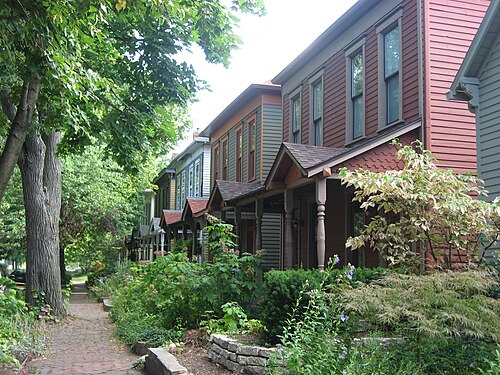
Lockerbie Square Historic District, located just northeast of downtown Indianapolis, holds distinction as the city's oldest intact residential neighborhood. Platted primarily between 1847 and 1850, the district reflects the rapid growth of Indianapolis during the mid-to-late nineteenth century, particularly following the arrival of the railroad. The neighborhood's charm lies in its remarkably preserved streetscape, characterized by narrow, tree-lined streets and a diverse collection of architectural styles ranging from modest Greek Revival and Federal-style cottages to grand Italianate and Queen Anne residences. This architectural variety mirrors the socio-economic diversity of its early residents, who ranged from working-class German immigrants and artisans to wealthy businessmen, making the district a vital physical record of the city's early social and economic development.
The district is famously associated with the beloved "Hoosier Poet," James Whitcomb Riley, who spent the last twenty-three years of his life residing in a prominent Italianate home on Lockerbie Street, which now serves as a museum and National Historic Landmark. By the mid-twentieth century, Lockerbie Square had suffered significant decline, but it subsequently became the birthplace of the modern historic preservation movement in Indianapolis. Beginning in the late 1960s, pioneering restoration efforts led by local citizens and the Historic Landmarks Foundation of Indiana transformed the neighborhood into a showcase of urban revitalization. Today, Lockerbie Square stands as a premier example of historic preservation, successfully safeguarding its nineteenth-century character within the heart of a bustling modern metropolis.
Historic Significance:
Person, Architecture/Engineering
Architect, builder, or engineer:
Olmsted Brothers, Davis, Lewis Ketchem
Architectural Style:
Late 19th And 20th Century Revivals
Historic Person:
Gallagher, Percival; Olmstead Brothe, Lilly, Josiah Kirby, Jr
Significant Year:
1913, 1923, 1940
Area of Significance:
Landscape Architecture, Health/Medicine
Period of Significance:
1925-1949, 1900-1924
Historic Function:
Domestic, Landscape
Historic Sub-function:
Garden, Secondary Structure, Single Dwelling
Current Function:
Recreation And Culture
Current Sub-function:
Garden, Museum
Oldfields, also known as the Lilly House and Gardens, is a magnificent 26-acre historic estate located in Indianapolis, Indiana, that exemplifies the American Country Place Era of the early twentieth century. Built between 1910 and 1913 for businessman Hugh McKennan Landon, the centerpiece of the estate is a stately 22-room French Chateauesque-style mansion designed by architect Lewis Ketcham Davis. In 1932, the property was purchased by Josiah K. Lilly Jr., collector, philanthropist, and president of the pharmaceutical giant Eli Lilly and Company. Lilly meticulously maintained and updated the residence, which served as his family's home until his death in 1966. Following his passing, the Lilly family donated the entire estate to the Art Association of Indianapolis, laying the groundwork for the modern Indianapolis Museum of Art (now Newfields) campus.
Beyond its architectural and historical associations, Oldfields is nationally renowned for its masterfully designed landscape, created by the prestigious landscape architecture firm of Olmsted Brothers. Between 1920 and 1925, landscape architect Percival Gallagher transformed the property's rugged topography into a harmonious series of formal and informal outdoor spaces, including the dramatic Ravine Garden, a formal perennial garden, a grand alle, and sweeping views of the White River valley. Designated a National Historic Landmark in 2003, Oldfields stands as one of the most intact and beautifully preserved examples of an early twentieth-century country estate in the United States, seamlessly blending outstanding architecture, historic association, and world-class landscape design.