Harrison County Indiana (Historic Districts) has 2 places on the National Register of Historic Places including 1 place of National significance and 2 places of Statewide significance. Significant places include Corydon Historic District, Corydon Historic District and Corydon Historic District (Boundary Increase).
The famous person William Henry Harrison is associated with one of more of the Harrison County historic places.
Some of the country's most noteable architects helped create the Harrison County places including George L. & Co. Mesker and William Mitchell. Prominent architectural styles found in Harrison Country are Federal, Italianate and Queen Anne.
Historic Significance:
Event, Architecture/Engineering
Architectural Style:
Federal
Area of Significance:
Politics/Government, Architecture
Period of Significance:
1825-1849, 1800-1824
Historic Function:
Domestic, Government
Historic Sub-function:
Capitol
Current Function:
Commerce/Trade, Domestic, Recreation And Culture
Current Sub-function:
Museum, Single Dwelling
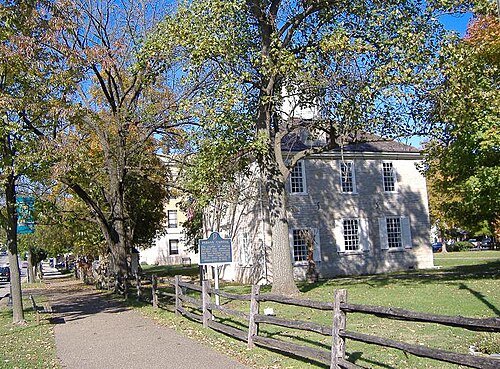
The Corydon Historic District possesses exceptional significance as the political cradle of Indiana, serving as the focal point of the transition from territory to statehood. Established in 1808, Corydon became the second capital of the Indiana Territory in 1813 and subsequently served as Indiana's first state capital from 1816 until the seat of government was relocated to Indianapolis in 1825. In June 1816, forty-three delegates convened in Corydon to draft the state's first constitution, famously holding sessions beneath the shade of the "Constitution Elm" to escape the summer heat. The physical centerpiece of this political legacy is the Corydon Capitol, a modest yet dignified Federal-style limestone building constructed between 1814 and 1816 that housed the early state legislature and supreme court.
Beyond its monumental association with early state government, the district comprises an remarkably intact collection of 19th-century architecture that reflects Corydon's evolution into a prosperous county seat. The district's layout retains its original grid pattern and public square, punctuated by outstanding examples of Federal, Greek Revival, and late-Victorian design. Key contributing properties include the Governor's Headquarters (home to Governor Jonathan Jennings), the Federal-style Posey House, and the restored Kintner House Inn. Together, these well-preserved residential, commercial, and civic structures create a cohesive historic streetscape that vividly conveys the administrative, social, and economic life of an early Midwestern frontier community.