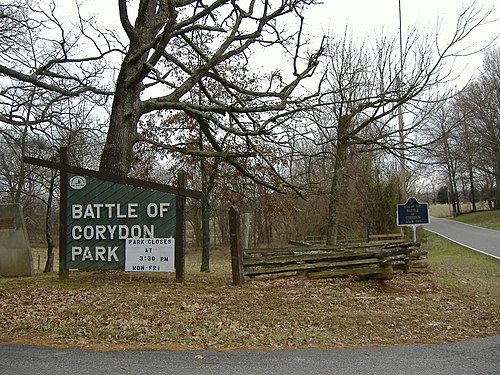
Harrison County Indiana has 7 places on the National Register of Historic Places including 2 places of National significance and 5 places of Statewide significance. Significant places include Corydon Historic District, Swan's Landing Archeological Site (12HR304), Corydon Battle Site, Corydon Historic District and Corydon Historic District (Boundary Increase).
Prehistoric cultural affiliation(s) include Kirk Tradition and Early Archaic dating back to 8999 BC.
The famous person William Henry Harrison is associated with one of more of the Harrison County historic places.
Some of the country's most noteable architects helped create the Harrison County places including George L. & Co. Mesker and William Mitchell. Prominent architectural styles found in Harrison Country are Federal, Italianate and Classical Revival.
Historic Significance:
Event, Architecture/Engineering
Architectural Style:
Federal
Area of Significance:
Politics/Government, Architecture
Period of Significance:
1825-1849, 1800-1824
Historic Function:
Domestic, Government
Historic Sub-function:
Capitol
Current Function:
Commerce/Trade, Domestic, Recreation And Culture
Current Sub-function:
Museum, Single Dwelling
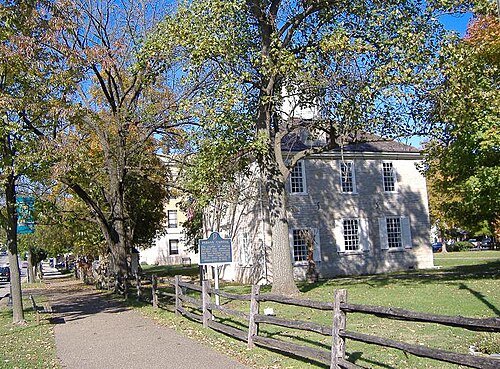
The Corydon Historic District possesses exceptional significance as the political cradle of Indiana, serving as the focal point of the transition from territory to statehood. Established in 1808, Corydon became the second capital of the Indiana Territory in 1813 and subsequently served as Indiana's first state capital from 1816 until the seat of government was relocated to Indianapolis in 1825. In June 1816, forty-three delegates convened in Corydon to draft the state's first constitution, famously holding sessions beneath the shade of the "Constitution Elm" to escape the summer heat. The physical centerpiece of this political legacy is the Corydon Capitol, a modest yet dignified Federal-style limestone building constructed between 1814 and 1816 that housed the early state legislature and supreme court.
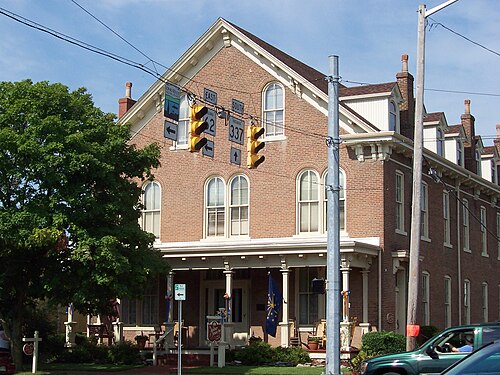
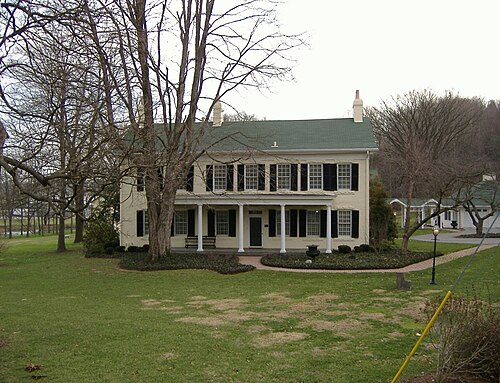
Beyond its monumental association with early state government, the district comprises an remarkably intact collection of 19th-century architecture that reflects Corydon's evolution into a prosperous county seat. The district's layout retains its original grid pattern and public square, punctuated by outstanding examples of Federal, Greek Revival, and late-Victorian design. Key contributing properties include the Governor's Headquarters (home to Governor Jonathan Jennings), the Federal-style Posey House, and the restored Kintner House Inn. Together, these well-preserved residential, commercial, and civic structures create a cohesive historic streetscape that vividly conveys the administrative, social, and economic life of an early Midwestern frontier community.
Historic Significance:
Information Potential
Area of Significance:
Prehistoric
Cultural Affiliation:
Kirk Tradition, Early Archaic
Period of Significance:
7000-8999 BC, 5000-6999 BC
Historic Function:
Domestic, Industry/Processing/Extraction
Historic Sub-function:
Camp, Manufacturing Facility
Current Function:
Landscape
Current Sub-function:
Underwater
The Swan's Landing Archeological Site (12HR304), listed on the National Register of Historic Places in 1987, is one of the most significant Early Archaic lithic workshop sites in Eastern North America. Situated along the floodplains of the Ohio River in Harrison County, Indiana, the site primarily dates to the Early Archaic period, roughly between 7500 and 6000 BC. Its location was highly strategic for prehistoric peoples due to the immediate availability of high-quality Wyandotte chert (also known as Harrison County chert) eroding from nearby bluffs. This prized raw material drew ancient hunter-gatherers to the riverbank, where they engaged in intensive, large-scale stone tool manufacturing, leaving behind an exceptionally dense and well-preserved archaeological record.
Swan's Landing is highly significant under Criterion D for its extraordinary potential to yield information vital to understanding prehistoric technology and lifeways. Archaeological excavations have revealed millions of artifacts, including massive concentrations of chert debitage, cores, preforms, and diagnostic projectile points-most notably those of the Kirk Serrated tradition. The site serves as an invaluable window into Early Archaic lithic reduction strategies, tool specialization, and the organization of labor. Furthermore, because Wyandotte chert from this region was traded widely across the mid-continent, research at Swan's Landing provides critical insights into early Holocene trade networks, seasonal mobility, and regional settlement patterns in the Ohio River Valley.