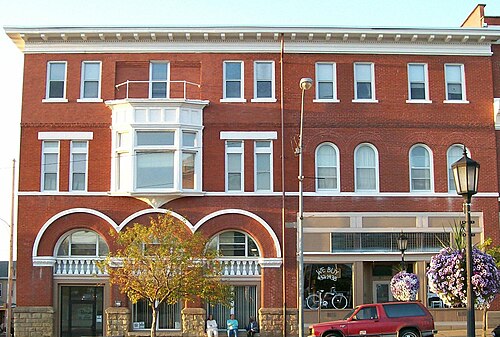
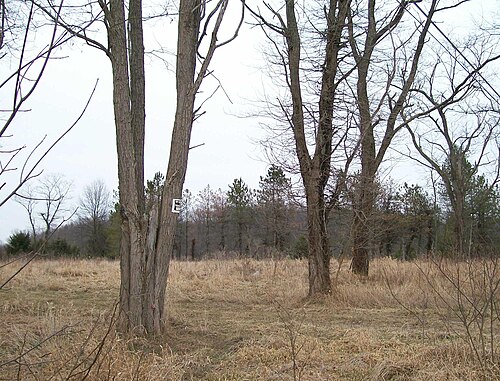
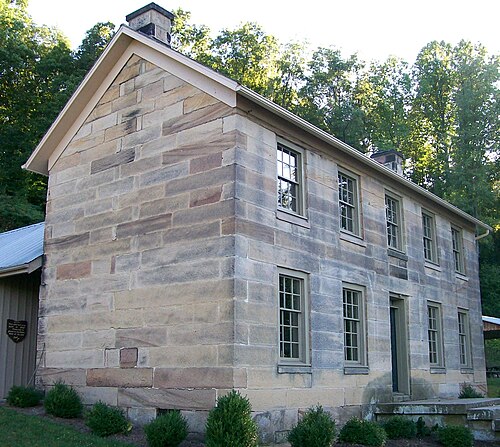
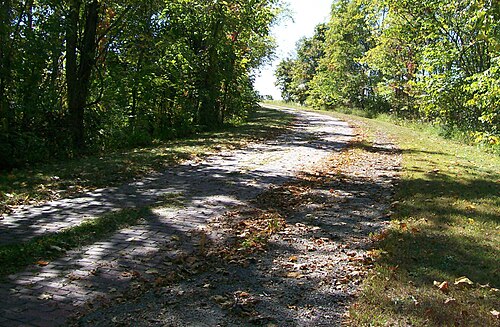
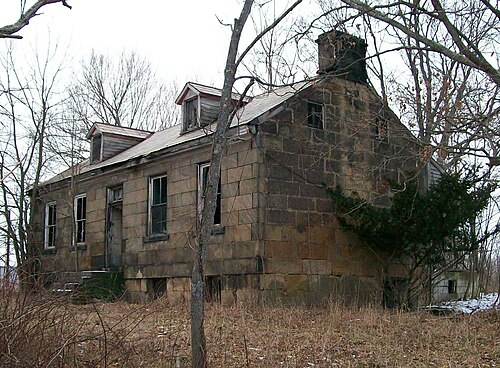
Guernsey County Ohio has 21 places on the National Register of Historic Places including 1 place of National significance and 4 places of Statewide significance. Significant places include S Bridge, National Road, Guernsey County Courthouse, Kennedy Stone House, National Road and Old Washington Historic District.
Many famous people are associated with these Guernsey County historic places including Thomas Sarchet, Ebenezer Finley, Joseph Danner Taylor, William McCracken and Hugh Broom.
Some of the country's most noteable architects helped create the Guernsey County places including T.B. Townsend, J.W. Yost, State of Ohio, Archibold Boal, James Booth, Joseph Danner Hannaford, John & Charles Halstead, unknown, William Wallace Rev. and William McCracken. Prominent architectural styles found in Guernsey Country are Greek Revival, Italianate and Late Victorian.
Historic Significance:
Architecture/Engineering, Event
Architect, builder, or engineer:
Unknown
Architectural Style:
Other
Area of Significance:
Engineering, Communications
Period of Significance:
1825-1849
Historic Function:
Transportation
Historic Sub-function:
Road-Related
Current Function:
Transportation
Current Sub-function:
Road-Related
Constructed in approximately 1828, the National Road S-Bridge in Guernsey County, Ohio, stands as a remarkable monument to early 19th-century American transportation engineering. Located near Old Washington, this historic structure is composed of locally quarried, roughly dressed sandstone, masterfully laid to form a durable, single-arch span over a tributary of Salt Fork Creek. Its distinctive "S" shape was a practical engineering solution common to the era, designed to cross the waterway at a perpendicular ninety-degree angle-thereby minimizing the span length and reducing construction costs-while still smoothly aligning with the diagonal trajectory of the road on either side. This layout required immense skill from pioneer stonemasons, who had to construct complex, curving wing walls to transition travelers safely across the creek.
Historically, the S-Bridge is highly significant for its direct association with the National Road (also known as the Cumberland Road), the nation's first federally funded highway. Built to connect the Eastern Seaboard with the rapidly developing Northwest Territory, the National Road served as the primary artery for westward migration, commerce, and communication in the early-to-mid 1800s. By facilitating the steady flow of pioneer wagons, stagecoaches, and livestock, infrastructure like this Guernsey County bridge played a pivotal role in the economic integration and physical expansion of the United States. Today, the bridge is celebrated as one of the few surviving and best-preserved examples of its type, representing a bygone era of civil engineering and the craftsmanship that helped shape the American Midwest.