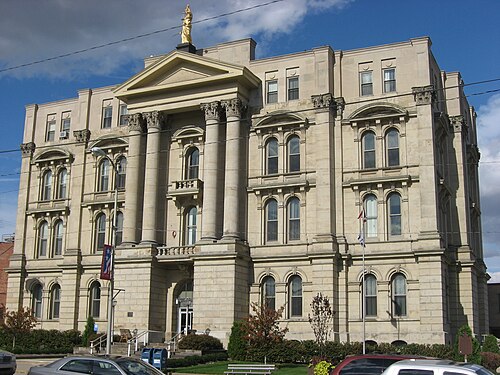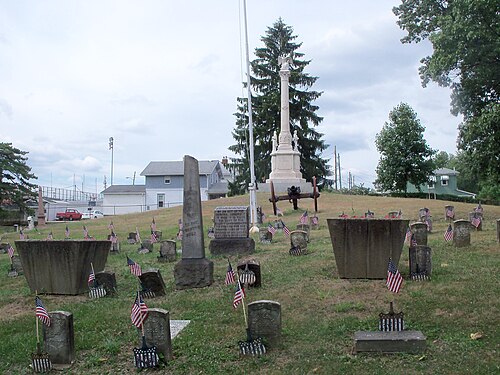
Jefferson County Ohio has 27 places on the National Register of Historic Places including 2 places of National significance and 5 places of Statewide significance. Significant places include Lundy, Benjamin, House, Steubenville Pottery Company Buildings, Federal Land Office, Friends Meetinghouse and Mount Pleasant Historic District.
Prehistoric cultural affiliation(s) include Adena and Woodland dating back to 499 BC.
Several famous people are associated with these Jefferson County historic places including Russell Wright, Benjamin Lundy and John Ickes.
Some of the country's most noteable architects helped create the Jefferson County places including Giuseppi Moretti, Roman Bronze Works, John H. Trimble, Carnegie Steel Co., Thomas Hamilton, Alden & Harlow, Floto Bros. Construction Co., Thomas Levering and Herbert B. Briggs. Prominent architectural styles found in Jefferson Country are Classical Revival, Greek Revival and Italianate.
Historic Significance:
Person
Historic Person:
Lundy,Benjamin
Significant Year:
1821, 1820
Area of Significance:
Politics/Government, Social History
Period of Significance:
1800-1824
Historic Function:
Domestic
Historic Sub-function:
Single Dwelling
Current Function:
Domestic
Current Sub-function:
Single Dwelling
The Benjamin Lundy House, located in the historic Quaker settlement of Mount Pleasant, Ohio, is of national significance for its direct association with one of America's earliest and most influential abolitionist leaders. Benjamin Lundy, a devout Quaker, was a pioneer in the anti-slavery movement, establishing the Union Humane Society in 1815 and launching his landmark anti-slavery newspaper, The Genius of Universal Emancipation, in Mount Pleasant in 1821. Lundy's intellectual and editorial work in this home laid the crucial groundwork for the national abolitionist press, famously mentoring a young William Lloyd Garrison and advocating tirelessly for the eradication of slavery through moral suasion, selective purchasing of free-labor goods, and colonization efforts.
Built in the early 19th century, the modest brick residence reflects the simple, functional aesthetic characteristic of the town's Quaker founders. The house stands as a physical testament to Mount Pleasant's broader history as a vibrant sanctuary for free Blacks, a major station on the Underground Railroad, and a center of early reform movements. Listed on the National Register of Historic Places in 1974, the Benjamin Lundy House serves as a powerful monument to the power of the printed word in the moral crusade against human bondage and the early intellectual origins of the American civil rights movement.
Historic Significance:
Event, Person
Historic Person:
Wright,Russell
Area of Significance:
Industry
Period of Significance:
1925-1949
Historic Function:
Industry/Processing/Extraction
Historic Sub-function:
Manufacturing Facility
Current Function:
Industry/Processing/Extraction
Current Sub-function:
Manufacturing Facility
The Steubenville Pottery Company Buildings, located along State Route 7 in Jefferson County, Ohio, stand as a significant monument to the region's prominent role in the American ceramic industry. Established in 1879, the Steubenville Pottery Company grew to become a major manufacturer of semi-porcelain dinnerware and earthenware, leveraging the area's rich natural clay deposits, abundant coal resources, and convenient transportation access along the Ohio River. The industrial complex represents the evolution of late nineteenth- and early twentieth-century manufacturing architecture, showcasing the specialized spatial organization required for large-scale pottery production, from raw clay preparation to kiln firing and final decoration. As one of the city's primary employers for nearly a century, the pottery was central to the economic development, industrial landscape, and working-class identity of Steubenville.
Beyond its regional economic impact, the Steubenville Pottery Company achieved national cultural and artistic significance through its collaborations with prominent mid-century industrial designers. Most notably, in 1939, the company began manufacturing the revolutionary "American Modern" dinnerware line designed by Russel Wright. Featuring organic, sculptural shapes and muted, mix-and-match glazes, Wright's affordable, informal dinnerware became an unprecedented commercial success and a defining aesthetic of mid-twentieth-century American domestic life. The Steubenville Pottery Company Buildings are thus historically significant not only for their association with the industrial heritage of the Ohio River Valley but also for their direct connection to a watershed moment in modern American consumer design and manufacturing.