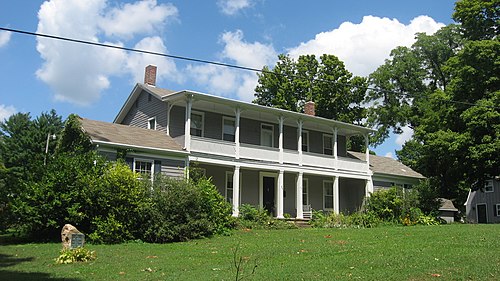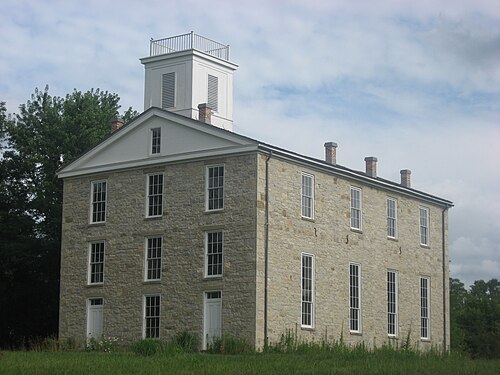
Jefferson County Indiana has 14 places on the National Register of Historic Places including 3 places of National significance and 3 places of Statewide significance. Significant places include Lanier Mansion, Madison Historic District, Shrewsbury, Charles L., House, Eleutherian College and Hoyt, Lyman and Asenath, House.
Several famous people are associated with these Jefferson County historic places including James F. D. Lanier and John Finley Crowe.
Some of the country's most noteable architects helped create the Jefferson County places including Francis Costigan and Patton & Miller. Prominent architectural styles found in Jefferson Country are Greek Revival, Federal and Italianate.
Historic Significance:
Architecture/Engineering, Person
Architect, builder, or engineer:
Costigan, Francis
Architectural Style:
Greek Revival
Historic Person:
Lanier, James F. D.
Area of Significance:
Architecture
Period of Significance:
1825-1849
Historic Function:
Domestic
Historic Sub-function:
Single Dwelling
Current Function:
Recreation And Culture
Current Sub-function:
Museum
The Lanier Mansion, constructed between 1840 and 1844 in Madison, Indiana, is widely regarded as one of the premier examples of Greek Revival residential architecture in the United States. Designed by the acclaimed architect Francis Costigan, the grand estate reflects the immense wealth and sophistication of the pre-Civil War Ohio River Valley. The mansion's striking south facade features a monumental portico supported by four colossal Corinthian columns facing the river, while its interior boasts exceptional craftsmanship, including a breathtaking, freestanding spiral staircase that ascends three stories to a central cupola. The property stands as a masterpiece of the Greek Revival style, showcasing Costigan's genius in proportion, ornamentation, and spatial design.
Historically, the mansion is of national significance for its association with James Franklin Doughty (F.D.) Lanier, a pioneering financier who played a pivotal role in backing the Union during the American Civil War. Lanier amassed a vast fortune as a founder of the State Bank of Indiana and a prominent railroad promoter. When the outbreak of the Civil War threatened to bankrupt Indiana, and a hostile state legislature refused to appropriate funds for the military, Lanier stepped forward to personally loan the state over one million dollars. This crucial financial lifeline allowed Governor Oliver P. Morton to equip and maintain Indiana's troops, ultimately securing the state's vital support for the Union cause and cementing Lanier's legacy as a major patriotic figure of the era.
Historic Significance:
Event, Architecture/Engineering
Architectural Style:
Other, Federal, Greek Revival
Area of Significance:
Architecture, Commerce, Transportation
Period of Significance:
1850-1874, 1825-1849, 1800-1824
Historic Function:
Domestic
Current Function:
Commerce/Trade
The Madison Historic District, encompassing the historic core of Madison along the Ohio River, is of exceptional significance as one of the nation's most intact and extensive collections of 19th-century architecture. Founded in 1809, Madison emerged as Indiana's premier river port and commercial hub during the steamboat era, a status cemented by the construction of the state's first railroad in the late 1830s. During the 1840s and 1850s, Madison was Indiana's largest and wealthiest city, serving as a bustling gateway for trade and westward migration. This period of intense economic prosperity fueled a massive building boom, leaving behind a remarkably preserved urban landscape that reflects the golden age of Ohio River commerce before the Civil War.
Spanning over 130 blocks, the district contains thousands of contributing historic structures showcasing a magnificent array of Federal, Greek Revival, Gothic Revival, and Italianate architecture. The district is particularly renowned for the work of master architect Francis Costigan, whose premier Greek Revival designs-including the Lanier Mansion and the Shrewsbury-Windle House-anchor the community's architectural legacy. Because Madison's economic growth slowed in the late 19th century, its historic core escaped the widespread urban renewal of the mid-20th century, allowing its historic integrity to remain virtually untouched. Designated a National Historic Landmark in 2001, the Madison Historic District stands as an extraordinary testament to early American riverfront urbanization and pioneer-era preservation.
Historic Significance:
Architecture/Engineering
Architect, builder, or engineer:
Costigan, Francis
Architectural Style:
Greek Revival
Area of Significance:
Architecture
Period of Significance:
1825-1849
Historic Function:
Domestic
Historic Sub-function:
Single Dwelling
Current Function:
Domestic
Current Sub-function:
Single Dwelling
The Charles L. Shrewsbury House, also known as the Shrewsbury-Windle House, is a premier masterpiece of Greek Revival architecture located in Madison, Indiana. Designated a National Historic Landmark in 1994, the home was designed by the acclaimed nineteenth-century architect Francis Costigan and constructed between 1846 and 1849. While the exterior features a stately, classically proportioned brick facade with monumental Doric columns, the home's crowning architectural achievement lies within. Costigan designed a breathtaking, three-story freestanding spiral staircase that ascends through the center of the reception hall without any central column or visible means of support. This staircase is widely considered a marvel of antebellum engineering and craftsmanship, solidifying the mansion's status as one of the most architecturally significant residences in the United States.
Historically, the house reflects the immense wealth and economic prominence of Madison during its mid-nineteenth-century golden age as a vital Ohio River port. The home was commissioned by Charles L. Shrewsbury, a highly successful salt manufacturer, commission merchant, and river shipper who later served as the mayor of Madison. The grandeur of the residence served as a direct testament to Shrewsbury's elite social status and the bustling river-borne trade economy of the region. In the mid-twentieth century, the home was acquired and meticulously preserved by John and Ann Windle, pioneers in the local historic preservation movement, ensuring that this monumental testament to Indiana's early commerce and architectural ambition was saved for future generations.