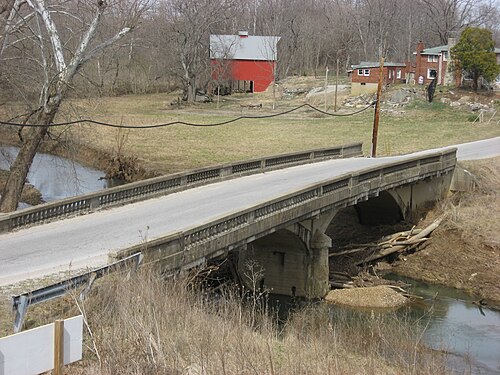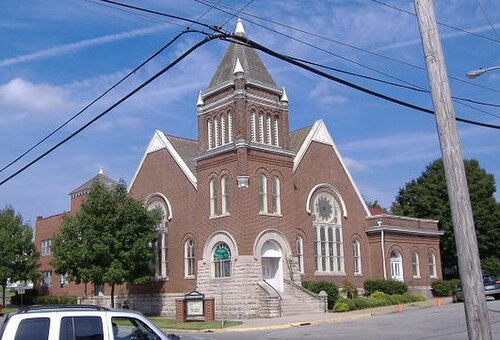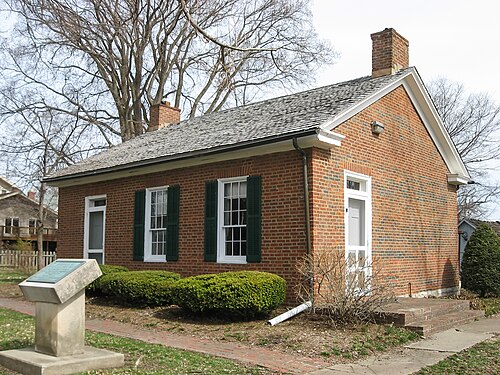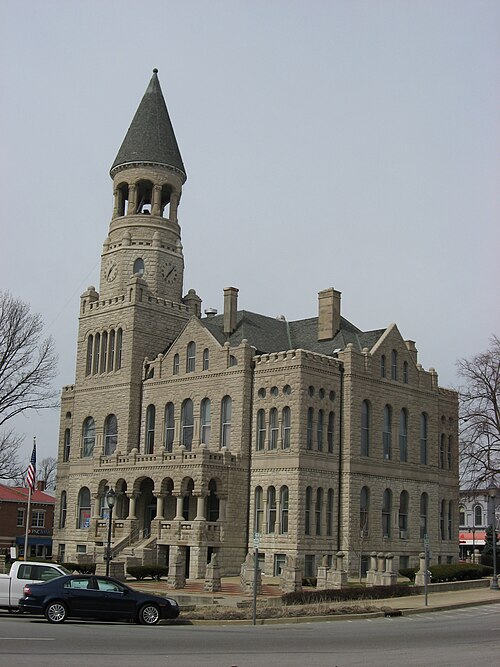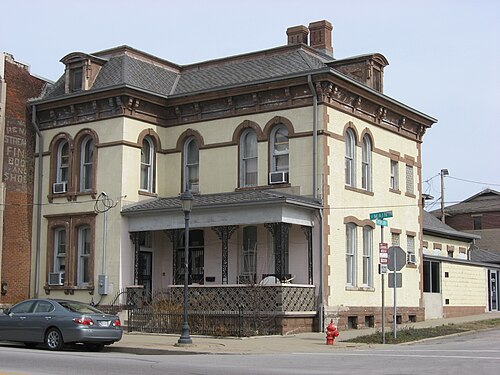
Washington County Indiana has 7 places on the National Register of Historic Places including 1 place of National significance and 1 place of Statewide significance. Significant places include Hay-Morrison House and Hay-Morrison House, Beck's Mill, Beck's Mill Bridge and First Baptist Church.
The famous person John Hay is associated with one of more of the Washington County historic places.
Some of the country's most noteable architects helped create the Washington County places including Shophell & Harris, Montgomery & Parker, Harry P. McDonal, McDonald Bro., Joseph Balsley, Daniel B. Luten and R.C. Stephans. Prominent architectural styles found in Washington Country are Romanesque, Early Republic and Federal.
Historic Significance:
Person, Architecture/Engineering
Architectural Style:
Federal
Historic Person:
Hay,John
Area of Significance:
Education, Architecture, Religion
Period of Significance:
1825-1849, 1800-1824
Historic Function:
Domestic, Education
Historic Sub-function:
School, Single Dwelling
Current Function:
Domestic, Work In Progress
Current Sub-function:
Single Dwelling
The Hay-Morrison House, located in Salem, Indiana, is a historically significant Federal-style brick cottage constructed around 1824. Originally built as a residence, the structure is highly notable for its association with John I. Morrison, a prominent 19th-century educator who purchased the home and used it to conduct classes. Morrison, who later became the President of the Indiana University Board of Trustees and the state's Treasurer, was a key figure in drafting the education clause of the 1851 Indiana State Constitution, which laid the foundation for the state's public school system. The simple, well-preserved brick exterior reflects the early vernacular architecture of southern Indiana during its pioneer period.
The property's primary national significance, however, lies in its status as the birthplace of John Milton Hay, born in the house on October 8, 1838. Hay rose to prominence as the private secretary and close confidant to President Abraham Lincoln during the American Civil War, a role that positioned him at the center of pivotal Union decision-making. Later in his distinguished diplomatic career, Hay served as the U.S. Secretary of State under Presidents William McKinley and Theodore Roosevelt. During his tenure, he championed the "Open Door Policy" with China and negotiated the treaties that cleared the way for the construction of the Panama Canal. Today, the Hay-Morrison House is preserved by the Washington County Historical Society as a museum, standing as a monument to two men who left indelible marks on both local education and international diplomacy.