Summit County Ohio (Page 3) has 50 places on the National Register of Historic Places including 2 places of National significance and 9 places of Statewide significance. Significant places include Smith, Dr. Robert, House, Stan Hywet Hall-Frank A. Seiberling House, Lock No. 34, Lock No. 35 and Loew's Theatre.
Many famous people are associated with these Summit County historic places including Dr. Robert H. Smith, Frank A. Seiberling, Orin Porter, Frank H. Mason, Wells Merriman and Lewis Miller.
Some of the country's most noteable architects helped create the Summit County places including Charles S. Schneider, Warren H. Manning, John Eberson, William P. Ginther, John F. Bliss, Edward S. Child, Frank R. Moore, H.H. Henninger, Robert McKisson and Orin Porter. Prominent architectural styles found in Summit Country are Greek Revival, Tudor Revival and Colonial Revival.
Historic Significance:
Person
Historic Person:
Smith,Dr. Robert H.
Area of Significance:
Social History
Period of Significance:
1925-1949
Historic Function:
Domestic
Historic Sub-function:
Single Dwelling
Current Function:
Recreation And Culture
Current Sub-function:
Museum
The Dr. Robert Smith House, located at 855 Ardmore Avenue in Akron, Ohio, is a two-story Dutch Colonial Revival-style residence built in 1914. Historically significant as the home of Dr. Robert Smith (popularly known as "Dr. Bob"), a prominent surgeon and the co-founder of Alcoholics Anonymous (AA), the house served as the primary residence for Dr. Bob and his wife, Anne, from 1915 until his death in 1950. With its modest wood-shingle siding, gambrel roof, and welcoming front porch, the home remains remarkably well-preserved, reflecting the early 20th-century domestic life of the Smith family and providing a tangible link to a movement that would transform addiction treatment worldwide.
The property possesses exceptional national significance as the birthplace of Alcoholics Anonymous. It was in this home in June 1935 that Dr. Bob and Bill Wilson (Bill W.) first met and formulated the foundational tenets of AA, culminating in Dr. Bob taking his final drink on June 10, 1935-the date widely recognized as the founding of the organization. Throughout the late 1930s and 1940s, the Smith home functioned as a sanctuary, hospital, and spiritual workshop for recovering alcoholics, where the pioneering members developed the Twelve Steps and offered hospitality to those seeking sobriety. Today, the residence is operated as a museum and remains a site of international pilgrimage, symbolizing a profound turning point in the history of public health, voluntary associations, and the treatment of alcoholism.
Historic Significance:
Person, Architecture/Engineering, Event
Architect, builder, or engineer:
Schneider,Charles S., Manning,Warren H.
Architectural Style:
Other, Tudor Revival
Historic Person:
Seiberling,Frank A.
Significant Year:
1915, 1955, 1911
Area of Significance:
Architecture, Landscape Architecture, Industry, Social History
Period of Significance:
1950-1974, 1925-1949, 1900-1924
Historic Function:
Domestic, Landscape
Historic Sub-function:
Forest, Single Dwelling
Current Function:
Landscape, Recreation And Culture
Current Sub-function:
Forest, Museum
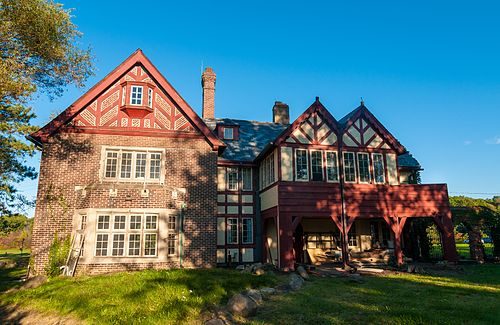
Stan Hywet Hall, constructed between 1912 and 1915, is nationally significant as one of the finest and most intact examples of Tudor Revival architecture and Country Place Era landscape design in the United States. Designed by prominent Cleveland architect Charles S. Schneider, the 65,000-square-foot, 65-room manor house features a striking facade of brick, stone, and half-timbering modeled after historic English estates, particularly Ockwells Manor. The interior serves as a masterclass in early 20th-century craftsmanship, showcasing hand-carved wood paneling, molded plaster ceilings, and leaded glass windows, largely preserving its original furnishings and decorative arts. Complementing the grand residence is the surrounding estate, masterfully designed by renowned landscape architect Warren H. Manning, which seamlessly integrates naturalistic topography, formal gardens, and scenic vistas to reflect the "English Natural" style.
Historically, the estate is deeply significant for its direct association with Frank A. Seiberling, co-founder of the Goodyear Tire & Rubber Company and the Seiberling Rubber Company. As a pioneering titan of the American industrial revolution, Seiberling played a pivotal role in establishing Akron, Ohio, as the "Rubber Capital of the World" during the rapid rise of the automotive industry. Stan Hywet Hall-named from the Anglo-Saxon for "stone quarry"-served as a prominent cultural and social hub for influential political, industrial, and artistic figures of the era, symbolizing the immense wealth, optimism, and civic influence of Akron's industrial elite. Designated a National Historic Landmark in 1998, the estate stands as a powerful monument to Seiberling's industrial legacy and represents one of the most comprehensively preserved historic house museums in the nation.












.jpg)


.jpg)
.jpg)


.jpg)