Marion County Indiana (Page 3) has 50 places on the National Register of Historic Places including 6 places of National significance and 7 places of Statewide significance. Significant places include Indiana State Capitol, Indiana Theatre, Indianapolis Motor Speedway, Indianapolis Park and Boulevard System and Indianapolis Union Railroad Station.
The famous person George W. Julian is associated with one of more of the Marion County historic places.
Some of the country's most noteable architects helped create the Marion County places including Edwin May, Rubush & Hunter, George Edward Kessler, Park Taliaferro Andrews, Lawrence Sheridan, Jungelaus,William P.,Company,In, Adolf Scherer, Walkers & Weeks, William F. Behrens and Shellhouse & Co.. Prominent architectural styles found in Marion Country are Italianate, Classical Revival and Colonial Revival.
Historic Significance:
Event, Architecture/Engineering
Architect, builder, or engineer:
Scherer,Adolf, May,Edwin
Architectural Style:
No Style Listed
Area of Significance:
Politics/Government, Architecture
Period of Significance:
1950-1974, 1925-1949, 1900-1924, 1875-1899
Historic Function:
Government
Historic Sub-function:
Capitol
Current Function:
Government
Current Sub-function:
Capitol
Completed in 1888, the Indiana State Capitol stands as a monumental masterpiece of Renaissance Revival architecture and serves as a testament to the state's late-19th-century civic pride and economic prosperity. Designed by architects Edwin May and Adolf Scherrer, the imposing four-story building was constructed primarily of Indiana oolitic limestone, a choice that famously catalyzed the nationwide popularity of the state's signature quarry product for monumental public architecture. The building's exterior is characterized by classical symmetry, Corinthian columns, and a majestic, copper-clad central dome rising more than 250 feet. Inside, a breathtaking rotunda features a soaring stained-glass dome, Italian marble, and intricate plasterwork, reflecting the grand aesthetic and craftsmanship of the Gilded Age.
Historically, the capitol is highly significant as the political heart of Indiana, housing the Indiana General Assembly, the Governor's office, and the state supreme court. Replacing an earlier, deteriorating 1835 statehouse, this grand structure symbolized Indiana's transition into a modern, industrialized Midwestern powerhouse. Over its lifetime, the building has served as the stage for critical legislative battles, historic speeches, and pivotal moments in the state's civil rights and labor histories. Listed on the National Register of Historic Places in 1975, the Indiana State Capitol remains an active seat of government and a profound physical manifestation of the democratic heritage and cultural identity of the Hoosier State.
Historic Significance:
Architecture/Engineering, Event
Architect, builder, or engineer:
Jungelaus,William P.,Company,In, Rubush & Hunter
Architectural Style:
Other
Area of Significance:
Art, Architecture, Performing Arts
Period of Significance:
1925-1949
Historic Function:
Commerce/Trade, Recreation And Culture, Social
Historic Sub-function:
Restaurant, Specialty Store, Sport Facility, Theater
Current Function:
Vacant/Not In Use
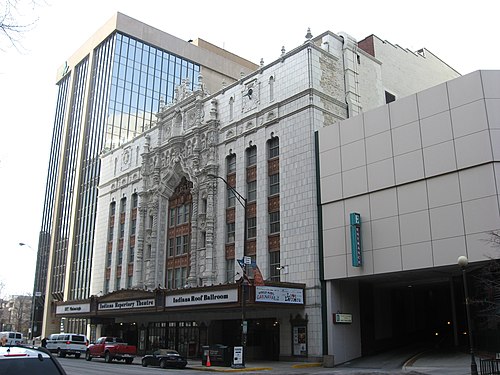
Opened in 1927, the Indiana Theatre in downtown Indianapolis is one of the state's most architecturally spectacular and culturally significant movie palaces. Designed by the renowned local architectural firm of Rubush & Hunter, the building is a masterpiece of the Spanish Baroque Revival, or Churrigueresque, style. Its most striking exterior feature is the soaring, intricately detailed white terra-cotta facade, which mimics an elaborate Spanish altarpiece and stands as a monument to the golden age of American cinema. Inside, the theatre originally boasted an opulent 3,200-seat auditorium designed to transport patrons to a fantasy world, as well as the famous Indiana Roof Ballroom on the top floor, which was meticulously designed to resemble a Spanish plaza under a simulated starlit night sky.
Beyond its architectural grandeur, the Indiana Theatre played a central role in the social and entertainment history of Marion County for decades. Initially operated by the Paramount-Publix chain as a venue for both motion pictures and live vaudeville acts, it stood as a premier downtown destination. Listed on the National Register of Historic Places in 1979, the building became a landmark success story for the preservation movement when it underwent a massive, award-winning rehabilitation in 1980. This adaptive reuse transformed the grand movie palace into the permanent home of the Indiana Repertory Theatre, saving a magnificent landmark from decay and serving as a vital anchor for the revitalization of downtown Indianapolis.
Historic Significance:
Event, Architecture/Engineering
Architect, builder, or engineer:
Andrews,Park Taliaferro
Architectural Style:
Other
Area of Significance:
Engineering, Landscape Architecture, Transportation, Entertainment/Recreation, Industry, Invention
Period of Significance:
1975-2000, 1950-1974, 1925-1949, 1900-1924
Historic Function:
Recreation And Culture, Transportation
Historic Sub-function:
Road-Related, Sport Facility
Current Function:
Recreation And Culture, Transportation
Current Sub-function:
Road-Related, Sport Facility
Established in 1909 by local automotive visionaries Carl G. Fisher, James A. Allison, Arthur Newby, and Frank H. Wheeler, the Indianapolis Motor Speedway (IMS) is globally recognized as the birthplace of modern American motorsports. Originally constructed with a surface of crushed stone and tar, the 2.5-mile rectangular oval was quickly repaved with 3.2 million paving bricks later that year to improve safety, earning it the enduring moniker "The Brickyard." Beyond its role as a spectator venue, the speedway was designed as a premier testing ground for the rapidly growing automotive industry. It served as a vital laboratory where manufacturers tested vehicle durability, aerodynamics, and mechanics under extreme conditions, leading to consumer-vehicle innovations such as the rearview mirror, seatbelts, and advanced tire and engine technologies.
In 1911, the track hosted the inaugural Indianapolis 500-Mile Race, an event that quickly evolved into "The Greatest Spectacle in Racing" and one of the oldest, most prestigious motorsports events in the world. As the home of the Indy 500, the speedway has played a central role in defining American sports culture and international racing history, attracting millions of spectators and the world's finest drivers for over a century. Designated a National Historic Landmark in 1975, the Indianapolis Motor Speedway stands as a monumental testament to American industrial ingenuity, technological progress, and athletic competition. Today, a symbolic three-foot strip of the original 1909 bricks remains exposed at the start/finish line, serving as a tangible connection to the dawn of automotive racing.
Historic Significance:
Architecture/Engineering, Event
Architect, builder, or engineer:
Sheridan, Lawrence, Kessler, George Edward
Architectural Style:
Other, Beaux Arts
Area of Significance:
Entertainment/Recreation, Landscape Architecture, Community Planning And Development, Conservation, Health/Medicine, Engineering, Transportation
Period of Significance:
1950-1974, 1925-1949, 1900-1924, 1875-1899, 1850-1874
Historic Function:
Landscape, Recreation And Culture, Social, Transportation
Historic Sub-function:
Meeting Hall, Outdoor Recreation, Park, Road-Related, Sport Facility
Current Function:
Government, Landscape, Recreation And Culture, Social, Transportation
Current Sub-function:
Fire Station, Meeting Hall, Outdoor Recreation, Park, Road-Related, Sport Facility
The Indianapolis Park and Boulevard System is a monumental achievement in American urban planning and landscape architecture, designed primarily by the renowned landscape architect George Edward Kessler starting in 1909. Grounded in the principles of the City Beautiful movement, the system was conceived to address both the aesthetic and utilitarian needs of a rapidly growing industrial city. Kessler's master plan masterfully integrated Indianapolis's natural waterways-including Fall Creek, Pleasant Run, and the White River-with a network of scenic, tree-lined parkways and boulevards that connected major municipal parks like Garfield, Riverside, and Brookside. This innovative design not only provided much-needed recreational spaces and vital flood control but also directed the residential expansion of the city, establishing a harmonious relationship between the built and natural environments.
Historically significant for its profound impact on the physical layout and civic identity of Indianapolis, the system represents one of the most intact and comprehensive examples of a Kessler-designed park system in the United States. Constructed primarily between 1909 and the onset of the Great Depression, the system features a wealth of historic infrastructure, including elegant stone-faced arched bridges, rustic shelter houses, and meticulously planned vistas. By utilizing parkways to link diverse neighborhoods, the system fostered a sense of shared civic pride and democratic access to nature. Today, the Indianapolis Park and Boulevard System remains a vital, living part of the city's infrastructure, recognized for its enduring architectural integrity and its pioneering role in early 20th-century municipal design.
Historic Significance:
Architecture/Engineering, Event
Architectural Style:
Romanesque
Area of Significance:
Architecture, Transportation, Commerce
Period of Significance:
1900-1924, 1875-1899
Historic Function:
Transportation
Historic Sub-function:
Rail-Related
Current Function:
Commerce/Trade, Transportation
Current Sub-function:
Rail-Related, Specialty Store, Warehouse
The Indianapolis Union Railroad Station is historically significant as the focal point of the world's first unified rail terminal system, which revolutionized American passenger and freight transit. Originally established at this site in 1853 to consolidate the operations of several competing railroad lines, the union station concept eliminated the need for passengers to transfer between disjointed depots across the city. This innovation propelled Indianapolis to become a premier Midwestern transportation hub, earning it the nickname the "Crossroads of America." Throughout the late 19th and early 20th centuries, the station served as the engine of the city's economic growth and functioned as a vital mobilization point, channeling millions of soldiers and travelers through its gates during the Civil War, World War I, and World War II.
Architecturally, the current station, completed in 1888, is a monumental masterpiece of the Romanesque Revival style designed by renowned Pittsburgh architect Thomas Rodd. Built of red brick, granite, and sandstone, the imposing headhouse is defined by its massive arches, heavy masonry, and a landmark 129-foot clock tower that remains a prominent feature of the city's skyline. The interior is anchored by the breathtaking Grand Hall, which features a spectacular 120-foot-wide barrel-vaulted ceiling composed of leaded stained glass, massive wheel windows, and elegant terrazzo floors. This combination of pioneering transportation engineering and bold, dramatic architecture solidifies the station's status as one of the finest surviving late-19th-century railway terminals in the United States.
Historic Significance:
Architecture/Engineering
Architectural Style:
No Style Listed
Area of Significance:
Architecture, Community Planning And Development
Period of Significance:
1900-1924, 1875-1899
Owner:
State, Local, Private
Historic Function:
Domestic
Historic Sub-function:
Single Dwelling
Current Function:
Commerce/Trade, Domestic, Recreation And Culture
Current Sub-function:
Museum, Single Dwelling
Lockerbie Square Historic District, located just northeast of downtown Indianapolis, holds distinction as the city's oldest intact residential neighborhood. Platted primarily between 1847 and 1850, the district reflects the rapid growth of Indianapolis during the mid-to-late nineteenth century, particularly following the arrival of the railroad. The neighborhood's charm lies in its remarkably preserved streetscape, characterized by narrow, tree-lined streets and a diverse collection of architectural styles ranging from modest Greek Revival and Federal-style cottages to grand Italianate and Queen Anne residences. This architectural variety mirrors the socio-economic diversity of its early residents, who ranged from working-class German immigrants and artisans to wealthy businessmen, making the district a vital physical record of the city's early social and economic development.
The district is famously associated with the beloved "Hoosier Poet," James Whitcomb Riley, who spent the last twenty-three years of his life residing in a prominent Italianate home on Lockerbie Street, which now serves as a museum and National Historic Landmark. By the mid-twentieth century, Lockerbie Square had suffered significant decline, but it subsequently became the birthplace of the modern historic preservation movement in Indianapolis. Beginning in the late 1960s, pioneering restoration efforts led by local citizens and the Historic Landmarks Foundation of Indiana transformed the neighborhood into a showcase of urban revitalization. Today, Lockerbie Square stands as a premier example of historic preservation, successfully safeguarding its nineteenth-century character within the heart of a bustling modern metropolis.