Indiana - Marion County
Marion County Indiana (Page 3) has 50 places on the National Register of Historic Places including 6 places of National significance and 7 places of Statewide significance. Significant places include Indiana State Capitol, Indiana Theatre, Indianapolis Motor Speedway, Indianapolis Park and Boulevard System and Indianapolis Union Railroad Station.

The famous person George W. Julian is associated with one of more of the Marion County historic places.

Some of the country's most noteable architects helped create the Marion County places including Edwin May, Rubush & Hunter, George Edward Kessler, Park Taliaferro Andrews, Lawrence Sheridan, Jungelaus,William P.,Company,In, Adolf Scherer, Walkers & Weeks, William F. Behrens and Shellhouse & Co.. Prominent architectural styles found in Marion Country are Italianate, Classical Revival and Colonial Revival.
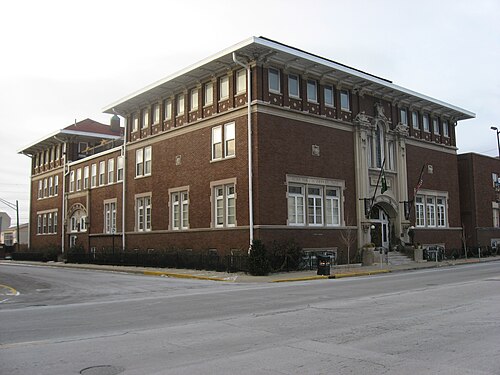
Homecroft Historic District (added 1996 - - #95001536)
Also known as 097-392-88000
Roughly bounded by Madison Ave., Southview Dr., Orinoco Ave., and Banta Rd. , Homecroft
Nyttend, Public domain, via Wikimedia Commons
Historic Significance:
Event
Area of Significance:
Community Planning And Development
Period of Significance:
1925-1949
Owner:
Private
Historic Function:
Domestic
Historic Sub-function:
Single Dwelling
Current Function:
Domestic
Current Sub-function:
Single Dwelling
More Information:
Horace Mann Public School No. 13 (added 1986 - - #86001389)
714 E. Buchanan St. , Indianapolis
Nyttend, Public domain, via Wikimedia Commons
Historic Significance:
Architecture/Engineering
Architect, builder, or engineer:
Fatout Brothers, May,Edwin
Architectural Style:
Italianate
Area of Significance:
Architecture
Period of Significance:
1900-1924, 1850-1874
Owner:
Private
Historic Function:
Education
Historic Sub-function:
School
Current Function:
Domestic
Current Sub-function:
Multiple Dwelling
More Information:
Horner--Terrill House (added 2013 - - #13000424)
410 S. Emerson Ave., Indianapolis
Nyttend, Public domain, via Wikimedia Commons
Historic Significance:
Architecture/Engineering
Architectural Style:
Second Empire
Area of Significance:
Architecture
Period of Significance:
1925-1949, 1900-1924, 1875-1899
Hotel Barton (added 2005 - - #05000197)
Also known as Barton Hotel
501-509 N. Delaware St. , Indianapolis
send us a photo to share
Historic Significance:
Architecture/Engineering, Event
Architect, builder, or engineer:
Wallingford, Charles A., Millikan, Lynn B.
Architectural Style:
Classical Revival, Beaux Arts
Area of Significance:
Commerce, Architecture, Engineering, Social History
Period of Significance:
1950-1974, 1925-1949, 1900-1924
Owner:
Private
Historic Function:
Domestic
Historic Sub-function:
Hotel, Secondary Structure
Current Function:
Vacant/Not In Use
Hotel Washington (added 1980 - - #80000056)
Also known as Washington Tower
32 E. Washington St. , Indianapolis
Nyttend, Public domain, via Wikimedia Commons
Historic Significance:
Architecture/Engineering, Event
Architect, builder, or engineer:
R. P. Daggett & Co.
Architectural Style:
Chicago, Beaux Arts
Area of Significance:
Architecture, Commerce
Period of Significance:
1900-1924
Owner:
Private
Historic Function:
Domestic
Historic Sub-function:
Hotel
Current Function:
Commerce/Trade
Current Sub-function:
Business
More Information:
Hubbard, Willard and Josephine, House (added 2016 - - #16000336)
Indianapolis, Indianapolis
Nyttend, Public domain, via Wikimedia Commons
Historic Significance:
Architecture/Engineering
Architectural Style:
Renaissance, Other
Area of Significance:
Architecture
Period of Significance:
1900-1924 AD
Independent Turnverein (added 1983 - - #83003577)
Also known as Hoosier Athletic Club; Marott Building
902 N. Meridan St. , Indianapolis
Nyttend, Public domain, via Wikimedia Commons
Historic Significance:
Architecture/Engineering
Architect, builder, or engineer:
Scholer,Walter, Sherrer,Adolph
Architectural Style:
Mixed (More Than 2 Styles From Different Periods)
Area of Significance:
Architecture, Social History
Period of Significance:
1900-1924
Owner:
Private
Historic Function:
Education, Social
Historic Sub-function:
Clubhouse, Research Facility
Current Function:
Vacant/Not In Use
More Information:
Indiana Avenue Historic District (added 1987 - - #87000912)
500 blk. of Indiana Ave. between North St., Central Canal, Michigan, and West Sts. , Indianapolis
Nyttend, Public domain, via Wikimedia Commons
Historic Significance:
Event, Architecture/Engineering
Architect, builder, or engineer:
Unknown
Architectural Style:
Italianate
Area of Significance:
Black, Architecture, Community Planning And Development
Period of Significance:
1925-1949, 1900-1924, 1875-1899, 1850-1874
Owner:
Local, Private
Historic Function:
Commerce/Trade
Historic Sub-function:
Business, Specialty Store
Current Function:
Commerce/Trade
More Information:
Indiana Dental College (added 1983 - - #83004575)
141 E. Ohio , Indianapolis
send us a photo to share
Historic Significance:
Event, Architecture/Engineering
Architect, builder, or engineer:
Bohlen,Oscar D., Bohlen,D.A., & Son
Architectural Style:
No Style Listed
Area of Significance:
Education, Science, Architecture
Period of Significance:
1875-1899
Owner:
Private
Historic Function:
Education
Historic Sub-function:
College
Current Function:
Commerce/Trade
Indiana Oxygen Company (added 1987 - - #87000545)
351 South East St. , Indianapolis
Nyttend, Public domain, via Wikimedia Commons
Historic Significance:
Event, Architecture/Engineering
Architect, builder, or engineer:
Fatout,Ray, Fatout Building/Construction Co.
Architectural Style:
Art Deco
Area of Significance:
Architecture, Industry
Period of Significance:
1925-1949
Owner:
Private
Historic Function:
Commerce/Trade, Industry/Processing/Extraction
Historic Sub-function:
Manufacturing Facility, Warehouse
Current Function:
Commerce/Trade, Industry/Processing/Extraction
Current Sub-function:
Manufacturing Facility, Warehouse
More Information:
Indiana School for the Deaf (added 1991 - - #91000790)
Also known as 097-296-09670
1200 E. 42nd St. , Indianapolis
OgreBot, Public domain, via Wikimedia Commons
Historic Significance:
Event, Architecture/Engineering
Architect, builder, or engineer:
Et al., Rubush & Hunter
Architectural Style:
Classical Revival
Area of Significance:
Education, Social History, Architecture
Period of Significance:
1925-1949, 1900-1924
Owner:
State
Historic Function:
Education
Historic Sub-function:
Educational Related Housing, School
Current Function:
Education
Current Sub-function:
School
More Information:
Indiana State Capitol (added 1975 - - #75000043)
Also known as Indiana State Capitol Building
W. Washington St. , Indianapolis
Massimo Catarinella, CC BY-SA 3.0, via Wikimedia Commons
Historic Significance:
Event, Architecture/Engineering
Architect, builder, or engineer:
Scherer,Adolf, May,Edwin
Architectural Style:
No Style Listed
Area of Significance:
Politics/Government, Architecture
Period of Significance:
1950-1974, 1925-1949, 1900-1924, 1875-1899
Owner:
State
Historic Function:
Government
Historic Sub-function:
Capitol
Current Function:
Government
Current Sub-function:
Capitol
More Information:
Completed in 1888, the Indiana State Capitol stands as a monumental masterpiece of Renaissance Revival architecture and serves as a testament to the state's late-19th-century civic pride and economic prosperity. Designed by architects Edwin May and Adolf Scherrer, the imposing four-story building was constructed primarily of Indiana oolitic limestone, a choice that famously catalyzed the nationwide popularity of the state's signature quarry product for monumental public architecture. The building's exterior is characterized by classical symmetry, Corinthian columns, and a majestic, copper-clad central dome rising more than 250 feet. Inside, a breathtaking rotunda features a soaring stained-glass dome, Italian marble, and intricate plasterwork, reflecting the grand aesthetic and craftsmanship of the Gilded Age.

Historically, the capitol is highly significant as the political heart of Indiana, housing the Indiana General Assembly, the Governor's office, and the state supreme court. Replacing an earlier, deteriorating 1835 statehouse, this grand structure symbolized Indiana's transition into a modern, industrialized Midwestern powerhouse. Over its lifetime, the building has served as the stage for critical legislative battles, historic speeches, and pivotal moments in the state's civil rights and labor histories. Listed on the National Register of Historic Places in 1975, the Indiana State Capitol remains an active seat of government and a profound physical manifestation of the democratic heritage and cultural identity of the Hoosier State.
Indiana State Federation of Colored Women's Clubs (added 1987 - - #87000512)
2034 N. Capitol Ave. , Indianapolis
Nyttend, Public domain, via Wikimedia Commons
Historic Significance:
Event
Area of Significance:
Social History, Black
Period of Significance:
1925-1949
Owner:
Private
Historic Function:
Social
Historic Sub-function:
Civic
Current Function:
Social
Current Sub-function:
Civic
More Information:
Indiana State Library and Historical Building (added 1995 - - #95000207)
Also known as 098-296-01501
140 N. Senate Ave. , Indianapolis
Nyttend, Public domain, via Wikimedia Commons
Historic Significance:
Event, Architecture/Engineering
Architect, builder, or engineer:
Wright, George Caleb, Pierre, Edward Dienhart Joseph
Architectural Style:
Art Deco, Classical Revival
Area of Significance:
Education, Art, Architecture
Period of Significance:
1925-1949
Owner:
State
Historic Function:
Education
Historic Sub-function:
Library
Current Function:
Education
Current Sub-function:
Library
More Information:
Indiana Theatre (added 1979 - - #79000035)
134 W. Washington St. , Indianapolis
Nyttend, Public domain, via Wikimedia Commons
Historic Significance:
Architecture/Engineering, Event
Architect, builder, or engineer:
Jungelaus,William P.,Company,In, Rubush & Hunter
Architectural Style:
Other
Area of Significance:
Art, Architecture, Performing Arts
Period of Significance:
1925-1949
Owner:
Local
Historic Function:
Commerce/Trade, Recreation And Culture, Social
Historic Sub-function:
Restaurant, Specialty Store, Sport Facility, Theater
Current Function:
Vacant/Not In Use
More Information:
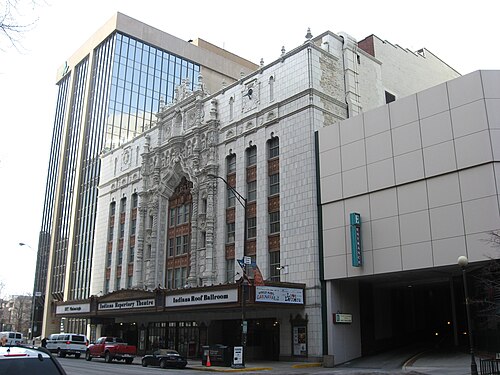
Opened in 1927, the Indiana Theatre in downtown Indianapolis is one of the state's most architecturally spectacular and culturally significant movie palaces. Designed by the renowned local architectural firm of Rubush & Hunter, the building is a masterpiece of the Spanish Baroque Revival, or Churrigueresque, style. Its most striking exterior feature is the soaring, intricately detailed white terra-cotta facade, which mimics an elaborate Spanish altarpiece and stands as a monument to the golden age of American cinema. Inside, the theatre originally boasted an opulent 3,200-seat auditorium designed to transport patrons to a fantasy world, as well as the famous Indiana Roof Ballroom on the top floor, which was meticulously designed to resemble a Spanish plaza under a simulated starlit night sky.

Beyond its architectural grandeur, the Indiana Theatre played a central role in the social and entertainment history of Marion County for decades. Initially operated by the Paramount-Publix chain as a venue for both motion pictures and live vaudeville acts, it stood as a premier downtown destination. Listed on the National Register of Historic Places in 1979, the building became a landmark success story for the preservation movement when it underwent a massive, award-winning rehabilitation in 1980. This adaptive reuse transformed the grand movie palace into the permanent home of the Indiana Repertory Theatre, saving a magnificent landmark from decay and serving as a vital anchor for the revitalization of downtown Indianapolis.
Indiana World War Memorial Plaza (added 1989 - - #89001404)
Bounded by St. Clair, Pennsylvania, Vermont, and Meridian Sts. , Indianapolis
GBart the Nerd~commonswiki, Public domain, via Wikimedia Commons
Historic Significance:
Architecture/Engineering
Architect, builder, or engineer:
Hering,Henry, Walkers & Weeks
Architectural Style:
Art Deco, Classical Revival
Area of Significance:
Art, Architecture, Community Planning And Development
Period of Significance:
1925-1949, 1900-1924
Owner:
State
Historic Function:
Landscape, Recreation And Culture, Social
Historic Sub-function:
Civic, Plaza, Work Of Art (Sculpture, Carving, Rock Art)
Current Function:
Landscape, Recreation And Culture, Social
Current Sub-function:
Civic, Plaza, Work Of Art (Sculpture, Carving, Rock Art)
Indianapolis Athletic Club (added 2015 - - #15000887)
Indianapolis, Indianapolis
Nyttend, Public domain, via Wikimedia Commons
Historic Significance:
Event, Architecture/Engineering
Architectural Style:
Renaissance, Other
Area of Significance:
Entertainment/Recreation, Social History, Architecture
Period of Significance:
1900-1974 AD
Indianapolis Chair Manufacturing Company (added 1986 - - #84000361)
Also known as Indianapolis Warehouse
330 W. New York St. , Indianapolis
send us a photo to share
Historic Significance:
Event, Architecture/Engineering
Architectural Style:
No Style Listed
Area of Significance:
Architecture, Commerce, Industry
Period of Significance:
1900-1924, 1875-1899
Owner:
Private
Historic Function:
Commerce/Trade, Industry/Processing/Extraction
Historic Sub-function:
Manufacturing Facility, Warehouse
Current Function:
Vacant/Not In Use
Indianapolis City Hall, Old (added 1974 - - #74000029)
Also known as Indiana State Museum
202 N. Alabama St. , Indianapolis
Nyttend, Public domain, via Wikimedia Commons
Historic Significance:
Event, Architecture/Engineering
Architect, builder, or engineer:
Behrens, William F., Rubush & Hunter
Architectural Style:
Classical Revival, Renaissance
Area of Significance:
Politics/Government, Art, Architecture
Period of Significance:
1925-1949, 1900-1924
Owner:
State
Historic Function:
Government
Historic Sub-function:
City Hall
Current Function:
Recreation And Culture
Current Sub-function:
Museum
More Information:
Indianapolis Fire Headquarters and Municipal Garage (added 2002 - - #02000686)
Also known as 098-296-01553/01554
301 E. New York St., and 235 N. Alabama St. , Indianapolis
Nyttend, Public domain, via Wikimedia Commons
Historic Significance:
Architecture/Engineering, Event
Architect, builder, or engineer:
Hunter, Frank B., Bohlen & Son
Architectural Style:
Tudor Revival, Classical Revival
Area of Significance:
Architecture, Politics/Government
Period of Significance:
1950-1974, 1925-1949, 1900-1924
Owner:
Private
Historic Function:
Government
Historic Sub-function:
Fire Station, Government Office
Current Function:
Commerce/Trade
Current Sub-function:
Warehouse
More Information:
Indianapolis Masonic Temple (added 2008 - - #08000193)
Also known as Freemasons Hall, 098-296-1519
525 N. Illinois Ave. , Indianapolis
Nyttend, Public domain, via Wikimedia Commons
Historic Significance:
Event, Architecture/Engineering
Architect, builder, or engineer:
Rubush, Preston C., Hunter, Edgar O.
Architectural Style:
Classical Revival
Area of Significance:
Architecture, Social History
Period of Significance:
1950-1974, 1925-1949, 1900-1924
Owner:
Private
Historic Function:
Social
Historic Sub-function:
Meeting Hall
Current Function:
Social
Current Sub-function:
Meeting Hall
More Information:
Indianapolis Motor Speedway (added 1975 - - #75000044)
Also known as Indianapolis Motor Speedway National Historic Landmark;The B
4790 W. 16th St. , Speedway
RickADikeman, CC BY-SA 3.0, via Wikimedia Commons
Historic Significance:
Event, Architecture/Engineering
Architect, builder, or engineer:
Andrews,Park Taliaferro
Architectural Style:
Other
Area of Significance:
Engineering, Landscape Architecture, Transportation, Entertainment/Recreation, Industry, Invention
Period of Significance:
1975-2000, 1950-1974, 1925-1949, 1900-1924
Owner:
Private
Historic Function:
Recreation And Culture, Transportation
Historic Sub-function:
Road-Related, Sport Facility
Current Function:
Recreation And Culture, Transportation
Current Sub-function:
Road-Related, Sport Facility
More Information:
Established in 1909 by local automotive visionaries Carl G. Fisher, James A. Allison, Arthur Newby, and Frank H. Wheeler, the Indianapolis Motor Speedway (IMS) is globally recognized as the birthplace of modern American motorsports. Originally constructed with a surface of crushed stone and tar, the 2.5-mile rectangular oval was quickly repaved with 3.2 million paving bricks later that year to improve safety, earning it the enduring moniker "The Brickyard." Beyond its role as a spectator venue, the speedway was designed as a premier testing ground for the rapidly growing automotive industry. It served as a vital laboratory where manufacturers tested vehicle durability, aerodynamics, and mechanics under extreme conditions, leading to consumer-vehicle innovations such as the rearview mirror, seatbelts, and advanced tire and engine technologies.

In 1911, the track hosted the inaugural Indianapolis 500-Mile Race, an event that quickly evolved into "The Greatest Spectacle in Racing" and one of the oldest, most prestigious motorsports events in the world. As the home of the Indy 500, the speedway has played a central role in defining American sports culture and international racing history, attracting millions of spectators and the world's finest drivers for over a century. Designated a National Historic Landmark in 1975, the Indianapolis Motor Speedway stands as a monumental testament to American industrial ingenuity, technological progress, and athletic competition. Today, a symbolic three-foot strip of the original 1909 bricks remains exposed at the start/finish line, serving as a tangible connection to the dawn of automotive racing.
Indianapolis News Building (added 1984 - - #84001133)
Also known as Goodman Jewelers Building
30 W. Washington St. , Indianapolis
Nyttend, Public domain, via Wikimedia Commons
Historic Significance:
Event, Architecture/Engineering
Architect, builder, or engineer:
Bedford Stone & Construction Co., Hunt,Jarvis
Architectural Style:
Other
Area of Significance:
Communications, Architecture
Period of Significance:
1900-1924
Owner:
Private
Historic Function:
Commerce/Trade
Historic Sub-function:
Business
Current Function:
Commerce/Trade
Current Sub-function:
Business
More Information:
Indianapolis Park and Boulevard System (added 2003 - - #03000149)
Roughly bounded by 38th St., Emerson, Southern and Tibbs Aves., ext.to Fall Creek and Pleasan Run Rkwys to Shadeland , Indianapolis
Nyttend, Public domain, via Wikimedia Commons
Historic Significance:
Architecture/Engineering, Event
Architect, builder, or engineer:
Sheridan, Lawrence, Kessler, George Edward
Architectural Style:
Other, Beaux Arts
Area of Significance:
Entertainment/Recreation, Landscape Architecture, Community Planning And Development, Conservation, Health/Medicine, Engineering, Transportation
Period of Significance:
1950-1974, 1925-1949, 1900-1924, 1875-1899, 1850-1874
Owner:
Private, Local
Historic Function:
Landscape, Recreation And Culture, Social, Transportation
Historic Sub-function:
Meeting Hall, Outdoor Recreation, Park, Road-Related, Sport Facility
Current Function:
Government, Landscape, Recreation And Culture, Social, Transportation
Current Sub-function:
Fire Station, Meeting Hall, Outdoor Recreation, Park, Road-Related, Sport Facility
More Information:
The Indianapolis Park and Boulevard System is a monumental achievement in American urban planning and landscape architecture, designed primarily by the renowned landscape architect George Edward Kessler starting in 1909. Grounded in the principles of the City Beautiful movement, the system was conceived to address both the aesthetic and utilitarian needs of a rapidly growing industrial city. Kessler's master plan masterfully integrated Indianapolis's natural waterways-including Fall Creek, Pleasant Run, and the White River-with a network of scenic, tree-lined parkways and boulevards that connected major municipal parks like Garfield, Riverside, and Brookside. This innovative design not only provided much-needed recreational spaces and vital flood control but also directed the residential expansion of the city, establishing a harmonious relationship between the built and natural environments.

Historically significant for its profound impact on the physical layout and civic identity of Indianapolis, the system represents one of the most intact and comprehensive examples of a Kessler-designed park system in the United States. Constructed primarily between 1909 and the onset of the Great Depression, the system features a wealth of historic infrastructure, including elegant stone-faced arched bridges, rustic shelter houses, and meticulously planned vistas. By utilizing parkways to link diverse neighborhoods, the system fostered a sense of shared civic pride and democratic access to nature. Today, the Indianapolis Park and Boulevard System remains a vital, living part of the city's infrastructure, recognized for its enduring architectural integrity and its pioneering role in early 20th-century municipal design.
Indianapolis Public Library Branch Number 3 (added 2016 - - #16000077)
Indianapolis, Indianapolis
Nyttend, Public domain, via Wikimedia Commons
Historic Significance:
Event, Architecture/Engineering
Architectural Style:
Late 19th And 20th Century Revivals, Tudor Revival
Area of Significance:
Architecture, Education
Period of Significance:
1900-1974 AD
Indianapolis Public Library Branch Number 6 (added 2016 - - #16000078)
Indianapolis, Indianapolis
GaymerCub, CC BY-SA 4.0, via Wikimedia Commons
Historic Significance:
Event, Architecture/Engineering
Area of Significance:
Architecture, Education
Period of Significance:
1900-1974 AD
Indianapolis Union Railroad Station (added 1974 - - #74000032)
39 Jackson Pl. , Indianapolis
Nyttend, Public domain, via Wikimedia Commons
Historic Significance:
Architecture/Engineering, Event
Architectural Style:
Romanesque
Area of Significance:
Architecture, Transportation, Commerce
Period of Significance:
1900-1924, 1875-1899
Owner:
Private
Historic Function:
Transportation
Historic Sub-function:
Rail-Related
Current Function:
Commerce/Trade, Transportation
Current Sub-function:
Rail-Related, Specialty Store, Warehouse
More Information:
The Indianapolis Union Railroad Station is historically significant as the focal point of the world's first unified rail terminal system, which revolutionized American passenger and freight transit. Originally established at this site in 1853 to consolidate the operations of several competing railroad lines, the union station concept eliminated the need for passengers to transfer between disjointed depots across the city. This innovation propelled Indianapolis to become a premier Midwestern transportation hub, earning it the nickname the "Crossroads of America." Throughout the late 19th and early 20th centuries, the station served as the engine of the city's economic growth and functioned as a vital mobilization point, channeling millions of soldiers and travelers through its gates during the Civil War, World War I, and World War II.

Architecturally, the current station, completed in 1888, is a monumental masterpiece of the Romanesque Revival style designed by renowned Pittsburgh architect Thomas Rodd. Built of red brick, granite, and sandstone, the imposing headhouse is defined by its massive arches, heavy masonry, and a landmark 129-foot clock tower that remains a prominent feature of the city's skyline. The interior is anchored by the breathtaking Grand Hall, which features a spectacular 120-foot-wide barrel-vaulted ceiling composed of leaded stained glass, massive wheel windows, and elegant terrazzo floors. This combination of pioneering transportation engineering and bold, dramatic architecture solidifies the station's status as one of the finest surviving late-19th-century railway terminals in the United States.
Indianapolis Union Station--Wholesale District (added 1982 - - #82000067)
Also known as Indianapolis Wholesale District
Roughly bounded by Capitol Ave., Maryland, Delaware and South Sts. , Indianapolis
Nyttend, Public domain, via Wikimedia Commons
Historic Significance:
Event, Architecture/Engineering
Architect, builder, or engineer:
Multiple
Architectural Style:
Romanesque, Other, Italianate
Area of Significance:
Engineering, Architecture, Transportation, Industry, Commerce
Period of Significance:
1925-1949, 1900-1924, 1875-1899, 1850-1874
Owner:
State, Local, Private
Historic Function:
Commerce/Trade, Domestic, Industry/Processing/Extraction
Historic Sub-function:
Business, Hotel, Manufacturing Facility, Rail-Related
Current Function:
Commerce/Trade, Government, Industry/Processing/Extraction, Transportation
Current Sub-function:
Business, Government Office, Manufacturing Facility, Rail-Related
More Information:
Indianapolis Veterans Administration Hospital (added 2012 - - #12000029)
2601 Cold Springs Rd., Indianapolis
Nyttend, Public domain, via Wikimedia Commons
Historic Significance:
Event, Architecture/Engineering
Architectural Style:
Colonial Revival, Classical Revival
Area of Significance:
Politics/Government, Health/Medicine, Architecture
Period of Significance:
1950-1974, 1925-1949
More Information:
Indianapolis White Castle Number 3 (added 2011 - - #11000385)
660 Fort Wayne Ave., Indianapolis
Nyttend, Public domain, via Wikimedia Commons
Historic Significance:
Event, Architecture/Engineering
Architectural Style:
Late 19th And Early 20th Century American Movements, Other
Area of Significance:
Architecture, Commerce
Period of Significance:
1925-1949
More Information:
Irvington Historic District (added 1987 - - #87001031)
Also known as Irvington;See Also: Benton House;Julian-Clarke House;Graham-
Roughly bounded by Ellenberger Pk., Pleasant Run Creek, Arligton Ave., B & 0 RR tracks, and Emerson Ave. , Indianapolis
Nyttend, Public domain, via Wikimedia Commons
Historic Significance:
Event, Architecture/Engineering
Architect, builder, or engineer:
Mutilpe
Architectural Style:
Other, Late 19th And 20th Century Revivals, Bungalow/Craftsman
Area of Significance:
Art, Education, Architecture, Community Planning And Development, Landscape Architecture
Period of Significance:
1925-1949, 1900-1924, 1875-1899, 1850-1874
Owner:
Local, Private
Historic Function:
Commerce/Trade, Domestic, Education
Historic Sub-function:
College, Secondary Structure, Single Dwelling
Current Function:
Commerce/Trade, Domestic
Current Sub-function:
Secondary Structure, Single Dwelling
More Information:
Irvington Terrace Historic District (added 2011 - - #11000913)
Roughly bounded by E. Washington St., Pleasant Run Pkwy., N. Arlington Ave., and E. side of N. Irwin St., Indianapolis
Nyttend, Public domain, via Wikimedia Commons
Historic Significance:
Event, Person, Architecture/Engineering
Architectural Style:
Bungalow/Craftsman, Late 19th And 20th Century Revivals
Historic Person:
Morlan, Dorothy
Area of Significance:
Community Planning And Development, Architecture, Art
Period of Significance:
1950-1974, 1925-1949, 1900-1924, 1875-1899
More Information:
Jackson Buildings (added 1993 - - #84000496)
Also known as Standard Grocery/Capital Furnace
419 and 425 E. Washington St. , Indianapolis
send us a photo to share
Historic Significance:
Architecture/Engineering, Event
Architectural Style:
Italianate
Area of Significance:
Commerce, Architecture
Period of Significance:
1900-1924, 1875-1899
Owner:
Private
Historic Function:
Commerce/Trade
Historic Sub-function:
Business, Specialty Store
Current Function:
Commerce/Trade
Current Sub-function:
Business
Jamieson--Bennett House (added 2001 - - #01000984)
8452 Green Braces North Dr. , Indianapolis
Nyttend, Public domain, via Wikimedia Commons
Historic Significance:
Architecture/Engineering
Architect, builder, or engineer:
Federman, Charles R.
Architectural Style:
Tudor Revival
Area of Significance:
Architecture
Period of Significance:
1925-1949
Owner:
Private
Historic Function:
Domestic
Historic Sub-function:
Single Dwelling
Current Function:
Domestic
Current Sub-function:
Single Dwelling
More Information:
Johnson's, Oliver, Woods Historic District (added 2004 - - #04000632)
Also known as 097-296-26000
Roughly bounded by Central and College Aves., 44th and 46th Sts. , Indianapolis
Nyttend, Public domain, via Wikimedia Commons
Historic Significance:
Architecture/Engineering, Event
Architect, builder, or engineer:
Nelson, William F., Cannon, Fermor Spencer, et al
Architectural Style:
Renaissance, Colonial Revival
Area of Significance:
Social History, Community Planning And Development, Architecture
Period of Significance:
1950-1974, 1925-1949, 1900-1924, 1875-1899, 1850-1874
Owner:
Private
Historic Function:
Commerce/Trade, Domestic
Historic Sub-function:
Business, Multiple Dwelling, Single Dwelling
Current Function:
Commerce/Trade, Domestic
Current Sub-function:
Business, Multiple Dwelling, Single Dwelling
More Information:
Johnson-Denny House (added 1979 - - #79000036)
Also known as Johnson-Manfredi House
4456 N. Park Ave. , Indianapolis
Nyttend, Public domain, via Wikimedia Commons
Historic Significance:
Architecture/Engineering, Event
Architect, builder, or engineer:
Fatout,Joshua L. & Moses K.
Architectural Style:
Italianate
Area of Significance:
Politics/Government, Architecture, Agriculture
Period of Significance:
1900-1924, 1875-1899, 1850-1874
Owner:
Private
Historic Function:
Domestic
Historic Sub-function:
Secondary Structure, Single Dwelling
Current Function:
Domestic
Current Sub-function:
Secondary Structure, Single Dwelling
More Information:
Jordan, Arthur, Memorial Hall (added 1983 - - #83000134)
4600 Sunset Ave. , Indianapolis
Peetlesnumber1, CC BY-SA 3.0, via Wikimedia Commons
Historic Significance:
Architecture/Engineering
Architect, builder, or engineer:
Daggett,Robert,Frost
Architectural Style:
Other
Area of Significance:
Education, Architecture
Period of Significance:
1925-1949
Owner:
Private
Historic Function:
Education
Historic Sub-function:
College
Current Function:
Education
Current Sub-function:
College
More Information:
Julian--Clark House (added 1986 - - #86001335)
Also known as Julian Mansion
115 S. Audubon Rd. , Indianapolis
Nyttend, Public domain, via Wikimedia Commons
Historic Significance:
Person, Architecture/Engineering
Architect, builder, or engineer:
Unknown
Architectural Style:
Italianate
Historic Person:
Julian,George W.,et al.
Significant Year:
1899, 1873
Area of Significance:
Politics/Government, Architecture
Period of Significance:
1925-1949, 1900-1924, 1875-1899, 1850-1874
Owner:
Private
Historic Function:
Domestic
Historic Sub-function:
Single Dwelling
Current Function:
Vacant/Not In Use
More Information:
Kuhn, Charles, House (added 1989 - - #89000237)
340 W. Michigan St. , Indianapolis
Nyttend, Public domain, via Wikimedia Commons
Historic Significance:
Architecture/Engineering
Architect, builder, or engineer:
Unknown
Architectural Style:
Italianate
Area of Significance:
Architecture
Period of Significance:
1875-1899
Owner:
Private
Historic Function:
Domestic, Funerary
Historic Sub-function:
Hotel, Mortuary, Single Dwelling
Current Function:
Vacant/Not In Use
More Information:
Laurel and Prospect District (added 1983 - - #83000132)
1335 to 1419 E. Prospect St. , Indianapolis
Nyttend, Public domain, via Wikimedia Commons
Historic Significance:
Event, Architecture/Engineering
Architectural Style:
No Style Listed
Area of Significance:
Art, Commerce
Period of Significance:
1900-1924, 1875-1899, 1850-1874
Owner:
Private
Historic Function:
Commerce/Trade
Historic Sub-function:
Restaurant, Specialty Store
Current Function:
Commerce/Trade
Current Sub-function:
Specialty Store
More Information:
Lauter, H., Company Complex (added 2015 - - #15000596)
Indianapolis, Indianapolis
Nyttend, Public domain, via Wikimedia Commons
Historic Significance:
Event, Architecture/Engineering
Architectural Style:
Italianate, Classical Revival
Area of Significance:
Industry, Architecture
Period of Significance:
1875-1949 AD
Levey, Louis, Mansion (added 1978 - - #78000047)
Also known as Pilgrim Life Insurance Company Building
2902 N. Meridian St. , Indianapolis
Nyttend, Public domain, via Wikimedia Commons
Historic Significance:
Architecture/Engineering
Architectural Style:
Late 19th And 20th Century Revivals
Area of Significance:
Architecture
Period of Significance:
1900-1924
Owner:
Private
Historic Function:
Domestic
Historic Sub-function:
Single Dwelling
Current Function:
Commerce/Trade
Current Sub-function:
Professional
More Information:
Linwood Colonial Apartments (added 2006 - - #06000308)
Also known as Colonial Park Apartments, 098-295-02136
4421 E. Washington St. and 55 and 56 S. Linwood Ave. , Indianapolis
Nyttend, Public domain, via Wikimedia Commons
Historic Significance:
Architecture/Engineering, Event
Architect, builder, or engineer:
Pierre & Wright, Moynahan Apartment Organization
Architectural Style:
Other, Colonial Revival
Area of Significance:
Architecture, Community Planning And Development, Social History
Period of Significance:
1950-1974, 1925-1949
Owner:
Private
Historic Function:
Domestic
Historic Sub-function:
Multiple Dwelling, Secondary Structure
Current Function:
Domestic
Current Sub-function:
Multiple Dwelling, Secondary Structure
More Information:
Lockefield Garden Apartments (added 1983 - - #83000133)
Also known as Lockefield Gardens
900 Indiana Ave. , Indianapolis
Nyttend, Public domain, via Wikimedia Commons
Historic Significance:
Event, Architecture/Engineering
Architect, builder, or engineer:
Harrison,Merritt, Russ,William E.
Architectural Style:
International Style
Area of Significance:
Politics/Government, Architecture, Social History
Period of Significance:
1925-1949
Owner:
Local
Historic Function:
Domestic
Historic Sub-function:
Multiple Dwelling
Current Function:
Vacant/Not In Use
More Information:
Lockerbie Square Historic District (added 1973 - - #73000038)
Also known as Lockerbie Street Neighborhood
Indianopolis , Indianapolis
send us a photo to share
Historic Significance:
Architecture/Engineering
Architectural Style:
No Style Listed
Area of Significance:
Architecture, Community Planning And Development
Period of Significance:
1900-1924, 1875-1899
Owner:
State, Local, Private
Historic Function:
Domestic
Historic Sub-function:
Single Dwelling
Current Function:
Commerce/Trade, Domestic, Recreation And Culture
Current Sub-function:
Museum, Single Dwelling
More Information:
Lockerbie Square Historic District, located just northeast of downtown Indianapolis, holds distinction as the city's oldest intact residential neighborhood. Platted primarily between 1847 and 1850, the district reflects the rapid growth of Indianapolis during the mid-to-late nineteenth century, particularly following the arrival of the railroad. The neighborhood's charm lies in its remarkably preserved streetscape, characterized by narrow, tree-lined streets and a diverse collection of architectural styles ranging from modest Greek Revival and Federal-style cottages to grand Italianate and Queen Anne residences. This architectural variety mirrors the socio-economic diversity of its early residents, who ranged from working-class German immigrants and artisans to wealthy businessmen, making the district a vital physical record of the city's early social and economic development.

The district is famously associated with the beloved "Hoosier Poet," James Whitcomb Riley, who spent the last twenty-three years of his life residing in a prominent Italianate home on Lockerbie Street, which now serves as a museum and National Historic Landmark. By the mid-twentieth century, Lockerbie Square had suffered significant decline, but it subsequently became the birthplace of the modern historic preservation movement in Indianapolis. Beginning in the late 1960s, pioneering restoration efforts led by local citizens and the Historic Landmarks Foundation of Indiana transformed the neighborhood into a showcase of urban revitalization. Today, Lockerbie Square stands as a premier example of historic preservation, successfully safeguarding its nineteenth-century character within the heart of a bustling modern metropolis.
Lockerbie Square Historic District Amendment (Boundary Increase) (added 1987 - - #87000734)
Also known as See Also:73000038;73000032;77000020;Apartments and Flats of
Bounded by Michigan and Davidson Sts., New York Ave., and New Jersey St. , Indianapolis
send us a photo to share
Historic Significance:
Event, Architecture/Engineering
Architect, builder, or engineer:
Mueller,Charles G.
Architectural Style:
Mid 19th Century Revival, Italianate, Late Victorian
Area of Significance:
European, Education, Architecture, Commerce, Religion
Period of Significance:
1925-1949, 1900-1924, 1875-1899, 1850-1874
Owner:
Private
Historic Function:
Commerce/Trade, Domestic, Religion
Historic Sub-function:
Religious Structure, Single Dwelling
Current Function:
Commerce/Trade, Domestic, Religion
Current Sub-function:
Religious Structure, Single Dwelling
More Information:
Lodge (added 1983 - - #83000073)
829 N. Pennsylvania St. , Indianapolis
Nyttend, Public domain, via Wikimedia Commons
Historic Significance:
Architecture/Engineering, Event
Architectural Style:
Colonial Revival
Area of Significance:
Architecture, Commerce
Period of Significance:
1900-1924
Owner:
Private
Historic Function:
Domestic
Historic Sub-function:
Multiple Dwelling
Current Function:
Domestic
Current Sub-function:
Multiple Dwelling
More Information:
Lombard Building (added 1982 - - #82000068)
22-28 E. Washington St. , Indianapolis
Nyttend, Public domain, via Wikimedia Commons
Historic Significance:
Architecture/Engineering
Architect, builder, or engineer:
R. P. Daggett & Co.
Architectural Style:
Renaissance
Area of Significance:
Architecture, Commerce
Period of Significance:
1875-1899
Owner:
Private
Historic Function:
Commerce/Trade
Historic Sub-function:
Business, Financial Institution
Current Function:
Commerce/Trade
Current Sub-function:
Business, Specialty Store
More Information:
Maennerchor Building (added 1974 - - #74002340)
Also known as Academy of Music
102 W. Michigan St. , Indianapolis
send us a photo to share
Historic Significance:
Event, Architecture/Engineering
Architect, builder, or engineer:
Sherrer,Adolph
Architectural Style:
No Style Listed
Area of Significance:
European, Social History, Performing Arts, Architecture
Period of Significance:
1900-1924
Owner:
Private
Historic Function:
Social
Historic Sub-function:
Meeting Hall
Current Function:
Vacant/Not In Use
Majestic Building (added 1980 - - #80000059)
Also known as Indiana Farm Bureau Co-op Building
47 S. Pennsylvania St. , Indianapolis
Nyttend, Public domain, via Wikimedia Commons
Historic Significance:
Architecture/Engineering
Architect, builder, or engineer:
Bohlen,D. A. & Son
Architectural Style:
No Style Listed
Area of Significance:
Engineering, Architecture, Health/Medicine, Community Planning And Development, Commerce
Period of Significance:
1875-1899
Owner:
Private
Historic Function:
Commerce/Trade
Historic Sub-function:
Business
Current Function:
Vacant/Not In Use
More Information:

Page 1 > 2 > 3 > 4 > 5

Return to Top
Select a Different Indiana County (map)
Adams
Allen
Bartholomew
Benton
Blackford
Boone
Brown
Carroll
Cass
Clark
Clay
Clinton
Crawford
Daviess
De Kalb
Dearborn
Decatur
Delaware
Dubois
Elkhart
Fayette
Floyd
Fountain
Franklin
Fulton
Gibson
Grant
Greene
Hamilton
Hancock
Harrison
Hendricks
Henry
Howard
Huntington
Jackson
Jasper
Jay
Jefferson
Jennings
Johnson
Knox
Kosciusko
La Porte
Lagrange
Lake
Lawrence
Madison
Marion
Marshall
Martin
Miami
Monroe
Montgomery
Morgan
Newton
Noble
Ohio
Orange
Owen
Parke
Perry
Pike
Porter
Posey
Pulaski
Putnam
Randolph
Ripley
Rush
Scott
Shelby
Spencer
St. Joseph
Starke
Steuben
Sullivan
Switzerland
Tippecanoe
Tipton
Union
Vanderburgh
Vermillion
Vigo
Wabash
Warren
Warrick
Washington
Wayne
Wells
White
Whitley
Select a Different State (map)
Alabama
Alaska
Arizona
Arkansas
California
Colorado
Connecticut
Delaware
District Of Columbia
Florida
Georgia
Hawaii
Idaho
Illinois
Indiana
Iowa
Kansas
Kentucky
Louisiana
Maine
Maryland
Massachusetts
Michigan
Minnesota
Mississippi
Missouri
Montana
Nebraska
Nevada
New Hampshire
New Jersey
New Mexico
New York
North Carolina
North Dakota
Ohio
Oklahoma
Oregon
Pennsylvania
Rhode Island
South Carolina
South Dakota
Tennessee
Texas
Utah
Vermont
Virginia
Washington
West Virginia
Wisconsin
Wyoming
Return to Home Page