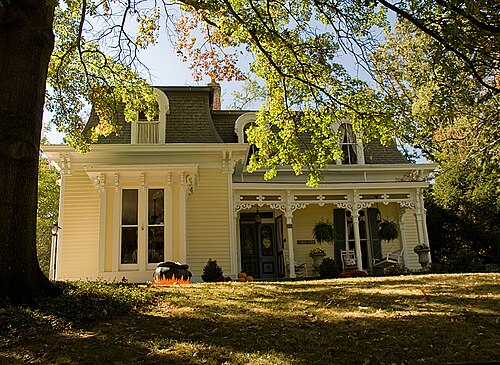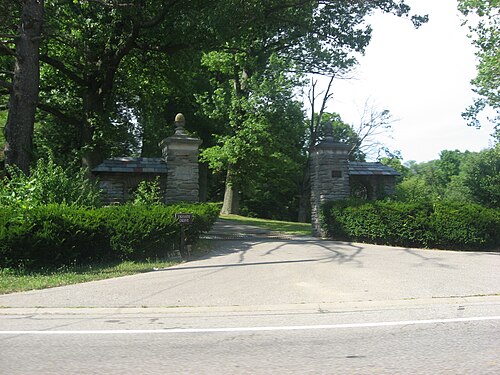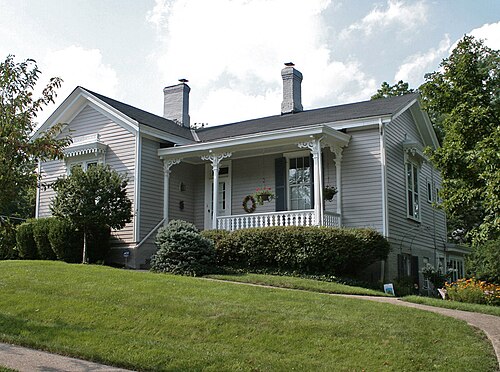
Hamilton County Ohio (Page 6) has 50 places on the National Register of Historic Places including 2 places of National significance and 9 places of Statewide significance. Significant places include SHOWBOAT MAJESTIC, Spring Grove Cemetery, Powell, Henry, House, Probasco Fountain and Ransley Apartment Building.
Prehistoric cultural affiliation(s) include Hopewell, Adena, Archaic and Woodland dating back to 12999 BC.
Many famous people are associated with these Hamilton County historic places including Robert Reily, John Rychen, Francis McCormick, W.C. Retszch, George Friend Sr. and Joseph Rawson.
Some of the country's most noteable architects helped create the Hamilton County places including Daniels,Howard; Salway,William, unknown, Adolph Strauch, Hannaford,Samuel,& Sons, Samuel Hannaford, Elzner & Anderson, Emil Baude, William Resor, Hammand Roudebush and Harry Hake. Prominent architectural styles found in Hamilton Country are Italianate, Late Victorian and Queen Anne.
Historic Significance:
Event
Area of Significance:
Performing Arts
Period of Significance:
1900-1924
Historic Function:
Recreation And Culture, Transportation
Historic Sub-function:
Theater, Water-Related
Current Function:
Recreation And Culture, Transportation
Current Sub-function:
Theater, Water-Related
Built in 1923 by Captain Thomas Jefferson Reynolds, the Showboat Majestic is historically significant as the last intact, floating, wooden-hulled showboat surviving in the United States. Representing the twilight of the American showboat era, which flourished from the mid-nineteenth century through the early twentieth century, the vessel served as a mobile theater that brought melodramas, comedies, and musical acts to isolated river communities along the Ohio and Mississippi River systems. Propelled by her loyal towboat, the Attaboy, the Majestic offered a vital cultural link to towns lacking permanent theaters, embodying a unique chapters in both American maritime history and the evolution of popular theater.
In the mid-twentieth century, the Majestic transitioned from a traveling commercial enterprise to an educational and civic institution, finding a long-term home in Cincinnati, Hamilton County, Ohio. Acquired by the University of Cincinnati in 1967 and later purchased by the City of Cincinnati, the showboat was permanently moored at the Public Landing, where it served for decades as a beloved summer stock theater and a training ground for generations of emerging actors. Its inclusion on the National Register of Historic Places in 1980, and its subsequent designation as a National Historic Landmark in 1989, recognizes the vessel's extraordinary preservation and its enduring legacy as the final active representative of the great American riverboat theater tradition.
Historic Significance:
Architecture/Engineering
Architect, builder, or engineer:
Strauch,Adolph, Daniels,Howard; Salway,William
Architectural Style:
Gothic Revival
Area of Significance:
Landscape Architecture, Architecture
Period of Significance:
1875-1899, 1850-1874
Historic Function:
Funerary
Historic Sub-function:
Cemetery, Graves/Burials, Mortuary
Current Function:
Funerary
Current Sub-function:
Cemetery, Graves/Burials, Mortuary
Established in 1845 by the Cincinnati Horticultural Society, Spring Grove Cemetery is internationally recognized as the birthplace of the "landscape lawn" cemetery plan, a design philosophy that fundamentally transformed American funerary landscapes. Spanning over 700 acres, the cemetery was originally conceived in the rural cemetery tradition to address cholera outbreaks and the limitations of crowded urban churchyards. Its true historical significance emerged in 1855 with the appointment of Prussian landscape gardener Adolph Strauch as superintendent. Strauch revolutionized cemetery design by dismantling the cluttered family plot fences, hedges, and heavy grave markers typical of the era, replacing them with sweeping lawns, winding roads, scenic lakes, and carefully curated groupings of trees. His vision of a unified, park-like environment that harmonized nature and memorialization became the definitive prototype for modern cemeteries across the United States.
Beyond its pioneering landscape architecture, Spring Grove Cemetery is renowned as an exemplary botanical garden and a repository of outstanding nineteenth- and twentieth-century funerary art. The grounds feature an expansive arboretum of mature, exotic specimen trees alongside a magnificent collection of monuments and elaborate mausoleums designed by prominent architects in styles ranging from Gothic and Egyptian Revival to Neoclassical. Serving as the final resting place for numerous figures of national importance-including Civil War generals, industrial giants, and political leaders-Spring Grove stands as one of the most aesthetically influential and historically intact rural-style cemeteries in the nation, a legacy that secured its designation as a National Historic Landmark.